Skip to content
Live
Oct 21Wed
  1. AWS Machine Learning Blog34

    Building an AI agent semantic layer on AWS using Strategy Mosaic and Amazon Bedrock AgentCore.

    Strategy Mosaic, as a semantic layer, models C360 domains on Amazon Redshift and Amazon Aurora without ETL using two linked models. Its metric syntax captures the business definition of agent reasoning and exposes the model to AgentCore-hosted Strands agents via the Mosaic MCP server, supporting user identity propagation to achieve end-to-end row-level and object-level security.
  2. AWS Machine Learning Blog40

    Fine-tune GPT-OSS-20B on Amazon SageMaker HyperPod for multilingual inference

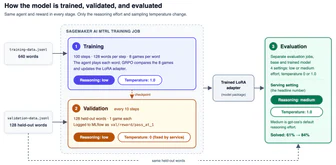
    GPT-OSS-20B is an open-source inference model that thinks in English by default, and only 22% met the target language requirements in multilingual inference tests. By using supervised fine-tuning (SFT) and reinforcement learning (GRPO) on Amazon SageMaker HyperPod, the team can improve the model's inference capabilities in French, German, Spanish, and Italian, where SFT is responsible for primary behavior teaching and GRPO optimizes when there is room for improvement.

  3. AWS Machine Learning Blog38

    How Amazon Quick and Amazon Bedrock AgentCore implement conversational intelligent decision-making in supply chains

    Amazon Quick combined with Amazon Bedrock AgentCore provides supply chain teams with real-time data access across systems. Users can get cross-system answers in seconds through conversational queries, such as identifying high-income SKUs and costs affected by port closures. Quick serves as the interface layer, and AgentCore as the intelligence layer, connecting backend systems like ERP, monitoring, and procurement via the MCP protocol to achieve a complete process from problem discovery to generating emergency purchase requests, all operations requiring manual confirmation.

  4. Databricks Blog

    Deploy RFD4-Proteina on Databricks

    Databricks has integrated the RFD4-Proteina model into Genesis Workbench, supporting execution in AI runtime environments and connecting research data and workflows. Developers can build and adjust pipelines using Genie Code and the NVIDIA BioNeMo Agent Toolkit, leveraging serverless NVIDIA GPU computing for protein design.

  5. vLLM Blog

    Ant Group and the vLLM community open-source Humming: A general-purpose high-performance quantized inference kernel library

    Ant Group and the vLLM community open-source Humming, a high-performance quantized inference kernel library. Humming supports NVIDIA GPUs starting from the Turing architecture and CUDA-compatible devices like the T-Head Zhenwu 810E, providing extensive quantization support covering various integer and floating-point types, bit widths, and scaling schemes. It significantly outperforms existing implementations such as vLLM Marlin, FlashInfer, and DeepGEMM on multiple representative workloads.

  6. Google Developers Blog

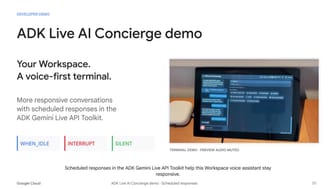
    Agents CLI Extension System: Supports the intelligent agent development lifecycle across frameworks.

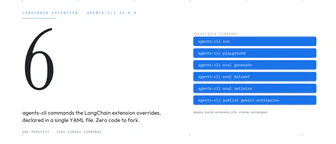
    Agents CLI 1.5.0 version introduces an extension system, allowing developers to override or add commands without modifying the tool, supporting cross-framework usage; the official LangChain extension replaces framework-bound commands while retaining other lifecycle functionalities; developers can create custom extensions, such as adding deployment commands for software bill of materials (SBOM) scanning, enabling enterprise platform teams to enforce governance policies.

  7. Databricks Blog

    Databricks introduces Agent Memory to enhance intelligent agent capabilities

    Databricks introduces Agent Memory, which improves agent quality, reduces costs and latency by storing key facts, preferences, and processes, and supports running on Lakebase. It is currently in Beta version. Agent Memory is based on Databricks' latest memory research and uses the MemCurrent architecture. In internal benchmark tests, it has tripled the pass rate of agent tasks while reducing token usage by 31%.

  8. OpenAI Alignment Blog50

    OpenAI introduces the complementary metric g-mean² to enhance model monitorability evaluation

    OpenAI has introduced the complementary metric g-mean² to improve model monitorability evaluation. g-mean² calculates TPR and TNR through behavioral labels and monitoring predictions, but cannot solve the problems of mixed differences in different model tasks and deployment risks. The new metric includes a paired matching metric for aligned shared instances and a post-control integrated metric simulating monitoring rejection of outputs, to more comprehensively evaluate model deployment risks.

Oct 20Tue
  1. Hugging Face Blog58

    How does ALTK-Evolve surpass state-of-the-art models in the τ²-bench customer service task through learning and memory?

    ALTK-Evolve uses GPT-4.1 to learn and apply customer service scripts. In the τ²-bench customer service agent benchmark test, it surpasses all retail entries in the retail sector, achieving a score of 67.5% Pass^4, and does not require updating model weights. The model is based on a basic ReAct agent and GPT-4.1. It attempts to analyze tasks and use GPT-4.1 to distill success and failure into short behavioral rules, then adds these guidelines to the agent's system prompts without updating weights or manual annotation.

  2. IBM Research Blog

    llm-d 1.0 Released: Strengthening Open Source AI Inference Production Environment

    The llm-d project announces the release of version 1.0, which is a Kubernetes-native distributed inference service network that supports deploying any model's inference stack on any accelerator in any cloud. This version enhances multi-tenant quality of service, zero-downtime operations, and agent-aware services to achieve continuous performance in common production operations. Through techniques such as prefix cache-aware routing and KV cache offloading, llm-d 1.0 can capture 97% of available cache reuse, reducing the cost of large-scale AI services.

  3. Hugging Face Blog58

    AnyLanguageModel 1.0 is released: supporting local model advancements on Apple platforms for a year.

    AnyLanguageModel 1.0 is released, supporting local model advancements on Apple platforms for a year. New support added for cloud models such as OpenAI Chat Completions, Anthropic Messages, and Google Gemini. Local model support includes llama.cpp, MLX, and Core ML. Tool calling and guided generation features are expanded. Cloud models have the same functionality as local models, and API keys support dynamic acquisition through closures.

  4. Meta Engineering

    Meta introduces GenRecs Tokenization to reshape ad recommendations with a stable model vocabulary.

    GenRecs Tokenization enhances conversion rates by 0.35% for advertisers by representing items like ads and products with a stable semantic vocabulary, combined with Meta's Generative Ad Model (GEM) and adaptive ranking model. This technology leverages the world knowledge of pre-trained large models to enable recommendation systems to understand preferences of new items or users with no historical interaction, accelerates learning through shared concepts, achieves cross-activity transfer, and improves performance as large model scale increases, forming a feedback loop for performance improvement.

Oct 19Mon
  1. Sakana AI55

    Sakana AI proposes 'QD-Rec' to improve recommendation quality and diversity with an open-ended exploration method

    Sakana AI proposed 'QD-Rec', recommending candidate-hypothesis pairs as units, with generative AI writing new hypotheses based on past excellent hypotheses in a cycle to accumulate high-quality and diverse recommendations. Experiments were conducted in M&A, customer targeting, and paper recommendations, achieving high average evaluations in many settings and building large sets of recommendations.

  2. LangChain Blog

    How Nu company builds AI health coaches using LangGraph and LangSmith and prioritizes evaluation

    Nu company, while developing AI health coach Nu, prioritized building evaluation criteria to avoid boundary-crossing medical diagnoses. Using the LangGraph framework and LangSmith tools, it ensures the system meets health guidance needs while complying with regulatory requirements through LLM judges scored by category and open-ended behavior tests. The evaluation framework is designed separately for single responses and complete conversations, supporting rapid migration between two leading model providers. Safety probes and guard nodes review conversation content in real-time, ensuring the product stays within compliance boundaries.

  3. IBM Research Blog22

    Coursera's new course 'AI Data Stream Architecture: From Principles to Practice' teaches the principles of modern accelerator operation

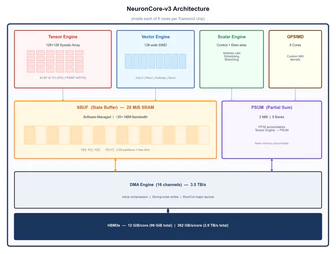
    Coursera's new course 'AI Data Stream Architecture: From Principles to Practice' teaches engineers how to work across GPUs, TPUs, Cerebras WSE, Groq LPU, and IBM Spyre accelerators. The course is taught by Kaoutar El Maghraoui, a senior research scientist at IBM Research, covering execution models, compilation, memory systems, debugging, and performance modeling through six courses and hands-on experiments, emphasizing how different architectures affect model performance and the key role of compiler optimization.

  4. Google Developers Blog

    LiteRT Tensor API release: A new solution for native model development on edge devices.

    LiteRT Tensor API is released, supporting developers to write and optimize models natively in C++ on edge devices, enabling cross-platform deployment (CPU/GPU/NPU) without script conversion. Developers can fully control the computational graph structure and directly load model weights, achieving zero-copy data transfer through shared accelerator buffers, while providing building blocks for AI coding agents.

  5. MiniMax News

    MiniMax M3.1 Flash released: Next-generation model with improved performance and reduced cost

    MiniMax M3.1 Flash is officially launched, with nearly a threefold increase in online inference speed and a 70% reduction in cost compared to the previous generation. The model performs excellently in benchmark tests for complex intelligent tasks (cowork), computer use, software development, and network security, ranking highly in the AutomationBench-AA for automated tasks, scoring 73.7% on DeepSWE v1.1, 61.7 on OSWorld V2, 29.6 on ALE, and 82% on CyberGym.

  6. Ollama Blog

    Cloudflare's 27B multimodal decision model Clef has landed on the Ollama cloud platform

    Cloudflare's 27B multimodal decision model Clef has landed on the Ollama cloud platform, users can run it locally or use cloud services. Clef transforms state and typed question patterns into decisions, supports text and image input, is compatible with Jev and System One APIs, is fine-tuned based on Qwen3.8-27B, and adopts the Apache 2.0 license. In Cloudflare's decision index evaluation, Clef outperforms Jev and performs leading in most benchmark tests.