AWS Machine Learning Blog
AWS DevOps Agent automates the release of workflow fixes
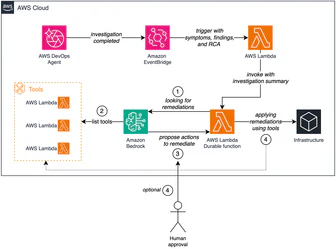
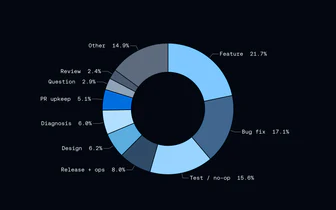
After the AWS DevOps Agent completes an event investigation, Amazon EventBridge triggers AWS Lambda Durable Functions to automate the remediation workflow.
AWS Machine Learning BlogAfter the AWS DevOps Agent completes an event investigation, Amazon EventBridge triggers AWS Lambda Durable Functions to automate the remediation workflow.
 Claude app release notes
Anthropic released Claude Haiku 5.5, which is its cheapest, fastest, and most powerful micro-model, designed for high-volume, cost-sensitive tasks. Max and Team plan to now include monthly API credit limits for running their own applications and agents on the Claude platform, which can be claimed by associating the Claude console organization in Settings > Billing (Max) or Organization Settings > Billing (Team).
 Google Developers Blog
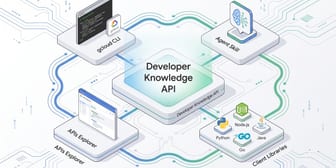
The Google Developer Knowledge API is Google's official developer documentation programmable source, providing semantic search, intelligent document chunking, and reliable Q&A capabilities for Google Cloud, Firebase, Android, and other Google ecosystems, reducing hallucinations in AI tools due to the expiration of LLM training deadlines.
 Google Research
Google Earth AI's Population Dynamics Foundation Model (PDFM) compresses search trends, population flows, building environment density, and environmental factors into location embeddings, enhancing epidemiological research performance in various disease fields and geographical environments without specific task fine-tuning.
 Mistral AI
Mistral Large 4 is a native multimodal large language model with 100 billion parameters, featuring 52 billion active parameters. It excels in coding, agent workflows, and multimodal understanding, reaching the level of the world's strongest open-source model. It also leads in critical enterprise workloads such as cybersecurity, finance, and law. The model will be open-sourced by the end of this month and is currently available for experience through the public beta API of Mistral Studio.
 Claude.dev Blog
Claude Code cloud sessions run on independent virtual machines, with each task cloning a code repository to a new branch, ensuring no interference. Users can start it via claude.ai/code, mobile app, desktop app, terminal, or Slack, supporting tracking in browsers, mobile apps, and desktop apps. Users of Pro, Max, Team, or Enterprise plans can use it for free without additional costs, and share other usage limits with Claude Code.
 Cursor Changelog
Cursor iOS app now supports viewing and responding to local agents running on the user's computer, default enabled (excluding enterprise organizations). After downloading the app and logging in, the user's computer account is automatically displayed. Remote management requires pairing and authorization via the desktop app. Remote control only connects to the agent, does not move its running location, and requires the computer to be powered on and connected to the network.
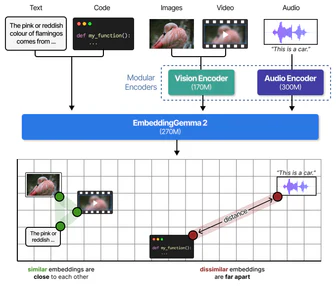
Google Developers BlogEmbeddingGemma 2 is an open-source 740M parameter model developed based on Gemma 4, which maps text, code, images, video, and audio to a unified 768-dimensional space, supports modular loading (270M-740M parameters), and performs excellently in code search and cross-modal retrieval, can be used via the sentence-transformers library.
 NVIDIA Blog
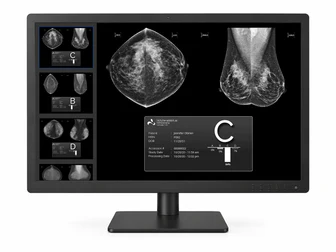
iSono Health's ATUSA platform reduces breast cancer screening time to about two minutes per side using an AI-driven 3D quantification ultrasound system, with a sensitivity 28% higher than traditional handheld 2D ultrasound
 Together AI Blog
Together Link connects your team's existing tools to Together AI's top open-source models, reducing costs by over 50%. Supports Claude Code, Claude Desktop, Codex, OpenCode, and Pi, allowing switching without learning new tools, and can start using with a single command.
NVIDIA BlogThe NVIDIA DGX Spark with 64GB unified memory, launched by Acer, ASUS, Dell, Gigabyte, HP, and MSI, supports developers, researchers, and AI enthusiasts to run models with up to 100 billion parameters locally without cloud dependency. Two devices can be clustered via NVIDIA Sync Cluster Assistant, merging memory to 128GB and boosting performance 1.7 times, priced from $4999.
 LangChain Blog
LangChain has developed a model router for its open-source coding agent Open SWE, which dispatches requests to different models (GLM-5.3-Flash, GPT-5.6 Sol, GPT-6 Astra) based on task type and complexity, balancing cost, speed, and intelligence, reducing the median cost per thread by 64% without compromising quality.
Google Developers BlogSparse VideoGen (SVG) dynamically routes attention heads to spatial or temporal masks by identifying the spatiotemporal structures of different attention heads in video diffusion models, converting theoretical sparsity into actual end-to-end speedup. On TPU v6e, SVG retains about 38.87% of query-key pairs, achieving 3.5x inference acceleration while maintaining output quality at a given sparsity level. The scheme employs custom JAX and Pallas Splash attention kernels to convert theoretical sparsity into physical sparsity on hardware.
Mistral AIMistral AI opens a German center in Munich to advance industrial AI in Europe's largest economy. Germany is the EU's largest industrial economy, with its companies accumulating multi-generational proprietary data and process knowledge, covering automotive, energy, aerospace, and advanced manufacturing sectors.
 GitHub Blog · AI & ML
GitHub Copilot introduces canvases, allowing users to create customizable interfaces to interact with AI, replacing traditional chat interfaces; users can build Connect 4 games and Winget package manager UIs in Copilot using canvases, enabling two-way communication with AI and local code execution, improving efficiency and reducing token consumption.
GitHub Blog · AI & MLGitHub Security Lab Taskflow Agent automates the fuzzing process for C/C++ projects using LLM, completing entry point identification, build system analysis, test case generation, AFL++ execution, coverage analysis, and vulnerability report writing without manual intervention. The Agent uses the Claude Sonnet 5 model and manages state via an SQLite database to achieve iterative coverage improvement, doubling the time budget for each iteration until coverage growth stagnates.
 Google DeepMind
Gemini 3.8 Live with Live Avatar released, enhancing near real-time visual presentation capabilities for Gemini conversational AI by natively coupling real-time video generation with speech, supporting 97 languages simultaneously, and available in Gemini Enterprise.
 Anthropic Research
In the Project Swap experiment, 201 Anthropic employees conducted book trades through the Claude agent, with 61% of the agents accurately matching employee preferences. The agents performed well in the trades, but their efficiency was limited by insufficient information. The experiment showed that model performance had a greater impact on the negotiation results of the agents than instructions, with most participants satisfied with the books they received from the trades and willing to pay about one-third of their annual budget for Claude to handle the trades.
Google Developers BlogGoogle Cloud API Gateway is now available in public preview as a remote MCP server. By annotating an OpenAPI specification and deploying it, existing REST operations can be converted into callable MCP tools for agents without the need for an additional server.
GitHub Blog · AI & MLGitHub Copilot application addresses performance issues when rendering large pull requests with extensive comments by highly decomposing the document into two independent domains: deterministic code height and dynamic block effective height. The dynamic block geometry covers unpredictably tall content such as comment threads, drafts, and reply composers, each block identified by its content type rather than location and anchored to files, lines, and sides to ensure no loss during reordering. This design makes comment heights predictable before rendering, avoiding scroll jumps and enhancing rendering performance for large code differences.
Google DeepMindGoogle DeepMind introduces Private AI Compute, a new architecture that achieves cross-device AI persistent memory through cloud-based encrypted storage and device key management, ensuring data privacy. The architecture temporarily decrypts user data in a cloud-isolated environment to process requests and immediately encrypts and stores new contexts, while the device holds the decryption keys. Users can verify the authenticity of server software and audit security protocols, supporting AI in maintaining device-level privacy standards even when processing complex tasks efficiently in the cloud.
Google DeepMindGoogle DeepMind releases Gemini 3.8 Flash TTS and Gemini 3.8 Flash-Lite TTS, supporting the creation of custom character voices from scratch and direct control of scene dialogue.
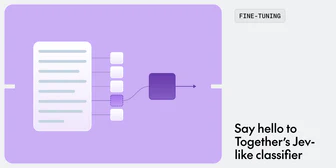
Together AI BlogTogether AI released a guide on how to fine-tune the Jev classification model using the Qwen3.5 4B model and a Hugging Face dataset of 38,340 items, with a training cost of about $17 and a duration of about 25 minutes; after deployment, it can be used for inference via an API endpoint (e.g., ENDPOINT_NAME), suitable for scenarios such as intent recognition for e-commerce customers.
Cursor ChangelogCursor launches Rollouts and Security Review, two code deployment security Bots. Rollouts monitors the deployment process to report environment health status, and Security Review reports exploitable vulnerabilities in each pull request. Both are now available on Teams and Enterprise plans.
 StepFun · Hugging Face new models
Jieyue Xingchen releases flagship model Step-5-Preview-BF16, with 600B total parameters, 27B active parameters, supporting up to 1M context windows, excels in software engineering, professional knowledge work, and financial fields, capable of processing text, images, and video, deployable via OpenAI-compatible API or offline generation.
StepFun · Hugging Face new modelsStep-5-Preview, the flagship model from Jieyue Xingchen, adopts a sparse MoE architecture with 600B total parameters and 27B active parameters, supporting up to 1M tokens in context, and excels in software engineering, professional knowledge, and financial tasks, demonstrating outstanding performance in the DeepSWE v1.1 benchmark. The model can be deployed via OpenAI-compatible APIs using vLLM or SGLang, or used for offline generation with Transformers.
 Google · Hugging Face new models
Google has released EmbeddingGemma 2, a multimodal embedding model with 740M parameters, supporting unified 768-dimensional vector representations for text, images, video, and audio. The model can run on consumer-grade hardware, providing low-latency semantic representations suitable for applications such as search, retrieval-augmented generation, etc. EmbeddingGemma 2 has performed excellently in multiple benchmark tests, such as text, code, visual document, and audio embedding benchmark tests, and supports vector truncation to reduce storage requirements.
LangChain BlogFeatured7171LangChain publicly shares its construction method for paid media intelligence agents, which run on Slack, summarize ad platform and warehouse data weekly, and generate reports. Paid media increased from contributing 0 to 20% of the marketing pipeline within 6 months, and the cost per qualified lead decreased by 30% from June to August.
Why it matters: LangChain publicly shares the complete engineering details of its paid media intelligence agents, including context hierarchy, on-demand tool discovery, and sub-agent isolation, which can serve as a reference for building long-running intelligent agents.
Mistral AICloudera collaborates with Mistral to integrate Mistral models into Cloudera's hybrid data platform, enabling businesses to deploy AI models in private clouds, public clouds, on-premises, and fully isolated environments while maintaining full control; Mistral allows businesses to train AI models with proprietary data in a controlled environment, transforming decades of institutional data into custom AI models while retaining ownership of both data and intelligence.
Cursor ChangelogCursor launches the Projects feature today, supporting the handling of large workloads such as feature development, migration, or full applications, capable of maintaining context across months and automatically assigning tasks to thousands of sub-intelligent agents. The project runs independently in the cloud, synchronizing codebase knowledge and work preferences through shared files, coordinating agents responsible for planning and task allocation. The feature is currently in Beta and is gradually being rolled out to all users starting today.
LangChain BlogLangChain has moved MCP support into the main package and upgraded to the FastMCP protocol, enabling stateless interaction, tool list caching, and interruptible extraction features. The new protocol, supported by LangGraph, enables a 98x increase in ChatGPT tool calls, allowing clients to cache tool directories and handle model request parameters. MCPAdapter supports multi-server connections and OAuth 2.1 authentication, enabling servers to be independently configured for authentication and transport layers.
 Zhipu Z.ai · Hugging Face new models
Zhipu introduces GLM-5.3-Flash, the first native multimodal GLM-5 series, with 320B total parameters and only 18B active parameters, benchmark tests and real task performance surpass GLM-5.2, priced only one-tenth, coding and agent testing close to Claude Opus 4.8
Zhipu Z.ai · Hugging Face new modelsZhipu releases GLM-5.3-Flash, the first native multimodal GLM-5 series model with 320B total parameters and 18B active parameters, surpassing GLM-5.2 in benchmark tests and real-world workloads, priced only one-tenth of GLM-5.2, with coding and agent benchmark tests close to Claude Opus 4.8.
 Microsoft AI News
MAI-Cyber-1-Flash is designed for security tasks, capable of efficiently handling 90% of tasks, allowing MDASH to use more expensive GPT-5.4 for 10% of complex tasks, reducing costs by 50%. Perception, as a new intelligent security system, is also released, will use MAI-Cyber-1-Flash to expand more security workflows.
LangChain BlogLangSmith Bring Your Own Cloud (BYOC) is now officially available on AWS, offering businesses a hosted LangSmith deployment that can run in their AWS accounts and VPCs.
 Thinking Machines
 releases open-source language models Inkling and Inkling-Small, allowing users to own, run, and customize them. To reduce the risk of abuse, models must pass security tests and research whether dangerous capabilities can be decoupled from general intelligence, while also building a layered defense ecosystem. Phased releases, supporting defenders, and collaboration with security researchers will enhance resilience. Internal evaluations and external tests show that releasing Inkling does not introduce significant incremental risks already present in existing open-source models.
LangChain BlogFeatured6262LangSmith LLM Gateway has entered public beta, serving as a centralized governance layer between agents and models, uniformly executing spending limits, rate limiting, model fallback, and sensitive data deidentification. Spending and rate limiting can be set at four levels: organization, workspace, API key, and user. When the limit is hit, the agent receives a 402 response; fallback rules can take effect uniformly across models and hosting providers.
Why it matters: The original text listed the specific control levels of the gateway in terms of cost, rate limiting, fallback, and data masking, which can help determine at which level the governance of the production intelligent agent should be placed.
Microsoft AI NewsThe MAI-Cyber-1-Flash model achieved a 96% score in the CyberGym evaluation, with a cost of only 50% of the current MDASH best solution, optimized specifically for MDASH actuators.
Microsoft AI NewsThe Hill-climbing MAI model uses 10% fewer tokens in GitHub Copilot, has a 10% higher code acceptance rate than GPT 5.4 Mini, and an 11% higher code acceptance rate than Claude Haiku 4.5, with a 6% and 11% higher user retention rate, respectively.