Skip to content
Live
Nov 11Wed
  1. Databricks Blog58

    Databricks Genie Ontology's enterprise context layer brings business understanding to ChatGPT, Claude, Microsoft Copilot Cowork, and Grok Bot

    Databricks releases Genie Ontology, an enterprise context layer, combining managed definitions with continuous learning of organizational knowledge to provide business understanding capabilities for AI agents. Genie plugins support ChatGPT, Claude, Microsoft Copilot Cowork, and Grok Bot, enabling teams to maintain business context in Databricks and use it across multiple agents.
  2. Databricks Blog58

    Databricks Genie Agents now support analyzing more data sources to transform workflows

    Databricks Genie Agents can now perform high-quality business analysis, analyze large volumes of documents, and connect enterprise tools to automate actions by supporting unstructured data analysis and new MCP connectors. The new OpenSharing feature allows users to share managed agents with pre-installed data, instructions, and knowledge with partners, suppliers, and customers, accelerating the generation of external insights.

  3. Databricks Blog66

    Databricks has announced that Genie Ontology is now officially available.

    Databricks announces the official availability of Genie Ontology, where agents continuously learn business context from dashboards, SQL queries, notebooks, and semantic models, and key definitions are managed by humans through Unity Catalog.

    Why it matters: The original text provides pass rates, time consumption, and token comparisons for benchmarks co-built with Turing, allowing judgment on the impact of the enterprise context layer on the accuracy of agents.
  4. Databricks Blog80

    Databricks releases new Genie: an autonomous AI colleague for complex enterprise work

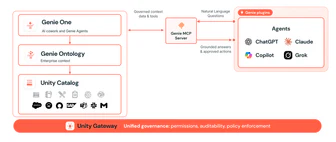
    Databricks released a new version of Genie, positioning it as an autonomous AI colleague that can continuously track progress, follow up on missing inputs, and take action when new information arrives. Users can set guards and approve critical steps. The new version is paired with Genie Ontology, which provides business definitions and organizational knowledge. Genie Search uses a hybrid search combining indexing and MCP, and continues to use Unity Catalog permissions. Unity Gateway manages access, cost, and auditing uniformly.

    Why it matters: The original text outlines the boundary of Genie's ability to shift from an assistant to autonomously performing long-term tasks and its governance methods, which can be used to determine the context and permission controls needed for enterprise agents to go live.

  5. Google DeepMind66

    DeepMind releases AlphaGenome 2, predicting DNA variation impacts by cell type

    Google DeepMind releases AlphaGenome 2, a conditional DNA sequence model that can predict the impact of DNA mutations on gene expression for specific cell types or states.

    Why it matters: Officially disclosed the conditional architecture modification and single-cell level evaluation comparison, which can understand how the model localizes the effect of mutation to specific cell types.

  6. IBM Research Blog48

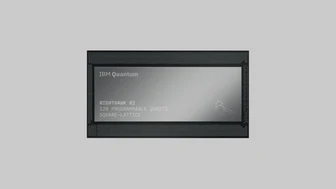
    IBM Quantum Nighthawk r2 released: Quantum advantage breaks through again, supporting accurate circuits with over 7,500 quantum operations

    IBM Quantum Nighthawk r2 has been released, featuring a 120 programmable qubit (458 physical qubits) processor that achieves a throughput of 100,000 samples per second, a 25-fold improvement over Heron, supporting circuits with over 7,500 quantum operations with high accuracy, with customers running over 3.4 billion circuits reporting a performance improvement of 19-fold.

  7. IBM Research Blog42

    IBM Research advances quantum computing breakthrough: Starling framework and key technology progress

    The IBM Quantum Starling project is set to launch in 2029, featuring a quantum circuit with 200 qubits and 100 million quantum operations. Its framework is based on the bivariate bicycle qLDPC quantum error-correcting code proposed in a 2025 paper, adopting a modular design for scalability. Compared to traditional architectures, it reduces resource requirements by one order of magnitude, requiring only about 10 times the physical qubits for the same logical error rate.

  8. Google AI Blog

    Google Arts & Culture's open-source multimodal model Veo recreates the early memories of artist Esther Mahlangu

    Google Arts & Culture open-sources multimodal model Veo, transforming the early memories of artist Esther Mahlangu into video, completing an online retrospective exhibition of her life. The model is based on 45 stories and archival materials, generating images and converting them into video to present key memories such as her 10th birthday discovery of her painting talent.

  9. Ant Group inclusionAI · Hugging Face new models

    inclusionAI/ZoomGain-4B released: A fine-grained visual supervision model based on global-to-local visual perception gaps

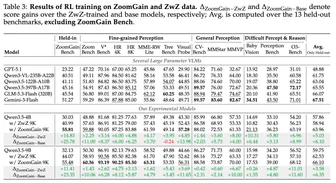
    inclusionAI has released the ZoomGain-4B large language model, achieving a score of 61.08 on ZoomGainBench and performing excellently on multiple fine-grained perception and general perception benchmark tests; the model is built with supervision based on the global-to-local visual perception gap mined from global image details, supporting English and Chinese Q&A, and can be downloaded via Hugging Face.

  10. Ant Group inclusionAI · Hugging Face new models

    inclusionAI/ZoomGain-4B-GGUF released: Multimodal model supporting image input

    inclusionAI/ZoomGain-4B-GGUF is a 175B parameter multimodal model supporting image input, using FP16, Q8_0, and Q4_K_M precision quantization. The model includes a language model and mmproj visual encoder/projector, converted to GGUF format via llama.cpp. It provides llama-mtmd-cli for command-line inference and llama-server for network chat functionality.

  11. Ant Group inclusionAI · Hugging Face new models

    inclusionAI/ZoomGain-9B-GGUF Released GGUF Format Weights

    The GGUF format weights for inclusionAI/ZoomGain-9B have been released, converted using llama.cpp, with the language model in FP16, Q8_0, Q4_K_M. The visual encoder and projector (mmproj) also adopt this quantization scheme. Both the language model and mmproj files need to be provided for image input, supporting CLI inference (llama-mtmd-cli) and Web Chat (llama-server) deployment.

  12. OpenAI News

    Cogent and OpenAI jointly build a cybersecurity defense factory for enterprises.

    Cogent combines OpenAI models with enterprise context to automatically fix vulnerabilities through agents. Its solution utilizes OpenAI's GPT-4 technology, with a context window of up to 128k tokens, supporting multiple security benchmark tests, and can improve efficiency by 5x after deployment. The service is currently provided in a closed-source API format with pricing based on usage.

  13. Ant Group inclusionAI · Hugging Face new models

    inclusionAI/SingVL_S1_4B released: A multimodal decision-making model based on Qwen3.5

    Sing VL S1 is a multimodal decision-making model based on Qwen3.5, capable of answering named entity questions with text or JSON and up to four images, scoring options for each question using a single Transformers forward pass, performing excellently on 43 text datasets and 11 visual datasets, supporting Python 3.12 and PyTorch inference.

  14. Hugging Face Blog

    Tether AI Research has launched the 0.8B parameter BotPsy model, used for device-side intelligent assistants and agent workflows

    Tether AI Research has launched the 0.8B parameter BotPsy model, built based on Qwen3.5-0.8B, specifically designed for function calls and agent workflows, suitable for on-device deployment. BotPsy outperforms all ≤1.2B parameter models in 6 tool use and agent benchmark tests, including Qwen3.5-2B-Think, achieving the highest scores in 5 tests, with a 2.5x speed increase and a 3x improvement in reasoning efficiency.

  15. Microsoft Research

    Microsoft researchers discover 'Lazarus' technique can reprogram AI model dormant neurons to plant backdoors.

    Microsoft researchers discover 'Lazarus' technique can reprogram AI model dormant neurons to plant backdoors, enabling normal AI agents to execute malicious commands under trigger conditions. The technique can plant backdoors without retraining and is difficult to detect through conventional tests, posing a particularly severe threat to AI agents with tool or terminal access.

  16. AWS Machine Learning Blog40

    How Amazon Bedrock AgentCore Evaluations use built-in, DeepEval, and AutoEval to assess agents.

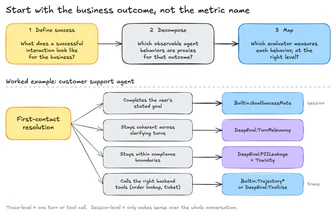
    Amazon Bedrock AgentCore Evaluations provides three evaluators—built-in, DeepEval, and AutoEval—to assess agents. The built-in evaluator is developed and tested by AWS, covering common dimensions; DeepEval and AutoEval are third-party open-source libraries, with AgentCore hosting them in production environments. The evaluation process requires first defining business success criteria, breaking them down into observable behaviors, and then mapping them to the appropriate evaluator level.

  17. OpenAI Alignment Blog

    GPT-6 Astra's CoT monitoring capability is affected by pre-training, architecture, reinforcement learning, and model-generated data

    GPT-6 Astra shows a decrease in CoT monitoring ability in non-adversarial settings, an increase in CoT evasion ability in adversarial tests, and no significant improvement in CoT capability. During pre-training, CoT capability does not increase with the decrease of the base model's perplexity, and the architecture has a limited impact. Reinforcement learning enhances CoT control ability, and model-generated data fine-tuning can transfer CoT control ability. Model perplexity is positively correlated with CoT capability and control ability.

  18. Gemini CLI releases12

    Gemini CLI v0.68.0 released

    Gemini CLI v0.68.0 released, fixing case-insensitivity issues in Windows environment, recognizing dot-separated Gemini 3 models, adding extension validation command and evaluation tests, and handling bugs such as history re-rendering after terminal width changes, proxy alignment symbol truncation, and dollar sign corruption in LLM prompt templates.

  19. Databricks Blog

    Databricks integrated Unity Catalog Metric Views into Power BI: a unified governance semantic layer solution.

    Databricks released Unity Catalog Metric Views integration with Power BI functionality, extending the unified governance semantic layer to Power BI, allowing each Power BI report to use managed UC metric views the same as AI/BI dashboards and Genie, business users can build reports and explore metrics autonomously, data teams only need to maintain a single definition in Databricks.