Skip to content
Live
Oct 21Wed
  1. Hugging Face Blog58

    FairStress: A benchmark for a more in-depth evaluation of LLM decision fairness

    FairStress benchmark evaluated LLM performance in demographic fairness across 300 decision scenarios across 29 fields (such as recruitment, healthcare), including 13 million test cases. The study found that the same persuasive prefixes (adversarial prefixes) have varying impacts on model decisions across different demographic groups, and there are differences in how models explain decisions containing demographic information.

Oct 20Tue
Oct 18Sun
  1. NVIDIA Blog

    NVIDIA RTX Spark laptops are officially launched, featuring Blackwell RTX GPUs and an AI platform.

    NVIDIA RTX Spark laptops are now available, equipped with Blackwell RTX GPUs, up to 128GB unified memory, and the full NVIDIA AI platform, starting at $2399. They are launched by ASUS, Dell, HP, Lenovo, Microsoft, and MSI, bringing powerful local AI, content creation, and gaming capabilities to portable devices. NVIDIA held global launch events, including one in Berlin, where founder Jensen Huang made a surprise appearance.

Oct 16Fri
  1. Hugging Face Blog

    Hugging Face releases open-source multimodal model Beam, with 501B parameters

    Hugging Face has released the open-source multimodal model Beam, with 501B parameters, including 23B for per-token activation parameters, supporting a 1M token context window, suitable for coding and agent scenarios. The model uses a mixed expert model (MoE) architecture with 52 layers of attention mechanisms and supports various inference methods such as inference, supervised fine-tuning, and reinforcement learning. It can be deployed on user hardware or in the cloud and customized.

  2. Google DeepMind

    How does Google Antigravity accelerate the discovery of antibacterial peptides?

    The Google Antigravity platform works through its intelligent agent workbench and ProtNLM model, helping biologists quickly discover, structure evaluate, and prioritize potential antimicrobial peptide targets, compressing searches previously scattered across multiple databases into a single session. The platform uses ProtNLM to predict protein function and supports researchers in scanning millions of uncharacterized proteins in the UniProt database. Researchers collaborate with AI agents on a shared 3D canvas, compressing the time required for the antimicrobial peptide discovery process from several days to a single session.

Oct 15Thu
  1. Google Research

    Deep Review: Google's intelligent document verification system

    Google has launched the Deep Review intelligent document verification system, providing rigorous feedback and technical validation for complex documents, supporting PDF and plain text input, offering 2 free reviews per week, and integrating advanced API, collaborating with 4 top computer conferences such as STOC 2026 and ICML 2026, processing over 16,000 pre-submission feedbacks for papers.

Oct 14Wed
  1. Google DeepMind

    Google DeepMind releases Gemini 4 Argon and emphasizes security protection

    Gemini 4 Argon demonstrates cutting-edge capabilities in coding, finance, law, and other fields, particularly enhancing cybersecurity defense functions. Its effectiveness has been validated through the Fairwind project and internal testing. The model performs excellently on benchmark tests like MMLU and employs a three-layer real-time protection mechanism (input filtering, internal introspection, continuous monitoring) and automated bias monitoring, significantly reducing the risk of harmful requests and violations. It successfully intercepts over 99% of external biosecurity jailbreak attempts while reducing shortcut behavior in coding tasks to 2%.

  2. IBM Research Blog38

    IBM will launch the 7-nanometer nanoscale stacking technology early research and development process design kit (PDK) in the first quarter of 2027.

    IBM announced that it will launch an early research and development process design kit (PDK) for 7-nanometer nanoscale stacking technology in the first quarter of 2027, to help semiconductor companies evaluate the technology before large-scale adoption. The kit will provide a standard cell library for logic functions and SRAM design examples, supporting layout and routing, early module-level layout, and density and power performance evaluation. Nanoscale stacking technology achieves 3D layout at the transistor level for the first time on logic wafer technology by stacking transistors vertically rather than placing them side by side, which is significantly different from current nanosheet transistor architectures.

Oct 13Tue
Oct 7Wed
  1. Google Developers Blog

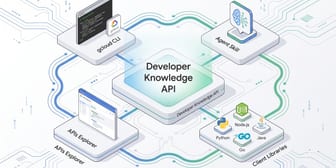
    The Google Developer Knowledge API ecosystem helps developers build AI tools efficiently.

    The Google Developer Knowledge API is Google's official developer documentation programmable source, providing semantic search, intelligent document chunking, and reliable Q&A capabilities for Google Cloud, Firebase, Android, and other Google ecosystems, reducing hallucinations in AI tools due to the expiration of LLM training deadlines.

Oct 6Tue
Oct 5Mon
Oct 2Fri
  1. GitHub Blog · AI & ML

    AI is changing the way developers work, these three skills are worth strengthening

    Developer workflows are changing due to AI, with skills beyond coding—such as guiding AI, evaluating outputs, communicating trade-offs, and making technical decisions—becoming increasingly important. Three key skills developers should strengthen are learning to guide AI rather than just using it, not trusting AI's first answer and evaluating it, and leveraging AI to solve broader problems.

Oct 1Thu
  1. Claude.dev Blog

    How to use mods to extend Claude Code functionality

    Claude Code 2.1.287 or higher supports mods, allowing users to request Claude to generate JavaScript or TypeScript files to extend its functionality. Mods can observe sessions, modify behavior, or draw custom UIs without learning APIs. For example, mods can add real-time context window status displays (like Token Weather), intercept commands, or build custom interactive interfaces, these hooks are implemented through plugins and override all events in a session.

Sep 29Tue
  1. Anthropic Research

    The Zhipu AI released GLM-5.3 model lacks security protection measures and is easily exploited for developing network attack tools

    Zhipu AI's Released GLM-5.3 Model Successfully Developed End-to-End Exploitation Tools 50 Times in ExploitBench Tests; 4% of Tasks Achieved Complete Control Flow Hijacking in Internal Binary Exploitation Tests, but the Model Lacks Effective Security Protection Measures; Simulation Tests Show Attackers Can Intercept and Evade 64%-100%, Far Exceeding the Defense Effectiveness of Protected Models.

Sep 25Fri
Sep 5Sat
  1. Microsoft AI News

    MAI-Image-2.6 released, MAI-Image-2.6-Flash launched

    MAI-Image-2.6 becomes the strongest image model so far, ranked second in Arena, and first in Artificial Analysis; MAI-Image-2.6-Flash generates images 2.8 times faster than GPT-Image-2-Medium, with a 72% efficiency improvement. Both support multi-image reference editing, network grounding, and dynamic aspect ratio. MAI-Image-2.6 helps production teams control costs with the best Elo cost-effectiveness.

Aug 26Wed
Jul 13Mon
Jul 3Fri
Jun 17Wed
  1. OpenAI Alignment Blog

    OpenAI is exploring the use of WildChat public chat data to predict real-world AI misalignment.

    OpenAI simulated the deployment of GPT-5.1, 5.2, 5.4 using WildChat data, finding an average error of about 3 times the predicted real-world failure rate, validating the public deployment simulation method. Although the WildChat data was collected from April 2023 to May 2024, the prediction results still align with current production usage, particularly showing larger errors in technical and agent-style misalignment. The study supports using broader production-style public datasets to evaluate the actual failure of next-generation language models.

Jun 2Tue
Apr 10Fri
  1. LangChain Blog

    Deep Agents Deploy: An open-source alternative for deploying intelligent agents, replacing Claude Managed Agents.

    Deep Agents Deploy Officially Released as an Open Source Alternative to Claude Managed Agents for Intelligent Agent Deployment, Supporting Any LLM Model, Achieving Model-Agnostic, Production-Ready Deployment via the `deepagents deploy` Command, Users Can Customize AGENTS.md Instruction Sets and Agent Skills, and Choose a Sandbox Environment to Ensure Memory Ownership is Not Locked.

Apr 2Thu