Skip to content
Live
Nov 11Wed
  1. Databricks Blog58

    Databricks Genie Agents now support analyzing more data sources to transform workflows

    Databricks Genie Agents can now perform high-quality business analysis, analyze large volumes of documents, and connect enterprise tools to automate actions by supporting unstructured data analysis and new MCP connectors. The new OpenSharing feature allows users to share managed agents with pre-installed data, instructions, and knowledge with partners, suppliers, and customers, accelerating the generation of external insights.

  2. Databricks Blog66

    Databricks has announced that Genie Ontology is now officially available.

    Databricks announces the official availability of Genie Ontology, where agents continuously learn business context from dashboards, SQL queries, notebooks, and semantic models, and key definitions are managed by humans through Unity Catalog.

    Why it matters: The original text provides pass rates, time consumption, and token comparisons for benchmarks co-built with Turing, allowing judgment on the impact of the enterprise context layer on the accuracy of agents.

  3. Databricks Blog80

    Databricks releases new Genie: an autonomous AI colleague for complex enterprise work

    Databricks released a new version of Genie, positioning it as an autonomous AI colleague that can continuously track progress, follow up on missing inputs, and take action when new information arrives. Users can set guards and approve critical steps. The new version is paired with Genie Ontology, which provides business definitions and organizational knowledge. Genie Search uses a hybrid search combining indexing and MCP, and continues to use Unity Catalog permissions. Unity Gateway manages access, cost, and auditing uniformly.

    Why it matters: The original text outlines the boundary of Genie's ability to shift from an assistant to autonomously performing long-term tasks and its governance methods, which can be used to determine the context and permission controls needed for enterprise agents to go live.

  4. AWS Machine Learning Blog40

    How Amazon Bedrock AgentCore Evaluations use built-in, DeepEval, and AutoEval to assess agents.

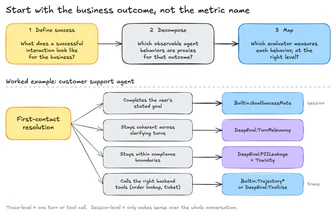
    Amazon Bedrock AgentCore Evaluations provides three evaluators—built-in, DeepEval, and AutoEval—to assess agents. The built-in evaluator is developed and tested by AWS, covering common dimensions; DeepEval and AutoEval are third-party open-source libraries, with AgentCore hosting them in production environments. The evaluation process requires first defining business success criteria, breaking them down into observable behaviors, and then mapping them to the appropriate evaluator level.

  5. Databricks Blog

    Databricks integrated Unity Catalog Metric Views into Power BI: a unified governance semantic layer solution.

    Databricks released Unity Catalog Metric Views integration with Power BI functionality, extending the unified governance semantic layer to Power BI, allowing each Power BI report to use managed UC metric views the same as AI/BI dashboards and Genie, business users can build reports and explore metrics autonomously, data teams only need to maintain a single definition in Databricks.

  6. LangChain Blog

    Workday how to build an AI intelligent agent platform with LangGraph and LangSmith

    Workday has utilized LangGraph for agent orchestration and LangSmith for tracking and evaluation, reducing prototype development time from 5 months to within 1 day with a 4-person team by 2025 and supporting production environment deployment. Its Python SDK 'Workday LangChain' encapsulates LangChain core components and routes through internal services (including LLM gateway, RAG retrieval) while meeting enterprise-level security and compliance requirements.

  7. AWS Machine Learning Blog

    How TCS uses Amazon Bedrock AgentCore to build an agentic test orchestrator

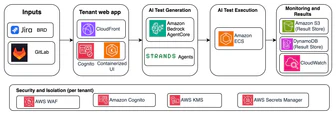
    TCS has built an Agentic test orchestrator for BFSI clients, transforming requirements into executable controlled tests through Amazon Bedrock AgentCore, breaking down tests into dedicated tasks and executing them using their respective agents, tools, and validation rules, while meeting project-specific context, API, and browser UI testing, tenant-level security isolation, and repeatable test path requirements, significantly improving test throughput and allowing engineers to focus on risk analysis and exploratory testing.

Nov 10Tue
Nov 9Mon
  1. NVIDIA Newsroom78

    NVIDIA released the GR00T 2 world action model and Isaac Lab 3.0 on CoRL.

    NVIDIA released the open-source world action model GR00T 2 on CoRL, built on NVIDIA Cosmos, trained with 100,000 hours of NVIDIA open-source first-person human data, and can complete 40 out of 50 evaluation tasks without task-specific demonstrations.

    Why it matters: The original text provides the success rate of GR00T 2 on few-shot tasks and the training throughput improvement of Isaac Lab 3.0, which can be used to judge the extent to which simulation training promotes robot deployment.

  2. Google Developers Blog65

    Google details Pathways: a single controller training system for large models.

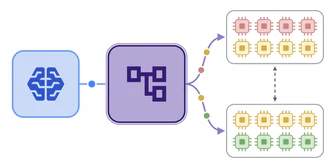
    Google announces Pathways is now generally available on Google Cloud Platform, which is Google's distributed system used to train its own large models like Gemini.

    Why it matters: Google engineers explain the single controller execution model of Pathways and provide a layered difference with Ray for judging the selection of large-scale training orchestration.

  3. NVIDIA Newsroom32

    NVIDIA has released an optimized deployment solution for South Korea's leading open-source models, Dynamo.

    NVIDIA has released an optimized deployment solution for South Korea's leading open-source models, Dynamo, supporting SK Telecom A.X K2, LG AI Research K-EXAONE 2.0, Upstage Solar Open 2, and Motif Technologies Motif-3, achieving up to 2x performance improvement through optimized multi-GPU coordination and communication, accelerating model production deployment.

Nov 8Sun
  1. OpenAI Agents SDK releases22

    OpenAI Agents SDK v0.24.0-alpha.7 released

    OpenAI Agents SDK v0.24.0-alpha.7 released, supports classic workflows and native execution, adds voice and managed tools, introduces persistent session storage and context control. The new version defaults to strict mode execution, requiring updates to existing environments; bundled model default inference strength is increased to medium.

Nov 7Sat
  1. Databricks Blog38

    OpenSharing: Replace SFTP and API data feeds with an open protocol

    OpenSharing is an open protocol developed based on Delta Lake and Iceberg, used for directly reading customer tables without copying data. It supports incremental pull of change data, real-time access to the latest data, and smooth backfill of historical data, while reducing costs for customers and consumers in data management, storage, and access control. Consumers do not need to maintain SFTP or API connections; customers can share tables with authorization and can track access records through system tables.

  2. Cursor Changelog60

    Cursor online with real-time voice calls to agents

    Cursor launches Voice Chat, allowing users to have real-time voice calls with agents, dictate modification requests, ask what the agent is doing, and receive progress updates.

    Why it matters: Officially, it explains which platforms the voice call is available on and how to divide tasks with coding agents, allowing readers to judge which collaboration scenarios it suits.

  3. AWS Machine Learning Blog42

    AWS releases serverless MCP server for accessing AI agent data lake on Amazon ECS Fargate

    AWS launches serverless Model Context Protocol (MCP) server on Amazon ECS Fargate to address integration challenges of LLM agents accessing corporate data lakes in AI applications. The server achieves metadata-driven, configurable data lake access without the need to write integration code for each dataset, and supports elastic scaling in multi-tenant environments.

  4. AWS Machine Learning Blog58

    Amazon SageMaker Inference now supports Multi-Instance GPUs to maximize GPU utilization

    Amazon SageMaker Inference now supports GPU partitioning, dividing physical GPUs into independent partitions via NVIDIA Multi-Instance GPUs (MIG), where each partition receives a fixed share of GPU computing units and dedicated memory blocks for isolation. Deploy more models in isolation and choose the appropriate size of GPU units on demand to reduce costs, with a maximum of 7 partitions per GPU, no need to build Kubernetes yourself.

  5. LangChain Blog72

    LangChain introduces asynchronous sub-agents for Deep Agents

    LangChain introduces asynchronous sub-agents in Deep Agents, where a resident orchestrating agent interfaces with users, and the sub-agents execute long tasks in the background in parallel and report results upon completion.

    Why it matters: The original text provides five management tools and notification mechanisms for asynchronous sub-agents, which can be used to determine how to set up the workflow for parallel long tasks.

  6. Databricks Blog38

    Databricks Feature Views implement real-time fraud detection.

    Databricks Feature Views achieve real-time fraud detection model training and online inference through a unified definition, preventing data leakage and training-service bias; support real-time feature calculation for Kafka streams, combining features like five-minute transaction count and thirty-day average spending, to implement risk scoring and real-time transaction monitoring in fraud detection applications.

  7. Claude · YouTube42

    How Salesforce leverages Claude Code to improve AI coding efficiency and output quality

    Salesforce expanded Claude Code to thousands of engineers, doubling effective output and reducing the number of bugs per line of code. The 'effective output' scoring system, co-built by the company's engineering leadership and Stanford researchers, measures AI coding ROI, and the intelligent agent maturity curve guides engineers from simple prompts to fully autonomous agents.

  8. AWS Machine Learning Blog38

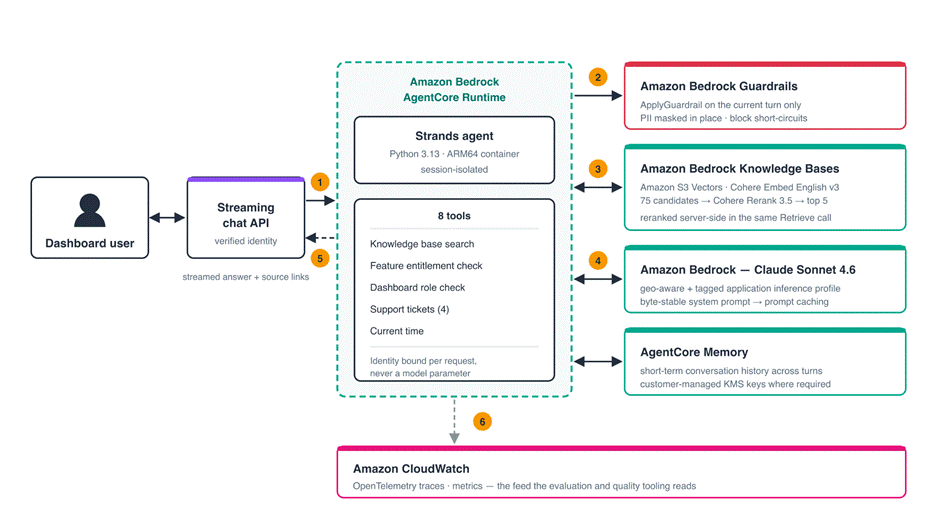
    Taxbit Assist: An authorized AI agent based on Amazon Bedrock AgentCore

    Taxbit Assist embedded in the Taxbit dashboard, running via Amazon Bedrock AgentCore, requiring user authentication. Intelligently searches for candidate paragraphs in the Amazon Bedrock knowledge base and rearranges them on the server side. Answers must be source attributed and role permission compliant, without providing tax advice. AgentCore manages conversation state in memory, supports regional data residency, and complies with ISO/IEC 42001 standards.

  9. AWS Machine Learning Blog38

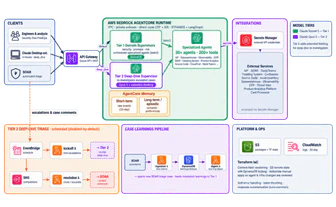
    Greenlight Financial builds an autonomous secure operations center solution based on Amazon Bedrock AgentCore

    Greenlight Financial autonomously processes over 90% of 4,000 security risk cases each month. Its solution, Luna, runs on Amazon Bedrock AgentCore, which includes over 30 specialized agents. Through AgentCore's runtime and memory support for hierarchical multi-agent systems, it achieves second-level security event triage in seconds without human intervention.