Skip to content
Live
Nov 13Fri
  1. Hugging Face Daily Papers65

    PhysLoop: Utilizing the physical perception capabilities of large language models to achieve self-improvement of video generation models

    PhysLoop utilizes large language models to guide video generation, selection, and correction, achieving physically consistent self-improvement and controllable data construction. The framework drives recursive self-improvement (RSI) of video generation models with limited human intervention by identifying and correcting physical errors in generated videos, and releases a diverse dataset containing 100K videos along with generation tools.
  2. Hugging Face Daily Papers

    BirdDreams: Joint Perspective and BEV Video Generation for Reasonable, Reactive Driving World Models

    BirdDreams jointly generates bird's-eye view (BEV) videos and bird's-eye view videos, making scene layout a part of predicting the future. By providing an overhead view of vehicle position and movement through BEV, it reduces occlusion, while the perspective video retains scene details. On PhysicalAI-AV and nuScenes, BirdDreams more faithfully follows the input trajectory of its own vehicle and generates more reasonable self-motion without HD map or vehicle state input.

Nov 5Thu
  1. Hugging Face Daily Papers65

    EmoReward: A self-evolving reward calibration mechanism for emotional video generation

    EmoReward adapts multi-reward weight allocation by extracting evidence reliability from reward trajectories collected during actual training runs to calibrate reward weights for emotional video generation. This mechanism first evaluates specific grounding cues based on emotional prompts, then scores videos during the generation phase using heterogeneous signal primitives, and calibrates their contributions through reflective reward gating.

  2. Hugging Face Daily Papers65

    The TurnWise framework enhances streaming video understanding through round-level credit assignment.

    The TurnWise framework improves streaming video understanding by round-level credit assignment and decision weight balancing. Its round-level credit assignment constructs group relative advantages using prefix scores from silent completions, and round-mean policy optimizes the token loss per round. Experiments show this method outperforms existing streaming video understanding RL methods.

Nov 4Wed
  1. Hugging Face Daily Papers65

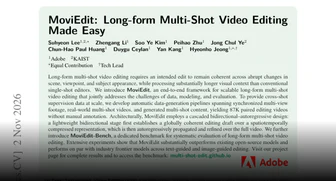
    MoviEdit: A framework for editing long-segment, multi-shot video

    MoviEdit framework, through cascaded bidirectional autoregressive modeling and new benchmark tests, maintains cross-scene coherence while reducing manual data annotation, significantly outperforming existing open-source models with performance comparable to industry leading models. The framework automatically generates 87K pairs of paired editing videos for cross-shot supervision, establishes a global editing draft using a lightweight bidirectional stage, and then performs autoregressive propagation and refinement.

Nov 3Tue
  1. Hugging Face Daily Papers65

    When Latent Prediction Error Supports Physical Anomaly Claims - Research on Video World Models

    Research shows that the latent prediction error in video world models reflects appearance and motion rather than reliable measurements of physical anomalies. Comparisons of latent prediction, masked pixel reconstruction, and simple visual statistics on the IntPhys2 benchmark show that appearance is easy to decode, and V-JEPA2 only slightly reveals whether an event is possible.

  2. Hugging Face Daily Papers

    Reviso: Not All Visual Evidence Should Be Given Equal Attention in Video Caption Generation

    Reviso is an intelligent video subtitle framework that prioritizes key visual evidence through hierarchical planning and active perception learning, enhancing subtitle quality and downstream video understanding capabilities. Multimodal large language models (MLLMs) generated video subtitles may overemphasize minor details while ignoring important context and key events.

  3. Hugging Face Daily Papers

    How Agent Harness Achieves Video Generation and Agent Interaction

    Agent Harness Integrates Video Generation and World Model, Supporting Agents in Multi-Camera Video Production for Planning, Tool Use, and Recursive Self-Improvement. The Framework Coordinates Script, Shooting Planning, Asset Management, Production, and Editing, and Analyzes Its Evaluation Challenges; Meanwhile, It Studies Agent-World Model Interaction in Observation, Control, Execution, and State Maintenance, as Well as How They Mutually Evaluate and Improve.

  4. Hugging Face Daily Papers34

    Venus-DefakerOne2: A broader visual forensics base model

    Venus-DefakerOne2 extends detection to multiple spoofing forms and media types through alternating LoRA and full-parameter fine-tuning, as well as entropy-based test adaptive, achieving SOTA performance in six benchmark tests including DeepFake faces (96.7%), AI-generated images (93.3%), and tampered documents (87.6%), significantly outperforming expert models and predecessor DefakerOne.

Nov 1Sun
  1. The Decoder42

    Google DeepMind released StreamVibe video agent to understand user needs

    Google DeepMind released StreamVibe video agent, a model based on Qwen3.5-9B and specifically trained to understand ambiguous requests and provide help when appropriate, improving response timing and quality by 10.7% on ProactiveBench and increasing proactive interaction rate by 12.3%. Tests show it outperforms other open-source models, but it still struggles to track changes in long videos (>5 minutes), with performance dropping to 38.5% of the benchmark.

Oct 30Fri
  1. Hugging Face Daily Papers52

    WeVisCut: An integrated smart editing agent from narration to long videos

    WeVisCut coordinates video editing tools, recovers from failures, and reduces token usage through a compact strategy trained on 9B parameters, while maintaining output quality. The system employs a four-stage data pipeline, combining editing inversion and validation replay, to generate over 130K training examples from 3,750 finished videos for training a single strategy.

Oct 28Wed
  1. Hugging Face Daily Papers65

    CodeCap-Bench: Can executable code serve as high-quality video subtitles?

    CodeCap-Bench demonstrates that code captions outperform natural language captions in terms of reasoning accuracy and reconstruction fidelity on video question answering and reconstruction tasks. The benchmark includes 323 structured 2D content videos, covering five categories. Evaluation finds that mainstream closed-source MLLMs perform well in code caption generation but struggle to capture complex temporal dynamics, while open-source models have a significant gap.

  2. Hugging Face Daily Papers65

    LociArt: A Unified Free-Style Local Video Styling Paradigm

    LociArt achieves precise local video stylization through generating refined networks, automated dataset construction, and dedicated benchmarks, supporting regional style control and temporal consistency. GRNStyle introduces a polarity-aware style perception mask on the basis of generating refined networks, combined with representation-geometric conditioning technology. Experiments show that it outperforms existing methods in regional style quality and spatial control. The LociArt-100K dataset contains 100,000 local stylization pairs, the benchmark includes 80 source videos and 84 target masks, using a style prototype similarity evaluation scheme.

  3. Hugging Face Daily Papers

    Hy-Nomas: A Video World Model for Free-Form Interactive World Generation

    Hy-Nomas is an 8B parameter diffusion model that supports free-form text instructions and camera control across multi-round interactions. It follows multi-round text and camera instructions by combining causal attention with structured video descriptions, outperforming existing world models in human evaluations. The model weights, code, and benchmarks are open-sourced.

Oct 27Tue
  1. Hugging Face Daily Papers65

    AV-FABLE: Audio-Visual Tampering Forensic Benchmark for Long Videos

    AV-FABLE introduces an audio-visual benchmark for sparse tampering in long videos, demonstrating that frozen audio-visual large language models' perceptual features contain forensic evidence that the best recovery is achieved by separating time decoders rather than language outputs. Local AI tampering in long videos often affects brief events that impact the authenticity of other content, making video-level classification insufficient for forensic analysis.

  2. Hugging Face Daily Papers65

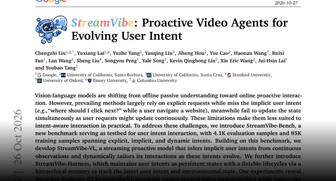
    StreamVibe: Active Video Agent and its benchmark, models, and memory framework

    StreamVibe-Bench releases a benchmark containing 4.1K evaluation samples and 85K training samples for testing explicit, implicit, and dynamic user intent interaction; StreamVibe-VL is a streaming active video language model that infers implicit intentions and dynamically adjusts interaction by continuously observing; StreamVibe-Harness maintains user intentions as persistent states through a hierarchical memory framework, tracking the latest user intentions and environmental states, improving the consistency of proactive interaction responses by 12.3%.

Oct 26Mon
  1. Hugging Face Daily Papers65

    Understanding the world through video reading, writing, sharing, and interaction

    This review unifies video understanding and generation within world modeling, organizing progress around inferring, synthesizing, sharing, and interacting with potential temporal states, emphasizing continuous dynamics rather than segment-level perception. Video foundation models are rapidly developing in understanding and generating visual sequences, while video world models attempt to capture the underlying dynamics of the world they depict.

Oct 23Fri
  1. Hugging Face Daily Papers65

    Factor-Aware Predictive Learning is released: a multi-modal large language model representation method for cinematic video generation.

    Factor-Aware Predictive Learning (FAPL) enables video diffusion Transformers to utilize multi-modal large language model (MLLM) representations for sparse temporal reasoning and cinematic control, achieving this through staged grounding and optimization. FAPL consistently outperforms baselines on three cinematic video generation tasks (sparse-to-video, factor-aware editing, and multi-shot generation), validating its contributions in MLLM feature utilization, temporal control, and factor coordination.

  2. Hugging Face Daily Papers38

    OmniDR-Bench: Video-centric deep report generation benchmark evaluation.

    Researchers have introduced the OmniDR-Bench benchmark and evaluation framework for in-depth study of video-centric deep agents, which can synthesize external evidence to generate interactive reports correlated with video moments. This task has direct practical value, helping users locate relevant video segments, verify claims, and reproduce demonstration steps. OmniDR-Bench includes 50 tasks in Chinese and English, covering 19 real-world subcategories, with a total of 6,414 standards, and the best system score is 63.3.

Oct 22Thu
  1. Hugging Face Daily Papers65

    StreamEval: Benchmark for evaluating interactive streaming video generation models

    StreamEval benchmarked the performance of interactive streaming video generation models on five tasks, finding reliable request execution and sustained state consistency to be major challenges. The benchmark includes 300 scripted test cases, covering character dialogue, character performance, world generation, instruction editing, and reference editing tasks, scored across four evaluation dimensions (task execution, state consistency, visual fidelity, and audiovisual coordination).

Sep 25Fri
  1. Amazon Science

    Reactor and Amazon Neuron Science jointly optimize the Rolling Forcing model to achieve real-time video generation on Trainium

    Reactor and Amazon Neuron Science jointly optimize the Rolling Forcing model to achieve real-time video generation on Trainium, which combines the sequence prediction of large language models with the iterative optimization of diffusion models, running at 16 FPS standard video frame rate, generating 30-second high-quality videos through Rolling Forcing technology, and achieving low latency, high-efficiency real-time video generation on Trainium.