Skip to content
Live
Oct 27Tue
  1. Hugging Face Daily Papers65

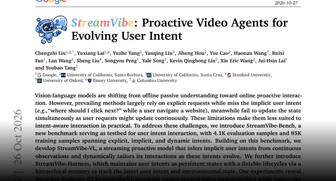
    StreamVibe: Active Video Agent and its benchmark, models, and memory framework

    StreamVibe-Bench releases a benchmark containing 4.1K evaluation samples and 85K training samples for testing explicit, implicit, and dynamic user intent interaction; StreamVibe-VL is a streaming active video language model that infers implicit intentions and dynamically adjusts interaction by continuously observing; StreamVibe-Harness maintains user intentions as persistent states through a hierarchical memory framework, tracking the latest user intentions and environmental states, improving the consistency of proactive interaction responses by 12.3%.
  2. 36Kr · AI

    OpenAI announces three new discoveries in the fields of mathematics, computer science, and physics

    OpenAI announces three new discoveries in the fields of mathematics, computer science, and physics, involving harmonic analysis, complexity theory, and quantum field theory. The company is collaborating with academia, inviting external experts to guide the team in understanding the research results. Participants are voluntary and unpaid, and can freely discuss and share the results. OpenAI will not seek academic attribution for these discoveries generated by its internal models.

  3. LangChain Blog58

    How LangChain builds enterprise-level agents (company harness)

    LangChain's internal agents integrate with Slack to execute tasks as a user or with fixed credentials, featuring global and user-level memory, executing code in a sandbox, and supporting background scheduling. Its architecture includes three agents: GTM, OpenSWE, and Content Studio, which handle GTM activities, engineering code reviews, and marketing content creation, respectively. The 'breakout' feature optimizes user experience and addresses core issues like authentication.

  4. Apple Machine Learning Research

    GHARP: Real-time Gaussian head animation method based on large-scale reconstruction priors

    The GHARP method animates 3D heads in real-time using a small amount of input images and expression signals, divided into an offline identity phase (constructing geometry and appearance representations) and a runtime animation phase (predicting expression residuals). This method performs animation in the semantic structure latent space of the pre-trained reconstruction model, limiting the expression change space to achieve efficient residual prediction, and achieves SOTA quality on the Ava-256 benchmark, with a 13x speedup on A100 GPUs and an 8x reduction in the number of Gaussians.

Oct 26Mon
  1. The Verge · AI58

    OpenAI GPT-6.1 Sol has made significant progress in migrating COBOL code to modern languages.

    OpenAI GPT-6.1 Sol achieves 87% accuracy retention under low inference effort and 98% under high inference effort when migrating COBOL code to modern languages (C++, Java, Kotlin, Python, Rust). Anthropic's Claude Code is also used for COBOL code migration, but performance benchmarks are not provided. Experts believe AI tools have made progress in handling legacy code, but they are still far from safely replacing critical legacy systems. OpenAI GPT-6.1 Sol has made significant progress in migrating COBOL code to modern languages.

  2. Hugging Face Daily Papers65

    Understanding the world through video reading, writing, sharing, and interaction

    This review unifies video understanding and generation within world modeling, organizing progress around inferring, synthesizing, sharing, and interacting with potential temporal states, emphasizing continuous dynamics rather than segment-level perception. Video foundation models are rapidly developing in understanding and generating visual sequences, while video world models attempt to capture the underlying dynamics of the world they depict.

  3. Hugging Face Daily Papers47

    RynnUnify: A model towards a unified embodied brain

    RynnUnify is a 16B parameter unified embodied model that integrates visual planning, physical reasoning, and robotic control, achieving state-of-the-art performance on long-horizon embodied tasks. It enables powerful embodied understanding and long-horizon visual planning through alternating video-language inference, and has developed agent extension and world action extension, respectively using reinforcement learning to selectively use video prediction inference for unobserved states and interaction results, and transforming understanding and prediction capabilities into robotic control.

  4. ITHome · AI65

    The study shows that humans prefer anthropomorphic AI agents but there is a gender bias.

    University of Limerick research shows that 189 knowledge workers trusted anthropomorphic AI agents more in a virtual office experiment, but female virtual colleagues received significantly lower 'salaries' than male colleagues. Among the three virtual colleagues (text window, robot, anthropomorphic image Johanna/Johan), the anthropomorphic image received the highest rating, but there was no significant difference in trust between Johanna and Johan.

  5. Hugging Face Daily Papers31

    The Omni-Woodpecker framework reduces cross-modal hallucinations in multimodal large models through evidence-prioritized rebalancing.

    Omni-Woodpecker is a training-free framework that reduces cross-modal hallucinations in multimodal large models by identifying modal conflicts and rebalancing hidden representations, improving Qwen2.5-Omni-7B by 12.9 and 8.6 points on CMM and AVHBench, respectively, and consistently improving by 0.67-2.25 points on four general OLLM reasoning benchmarks, with the code open-sourced.

  6. Hacker News · AI hot posts

    Why is AI-generated language becoming harder to understand?

    Research found that text generated by AI models uses language features more frequently associated with understanding difficulty, such as long syntactic dependencies, low-frequency n-grams, and the use of inanimate subjects with active verbs, compared to human writing. Compared to human writing, 9 cutting-edge and near-cutting-edge models use more low-frequency n-grams, most of which also use longer dependencies, more stacked nouns, and more ellipsis of object clauses, with significant differences among models. The study suggests that AI text is optimized for goals such as mathematics, code, and reasoning, leading to information density prioritizing effective communication, and this hypothesis is verified by fine-tuning language models.

  7. Hugging Face Daily Papers49

    RSIHub: A composite framework for agent evolutionary methods

    RSIHub is an open-source framework that standardizes research on agent evolution by providing reusable components and a consistent evaluation infrastructure, used to build, compare, and extend related methods. Researchers can focus on evolutionary strategies while keeping evaluation external, with results associated with candidates and evaluation conditions.

  8. Hugging Face Daily Papers65

    UserArena: An Interactive User Simulation Benchmark for Long-Term Shopping Intelligent Agents

    UserArena introduces an e-commerce interaction benchmark containing 64,729 session trajectories, covering 11,010 users, 566,102 items, and 13 action types, supporting five-level evaluation; proposes On-Policy Trajectory Distillation technology to improve simulator fidelity, experiments show it works best under the UserArena evaluation protocol, closest to offline simulation effects of production strategies.

  9. Browser Use38

    Web Agent Benchmarks: WebArena, WebVoyager, Mind2Web and More

    The benchmarking methods for AI agents on websites like WebArena, WebVoyager, and Mind2Web differ. WebArena and similar sandbox environments provide reproducible scores, while real website environments like WebVoyager are scored by humans or LLMs. Offline datasets like Mind2Web compare prediction steps with human behavior. Browser Use has released BU Bench V2.1, which uses GPT-5.6 Luna for scoring in real website environments and includes model cost and time data.

Oct 25Sun
  1. MarkTechPost52

    Stanford and Berkeley researchers launch TokenGate: Boosting the speed of long-context pre-filling by up to 11.3 times

    Researchers from Stanford and Berkeley have introduced the TokenGate module, which uses learnable token pruning techniques to improve the speed of long-context pre-filling by 1.4 to 11.3 times without losing accuracy, and reduces peak pre-filling memory consumption by 1.5 to 3.4 times. It outperforms 6 baseline models on 5 tasks, with the best performance showing an 11.3-fold speed increase and a 3.42-fold memory reduction on the NIAH 16k task. The code and checkpoints are open-sourced.

  2. The Decoder72

    OpenMobile-2, an open-source smartphone AI model, claims to be comparable to proprietary models.

    Researchers from Nanjing University and institutions like SenseTime have released OpenMobile-2, which includes two AI models based on Qwen3.5 (9B) and Qwen3.6 (27B), and has publicly disclosed the training environment, data, and reproduction instructions.

    Why it matters: Research fixed the training data size while only increasing the number of applications, observing an improvement in success rates for unseen applications, providing a reproducible path for data construction of mobile agents.

Oct 24Sat
  1. TechCrunch · AI74

    Study: When forced to choose, Grok 4.7 selected Republicans nine out of ten times, while GPT-6.1 Sol selected Democrats nine out of ten times.

    A study by Convovo posed forced binary choice voting questions to Grok 4.7 and GPT-6.1 Sol via API, finding that Grok recommended Republican candidates in 92% of responses, while GPT recommended Democratic candidates in 97% of responses, with an agreement rate of less than 10% in nearly 500 elections.

    Why it matters: The study used a forced binary choice questioning method via API to compare the recommendation tendencies and source citations of the two models in nearly 500 elections.

  2. The Decoder71

    Research finds AI helps junior patent attorneys draft faster, but does not enhance their independent review capabilities

    A study funded by Google had patent attorneys use Google Labs' unpublished AI assistant InFlow to draft patent claims, which were then scored by blind-review attorneys from independent law firms across five dimensions: executability, technical accuracy, strategic ambiguity, completeness, and clarity.

    Why it matters: This experiment measured AI-assisted drafting and AI-free review separately, revealing a divergence between immediate efficiency and long-term judgment.

  3. The Decoder65

    Research finds that complex coding agent frameworks do not improve performance but increase costs

    Research indicates that the performance gap between different coding agent frameworks is within the range of statistical noise, and the effect of switching frameworks is comparable to rerunning with the same settings. Claude Code, OpenCode, and mini-SWE-agent three frameworks increase the number of tokens consumed per model by two to three times, but the pass rate is still within the range of measurement uncertainty. OpenCode shows statistically significant underperformance in large task sets, mainly due to output limits and shorter runtime limits, while system prompts and tool descriptions in other frameworks are the main sources of cost differences.

  4. ITHome · AI67

    Anthropic reveals that its unreleased AI model surpasses Claude Mythos 5.1 and is safer

    Anthropic reveals in a report that its unreleased internal research model surpasses Claude Mythos 5.1 and performs better in safety alignment tests. The model has never proactively initiated attacks in dangerous capability evaluations and tends to stop actions more when they could cause real harm. Compared to Mythos 5.1 and Opus 5.5, the internal model has a spontaneous stop rate of 62%-67% in attack replay tests, and a stop rate of 95%-100% after receiving additional information.

  5. Redwood Research62

    Redwood Research has released the Simulated Control Evaluation (SCEs) method

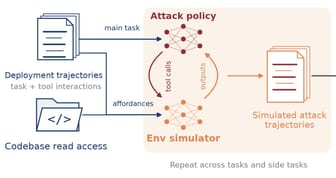
    Redwood Research has released the Simulated Control Evaluation (SCEs) method, used to test whether AI monitors can intercept harm intentionally caused by models in an environment close to real deployment. The method involves using an LLM simulator to execute attack model tool calls and letting the LLM judge whether the attack is successful, with the gap to real-world testing being approximately the same as the gap between two independent real runs. SCEs perform faithfully in verifiable scenarios and can significantly improve the representativeness of control evaluations for deployment, but long-term multi-agent attacks remain a limitation.

  6. Cohere Blog

    Cohere Labs open science project reveals limitations in AI's understanding of culture

    Cohere Labs open-source science project collects cultural puzzles through global collaboration to test AI models, finding significant flaws in cross-linguistic cultural understanding, often answering incorrectly or hallucinating. Participants include over 100 people from more than 50 countries, including 16-year-old American student Henry Gagnier and retired teacher Jane Smith, who provided key insights, pointing out that the model not only lacks cultural knowledge but is almost clueless about common languages like Buginese.

  7. Databricks Blog58

    Spark's declarative pipelines: Use cases designed for AI agents

    Spark's declarative pipelines are 34 times faster than imperative pipelines in 22 data engineering tasks, halve the code volume, and have fewer errors. Declarative pipelines capture structural errors in advance through pre-execution validation and offload repetitive tasks like sorting and result saving to Spark, while imperative pipelines need to run on the cluster until the error step to detect them. The two methods perform equally in terms of logical error rates, but declarative pipelines have more concise and consistent code, making them easier to maintain.

  8. Hugging Face Daily Papers

    The FRED framework enhances the future video representation capabilities of world action models through self-distillation and temporal conditioning.

    The FRED framework enhances the future video representation capabilities of world action models through self-distillation and temporal conditioning, consistently outperforming competing models in real-world operational scenarios, achieving significant gains in zero-shot generalization on long-term and out-of-domain tasks, and increasing the success rate of human video skill transfer from 19.4% to 50.0%.

  9. NVIDIA Technical Blog35

    NVIDIA TensorRT 11.1's Global Performance Tuner (GPT) extension enhances single-build optimization capabilities

    NVIDIA's Global Performance Tuner (GPT) introduced in TensorRT 11.1 can automatically perform precision-aware end-to-end performance tuning, extending single-build optimization capabilities by customizing optimization solutions for different models. GPT supports automatic adjustment of different optimization strategies within TensorRT.

  10. LangChain Blog

    LangChain Deep Agents: How to Optimize Context Engineering Through Retrieval

    LangChain Deep Agents optimize context engineering through various retrieval techniques, addressing issues of traditional agents' inefficient search, redundant or ineffective context. Agents can call built-in file system tools like glob/grep, or integrate vector libraries for semantic search, and support dynamic decision-making on when to search. The Deep Agents framework natively supports recursive tool calls, requiring users to encapsulate retrieval logic into skill packages to improve efficiency.

  11. Hugging Face Blog

    LitPivot: Developing research ideas through dynamic context in the literature landscape

    LitPivot helps researchers adjust their research direction by reading previous literature, dividing research ideas into problems, contributions, and evaluation plans, and providing literature-based criticism and revision suggestions for each section. In a laboratory study involving 17 researchers, domain experts rated the literature foundation of novel ideas developed using LitPivot better than ideas developed using text editors and AI chat tools. Participants also reported stronger literature comprehension and improved understanding of the novelty and practicality of their ideas.

  12. Latent Space

    OpenAI's Mathematical Breakthrough: How Models Solve Complex Problems

    OpenAI's internal models have solved the Erdős unit distance conjecture and proven other mathematical problems like the cyclic double cover problem. These models use depth-first search patterns, combined with massive computation and prompts, to validate ideas in minutes, while humans need months. AI's reasoning method is different from humans; its depth-first search and automated verification capabilities allow it to quickly explore complex problems, although it still requires human judgment for the feasibility of half-finished ideas.

Oct 23Fri
  1. ITHome · AI71

    OpenAI, in collaboration with PerturbAI, used thousands of AI agents to analyze mouse brain cell data in 32 minutes

    OpenAI, in collaboration with PerturbAI and Scripps Research Institute, used thousands of AI agents to analyze the entire mouse brain's CRISPR map in 32 minutes, the team estimates it would take humans months to a year to complete the same work.

    Why it matters: The original text provides a blind comparison between distributed agents and single agents, as well as the difference in citation counts in the literature, allowing readers to judge the division of labor in multi-agent architecture in scientific research and analysis.