 Qoder Blog4242
ProductQoder subscription plans are launched
ProductQoder has launched a subscription plan, offering different versions for users to choose from.
Qoder Blog4242ProductQoder has launched a subscription plan, offering different versions for users to choose from.
Qoder Blog00ProductSmart Context Control released, optimizing large model usage through intelligent context management, saving costs. This tool supports 8k context length, priced at $3.5 per million tokens, currently provided as a closed-source API.
Qoder Blog1717Qoder generates dynamic shared documents through code, its Agent SDK supports cloud and local deployment, with a context window of up to 128k, priced on a pay-as-you-go basis.
Qoder Blog2020Qoder has attracted over 100,000 developers in five days, offering code-free creation features, supporting multiple usage methods such as mobile, IDE plugins, CLI, and including enterprise-level services like Agent SDK and cloud Agent.
Qoder Blog6565Qoder is an intelligent coding platform for creating real software. It offers multiple usage methods, including mobile, IDE plugins, CLI, and cloud agents.
Qoder Blog6565Qoder introduces the ProductQuest mode, delegating tasks to AI-assisted coding. This mode supports a context length of 128k tokens and speeds up the process 3.5 times.
 Dify Blog7070
Kakaku has addressed speed, security, and scalability issues in AI application development through the Dify platform, making 30% of employees AI builders and launching a product data extractor within 3 hours, cumulatively building nearly 950 internal applications. Dify Enterprise provides a multi-workspace architecture, single sign-on, sandbox environment, and production-grade infrastructure, achieving a combination of central control and local freedom.
 Liquid AI Blog
Liquid AI and Shopify have reached a multi-million dollar multi-year agreement, under which Shopify will be authorized to use Liquid AI's flagship Liquid foundation model (LFMs) for search and other use cases
Dify BlogDify Knowledge Pipeline has officially integrated TiDB Vector, allowing developers to seamlessly reuse processes like parsing tables, extracting entities, and embedding text for knowledge construction in downstream AI applications. TiDB Vector supports hybrid SQL + vector search, filtering structured metadata via SQL syntax before performing semantic retrieval to ensure precise, context-aware responses, and leverages TiDB's distributed architecture for enterprise-grade scalability and stability.
Dify Blog7070Dify Platform now integrates Qdrant high-performance Rust vector database, providing faster retrieval, hybrid search, and scalable performance for building reliable, production-grade AI applications. This integration enables developers to choose Qdrant without becoming vector search experts through simple configuration, achieving millisecond-level retrieval for millions of documents, complex metadata-based retrieval strategies, and hybrid search capabilities, supporting high-performance scaling from prototype to production.
Dify Blog6565Bright Data has launched on the Dify Marketplace, bringing real-time structured network data sources to Knowledge Pipeline. Its Web Scraper plugin can be installed and configured in 5 steps, accessing a 72M+ proxy network to collect data from e-commerce, social media, etc., supporting API key authorization, enriching the knowledge base of AI workflows.
Dify Blog6565Dify platform now supports Tavily Real-time Web Search API, allowing users to directly embed web data into knowledge pipelines to enhance accuracy and timeliness; Tavily can be used as a data source plugin in Dify Marketplace, paired with Dify knowledge pipelines, which support modular components from upload and parsing to chunk embedding; users can install the plugin, obtain an API key, and configure LLM nodes to use Tavily search results for generating Q&A pairs and storing them in a knowledge base.
 Anthropic ResearchFeatured7171
Anthropic has released an open-source auditing tool, Petri (Parallel Exploration Tool for Risky Interactions), where automated agents test target models through multi-round dialogues, and then LLM reviewers score them based on safety dimensions and select the most worthy dialogues for manual review.
Why it matters: Anthropic has open-sourced the automated auditing tool Petri and provided cross-comparison results for 14 cutting-edge models on behaviors such as deception, sycophancy, and self-preservation.
Dify BlogDify has launched the Knowledge Pipeline visualization process, which transforms enterprise PDF, PPT, Excel, and other messy data into high-quality LLM context. This process manages data source connections, document parsing, text/image/table processing, knowledge distillation, and embedding through visual nodes, supporting over 30 local file formats, cloud storage, online documents, web crawlers, and other data sources. It provides 7 preset templates and pluggable parsing, enhancement, chunking, embedding, and loading modules, featuring real-time variable debugging capabilities.
Dify Blog7575Dify collaborates with Arize to bring observability tools Phoenix and AX into the Dify ecosystem to evaluate, monitor, and improve agents. Phoenix can automatically track model calls, tool calls, and chain steps, collecting inputs, outputs, latency, and metadata, and supports annotation tracking, building structured test datasets, creating custom evaluations, and running tests.
 Prime Intellect Blog
Environments Hub released, an open community platform for extending RL to Open AGI; supports development, sharing, and reusing RL environments, reducing friction in building, sharing, and reusing environments, promoting open-source AGI progress; now open to everyone, providing RL, Reinforcement Fine-tuning (RFT), computing, and reasoning infrastructure.
Liquid AI BlogLiquid AI announces that its efficient Liquid Edge AI Platform (LEAP) platform now natively supports AMD's latest Ryzen™ and Ryzen AI™ processors, bringing performance improvements for developers building high-quality AI solutions on devices.
 Cohere Blog
Cohere launches the enterprise AI platform North, which enhances employee task efficiency and quality by securely accessing work data, combining generative search models, customizable agents, and built-in workflow automation. The platform supports private deployment and can run with as few as two GPUs, has been adopted by companies like RBC and Dell, covering key industries such as finance and healthcare, and features security characteristics like fine-grained permission control, autonomous policies, and compliance certifications.
Dify Blog6565Dify Enterprise is officially launched on Microsoft Azure Marketplace, allowing enterprises to use the AI application development platform through a simplified procurement process; users can directly build, deploy, and scale AI applications within the Azure cloud infrastructure while maintaining existing compliance frameworks and security, supporting on-premises or cloud deployment models, and providing enterprise-level features such as advanced multi-tenant management, SSO integration, centralized access control, and audit logs.
Dify BlogDify v1.6.0 version includes built-in bidirectional Model Context Protocol (MCP) support, allowing direct calls to MCP servers or exposing Dify proxies/workflows as MCP servers to achieve faster and more reliable integration and feature expansion.
Dify BlogDify 1.5.0 is released, enabling workflow debugging through node execution records and variable passing features, supporting single-step execution and real-time variable modification, significantly enhancing the transparency of AI application development.
Dify Blog6565Dify has surpassed 100,000 GitHub stars and joined the top 100 global open-source projects. The platform was open-sourced two years ago, aiming to make it easier for developers to build LLM applications, and has continued to grow thanks to community contributions. The project especially thanks 10 core contributors who have driven platform progress through code submissions, feature development, and documentation improvements.
Prime Intellect BlogPCCL released, designed for global distributed training, with fault tolerance, supports operation on the public internet, bandwidth up to 45 Gbit/s between each pair of data centers, training bandwidth up to 25 Gbit/s between North America and Western Europe, supports dynamic member joining and rejoining, verified its high fault tolerance through long-term stress tests on major sockets (Linux, macOS, Windows WSA).
Dify Blog6565Dify has integrated Palo Alto Networks' AI runtime security plugin into its marketplace, allowing users to deploy the industry-leading security engine with a single click for each model call, user input, and model response. The plugin filters user inputs and model outputs, covering multiple levels from network posture to model behavior, including blocking prompt injection, denial-of-service attacks, data leakage, and harmful content, providing the first line of defense for AI applications without requiring model retraining.
Prime Intellect BlogPrime Intellect previews its distributed reasoning stack, designed for consumer-grade GPUs and public internet 100ms latency, and releases three open-source code repositories PRIME-IROH, PRIME-VLLM, PRIME-PIPELINE to achieve latency-aware pipeline parallelism, aiming to achieve the openness and democratization of AGI through consumer-grade hardware and network connections.
Dify BlogDify has launched a free LLM technology stack for the education sector, providing teachers and students worldwide with a complete generative AI toolset from construction to application, supporting drag-and-drop low-code development, visual workflow design, and various plugins. Early users can enjoy a 100% discount coupon.
Dify BlogDupDub AI audio plugin has been launched on the Dify market platform, offering speech translation, speech cloning, speaker recognition, and text-to-speech functions to help users build more engaging AI applications. These plugins are integrated into the Dify platform, supporting speech transcription, speech cloning, speaker recognition, and text-to-speech synthesis, which can be easily arranged through Dify's visual workflow builder to achieve automated audio processing.
Dify BlogDify integrates Fish Audio plugin from Open Audio into its platform, providing real-time text-to-speech (TTS) and voice cloning functions for AI applications. Fish Audio supports formats such as Opus, MP3, WAV, and cloning voice takes only 30-45 seconds. Users can control output parameters through WebSocket API. Developers can install the plugin on Dify marketplace and configure API keys to automatically convert LLM generated text into audio clips of specified voices.
Dify BlogAgora's conversational AI extension, as a plugin, has launched on the Dify market platform, providing developers with real-time voice AI capabilities. The extension supports multiple LLMs, featuring industry-leading speech-to-text and mainstream text-to-speech services, achieving rapid response and global reliability through Agora's low-latency SD-RTN™ technology. Developers can quickly deploy virtual assistants or customer service robots. The Dify market platform now hosts over 120+ plugins, supporting community sharing and local deployment.
Dify Blog6565Dify.AI will attend the NVIDIA GTC conference from March 17 to 21, 2025, demonstrating the latest innovative achievements in Room 3226, including the plugin system, workflow mechanism, and NVIDIA NIM integration. The core of the company is to help developers define AI applications through prompts, context, and plugins. Version 1.0.0 introduced the plugin mechanism, workflow enhancements, and an open ecosystem.
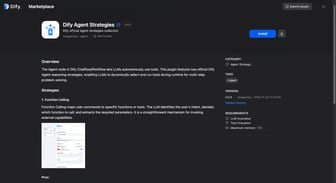
Dify BlogDify has officially launched the Agent Strategy plugin, enabling workflow nodes to delegate steps outside of fixed processes to LLM for autonomous decision-making. The Agent Node serves as the execution unit, managing resources and reasoning processes; Agent Strategy is a pluggable reasoning algorithm module that defines tool usage and problem-solving logic.
Dify BlogDify v1.0.0 introduces a plugin system, allowing developers to easily integrate real-time search functionality through the Brave Search API plugin. Create smart agents or workflows in Dify Studio, choose models like Claude-3.5 Sonnet, and add the Brave Search tool to enable search. Deploy in workflows or integrate custom plugins to extend functionality.
Dify Blog6565Dify will sponsor the 2025 AWS Summit Japan, demonstrating the latest features such as the plugin system, Workflow Agent Node, and seamless AWS integration at Makuhari Messe. Dify.AI is a leading open-source platform that helps organizations easily build and deploy large language model (LLM) based applications through its open-source community edition, cloud SaaS service, and enterprise deployment options.
Dify BlogAfter the release of Dify v1.0.0, its plugin system has become a key feature, achieving module decoupling, a plugin marketplace and sharing mechanism, and Endpoint plugins by separating horizontally scalable modules from Dify and operating them as independent runtimes.
Dify BlogDify officially releases version v1.0.0, introducing a plugin architecture to support independent model and tool upgrades, adding an Agent node to implement intelligent workflow orchestration, and launching the Dify Marketplace to promote the sharing of 120+ plugins.
Dify BlogDify has launched the Plugins plugin system into Beta, extending AI application functionality through plug-and-play components. Developers can obtain ready-made plugins or build their own on the Dify Marketplace, supporting capabilities such as image processing, audio analysis, text generation, data analysis, logical reasoning, and external integration. The system adopts a decoupled architecture, including five types of components: models, tools, strategies, extensions, and packages, achieving bidirectional communication with Dify's core functionality through custom endpoints.
Dify Blog6565Dify v0.15.0 Launches Parent-Child Retrieval Technology, Achieving Precise Retrieval by Matching Fine-Grained Child Fragments, Combined with Coarse-Grained Parent Fragments to Supplement Context, Improving RAG System's Response Accuracy and Information Richness. This Feature Supports Two Parent Fragment Splitting Modes (Paragraph/Full Text), Allows Users to Edit Parent-Child Fragments Independently and Choose Whether to Regenerate Child Fragments, While Optimizing Fragment Preview Interface to Enhance Low-Code Platform Usability.
Dify Blog6565Dify v0.14.0 introduces powerful error handling features, allowing developers to define custom error handling for LLM nodes, HTTP nodes, tool nodes, and code nodes. It prevents process interruptions through strategies like default values and workflow redirection, enhancing the reliability of AI applications.
 LangChain Blog
Promptim is an experimental prompt optimization library that automatically runs an optimization loop to generate better prompts by providing an initial prompt, a dataset, and a custom evaluator (optional human feedback). It integrates LangSmith for dataset management, prompt management, and result tracking (optional human annotation). The core algorithm modifies prompts based on evaluator feedback and iteratively optimizes, supporting human feedback loops. The tool aims to save manual prompt engineering time, introduce rigorous processes, and simplify model switching, but requires manual review.