Skip to content
Live
Found 43 items · updated 01:10
Oct 26Mon
  1. MarkTechPost66

    Hugging Face releases Carbon-X: the first open-source 14B model combining DNA and natural language

    Hugging Face has released Carbon-X, an open-source DNA language model with 14.8B parameters, which is the first to decode DNA into English answers. It achieved an average score of 66.7% on 5 DNA benchmark tests, outperforming all test models on BioReason Coding (74.9%) and NextBase (39.4%). The model can run on 1 x 80 GB GPU, and the official GGUF Q8_0 version is 15.8 GB.

Oct 29Thu
Nov 11Wed
Nov 6Fri
  1. The Decoder65

    SemiAnalysis GDPx Benchmark: No AI agent score exceeds 12%

    SemiAnalysis's GDPx Benchmark places AI agents in a simulated work environment, with results showing no model score exceeds 12%. Claude Opus 5.5 leads with a 12% score, but Gemini 4 Carbon follows closely with a lower price (16.29 USD/task). Security filters significantly impact rankings, with GPT-6 Astra rising to first after removing related fields.

Oct 29Thu
  1. Latent Space82

    Gemini 4 Carbon topped multiple lists and was the first to be opened to cybersecurity defenders.

    Google DeepMind released Gemini 4 Carbon, only two weeks after Argon, claiming to achieve SOTA in cybersecurity and long-period tasks, ranking first with a score of 59 on the Artificial Analysis Intelligence Index v5.

    Why it matters: Summarizes the positions and pricing of Gemini 4 Carbon on multiple independent lists, and lists the gaps in coding, hallucination rate, etc., compared to competitors.

  2. The Verge · AI

    Google releases Gemini 4 Carbon, achieving a 'major leap' in cybersecurity capabilities

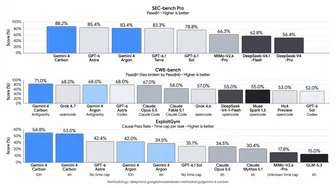
    Google has released its latest large model, Gemini 4 Carbon, achieving 'significant improvements' in coding, agent tasks, and network security. The model ranked first in the AI Analysis Index (v5.0) benchmark test and performed excellently in the SEC-bench Pro and ExploitGym evaluations.

  3. MarkTechPost80

    Google DeepMind released Gemini 4 Carbon, emphasizing network security defense and coding.

    Google DeepMind has launched Gemini 4 Carbon, describing it as a cutting-edge model for long-period intelligent agent coding and cybersecurity defense, ranking first with 59 points on the Artificial Analysis Intelligence Index v5.0.

  4. Google DeepMind82

    Google DeepMind releases the Gemini 4 Carbon cutting-edge model

    Google DeepMind releases the Gemini 4 Carbon, claiming it has the strongest capabilities in cybersecurity and long-term tasks, ranking first with a score of 59 in the Artificial Analysis Intelligence Index v5.0

TodayNov 15Sun
Nov 11Wed
  1. The Decoder

    Google releases the Gemini 4 Carbon model

    Google has released the Gemini 4 Carbon model, showing better reasoning performance than Fable 5.2 in the Artificial Analysis test, complementing rather than replacing Gemini 4 Argon, which is more suitable for most software engineering tasks.

  2. Google DeepMind87

    Google DeepMind releases the Gemini 4 Carbon cutting-edge model

    Google DeepMind has opened Gemini 4 Carbon to developers, enterprises, scientists, and consumers, claiming it has reached cutting-edge levels in network security capabilities and long-range intelligent agent workflows.

    Why it matters: The official provides the positioning division of roles between Carbon and Argon, multiple benchmark rankings, and cost comparisons per task to help determine when to use a heavier model.

Nov 3Tue
Nov 2Mon
  1. SemiAnalysis0

    GDPx: A benchmark to measure the capabilities of cutting-edge models in the most valuable domains.

    GDPx benchmark covers valuable areas such as chip design and cybersecurity, aiming to measure the capabilities of general intelligence agents, with results showing that top models scored only 12%. Opus 5.5 and GPT-6 Astra were penalized due to their security classifier scores, this benchmark was developed by SemiAnalysis in collaboration with 14 professional data partners and ensures task quality through a strict QA process.

Nov 11Wed
Nov 10Tue
  1. The Decoder

    Anthropic's Claude Fable 5.2 and Mythos 5.2 reclaim the leading position in AI performance before their IPO.

    Anthropic's Claude Fable 5.2 and Mythos 5.2 outperform competitors in multiple benchmarks, including leading GPT-6 and Gemini 4 Carbon by 65 points at the high computational tier of the Artificial Analysis Index v5.

    Same story · 11 outlets

    How the accounts differ:TechCrunch states the input price of Fable is reduced to $8 per million tokens; others do not mention the price.

Nov 14Sat
  1. Latent Space

    No AI Slop Declaration released

    The No AI Slop Declaration was released after discussions at the AIE CODE conference. It was introduced by Dex in the closing keynote speech and signed by multiple speakers, aiming to provide practical tools for working discussions; the declaration has been supported by Hacker News.

  2. Google Research88

    Google Opens /teamwork Multi-Agent Workflow in Antigravity

    Google has opened the /teamwork multi-agent workflow in Antigravity to external researchers and developers, which can be used in conjunction with Gemini 4 Argon, Carbon, and Hydrogen; /boost and Deep Review are also available.

    Why it matters: Google has disclosed /teamwork's specific results in multi-agent research and engineering tasks and made it available for external researchers to use.

Nov 13Fri
  1. TechCrunch · AI

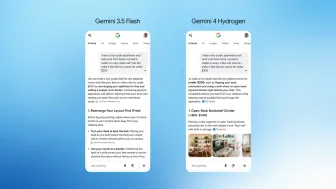
    Google launches Gemini 4 Hydrogen model to enhance search complex question understanding ability

    Google improves search complex question understanding ability through the newly released Gemini 4 Hydrogen model, which is 2.5 times faster and lower in cost than the previous generation. Hydrogen ranks 5th in Agent Arena for multi-step tasks, supports reasoning up to xhigh four tiers, and surpasses more powerful Gemini 4 Argon on one benchmark.

Nov 7Sat
  1. O'Reilly Radar22

    AI Weekly Scan: The cost of progress

    Google has released the Gemini 4 Carbon for cybersecurity and multi-step tasks, French Mistral has announced the weights of its 100 billion parameter Large 4 model, and DeepMind has previewed the Genie 4 world model for simulated environments.

Nov 3Tue
  1. Latent Space

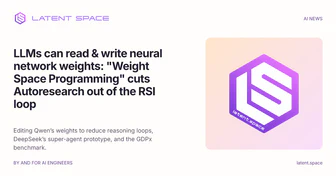
    Claude Code can read and write neural network weights: 'Weight space programming' bypasses Autoresearch

    Claude Code can directly read and edit the weights of other models without human intervention or PyTorch/Jax code, achieving weight reading, single-time bug fixes, performance improvements, or writing network weights from scratch. This technology bypasses the traditional process of Autoresearch by running experiments in a cluster to train models, demonstrating the potential of LLMs in weight space programming, currently mainly applicable to simple games and RL policies.

Oct 30Fri
  1. Platformer62

    What are the common points between the bad days of Google and Reddit?

    Google's released Gemini 4 Carbon large language model performs excellently in AI evaluations, but Alphabet's stock price plummets by 12.6%, with a market value evaporating by about 5000 billion US dollars, mainly due to investors' concerns about its AI infrastructure expenses reaching 2050 billion US dollars and a negative 90 billion US dollar cash flow.

  2. The Decoder

    French Mistral releases 'Le Chonk,' which has strong coding capabilities but still lags behind Chinese models.

    Mistral has released its largest model, Mistral Large 4, which leads open-source competitors in coding tasks but still lags behind Chinese models in overall rankings. The model has approximately 100 billion parameters, with 52 billion parameters per step, requiring 8 Nvidia B300 GPUs to run.

Oct 22Thu
  1. Google DeepMind

    Google DeepMind releases Forest Typology (ForTy) 2020 global forest type map

    Google DeepMind and Google Research jointly release the Forest Typology (ForTy) 2020 Global Map, which classifies every 10x10 meter land on Earth into six types of forests and land use, and tracks changes from 2017 to 2025. The map is based on definitions by the United Nations Food and Agriculture Organization, accurately distinguishing native forests, plantations, monoculture forest plantations, economic crop forests, and other land types, supporting the EU's deforestation regulations with an accuracy of 90%.

    Same story · 2 outlets

    How the accounts differ:Google DeepMind states the map classifies land into six types; The Decoder mentions only four types (original forest, plantations, and tree crop farms).

  2. The Verge · AI40

    The surge in data centers in Texas could wipe out decades of air quality improvements.

    The surge in data centers in Texas could wipe out decades of air quality improvements. HARC reports show that if all planned projects are connected to the grid and rely on the expected mixed energy mix, fine particulate matter pollution will exceed 2006 levels within five years, NOx emissions will increase by 136%, and CO2 will increase by 90%. The existing and under-construction data center capacity in Texas reaches 26GW, and the planned self-consumption capacity is the highest in the United States.

Nov 13Fri
  1. Latent Space88

    Huang Renxun Resigns as NVIDIA CEO, Colette Kress Takes Over as Interim CEO

    NVIDIA announced that Huang Renxun resigned from his positions as CEO, President, and Board Member after 33 years in charge, SEC filings show the board accepted the resignation on November 11, and the company announced it on November 12; Colette Kress, who has been CFO since 2013, retains her position and takes over as interim CEO, Harvey Jones becomes the first chairman of the board, and the board has launched a search for a successor.

    Why it matters: NVIDIA's board accepted Huang Renxun's resignation and the CFO temporarily took over, while Anthropic submitted its IPO registration documents, two personnel and capital actions occurred on the same day.

Nov 12Thu
Nov 10Tue
  1. MarkTechPost82

    Anthropic released Claude Fable 5.2 and Mythos 5.2: The same model, different safety guards.

    Anthropic releases Claude Fable 5.2 and Claude Mythos 5.2, both based on the same underlying model. Fable 5.2 adds a classifier to intercept high-risk cybersecurity tasks and most biology research tasks, while Mythos 5.2 removes these restrictions and requires access through the Cyber Verification Program and Life Sciences Verification Program.

    Same story · 11 outlets

    How the accounts differ:TechCrunch states the input price of Fable is reduced to $8 per million tokens; others do not mention the price.

Nov 7Sat
  1. Latent Space0

    Anthropic IPO: Current Market Dynamics and Valuation Analysis

    Anthropic's annual revenue target is 100 billion USD, currently reaching 80 billion USD; the AI market remains sluggish, with the Nasdaq falling 10%, valuation estimates dropping to 1 trillion USD, and the probability of a decline increasing by 18%. The market is overvalued, and any unexpected non-rising event could trigger a downturn.

Nov 3Tue
Oct 30Fri
  1. Latent Space65

    AIE CODE 2026 Highlights: Three Themes Focus on AI Programming Agent Development

    AIE CODE 2026 will explore three themes: redundant-free expansion, system-one model, and raising ambition, focusing on AI programming agent development, attracting 1000 top smart agent engineers globally. The conference will showcase the practical application of the System One model and focus on software rewrite cases from browser to Adobe Photoshop Suite.

Oct 29Thu
  1. Hugging Face Blog

    Project ProtoStar project release: Promoting the AI compatibility of publicly funded scientific research

    Project ProtoStar is announced, aiming to unlock the potential of publicly funded scientific research by making datasets, models, and code more accessible and reusable. The project brings together universities, research institutions, industry, and the open science community, supporting the release of scientific achievements in AI-compatible, machine-actionable formats, and demonstrating its value through a series of public challenges. The first challenge, hosted by Carnegie Mellon University, will launch on November 2.

Oct 28Wed
  1. Ars Technica · AI65

    Pinal released: AI tools can design proteins through natural language

    Pinal can generate proteins through natural language prompts, with a success rate meeting specific functional requirements; Hugging Face also launches a similar tool at the DNA level. Pinal uses T2struct to convert prompts into structural blueprints, which are then combined with SAProt-T for sequence generation based on probabilistic evaluation, trained based on three major databases and AlphaFold predictions.

Oct 24Sat
Oct 23Fri
  1. Hugging Face Blog

    Hugging Face releases OlmoEarth v1.3: Global satellite embedding model achieves new milestones

    Hugging Face releases OlmoEarth v1.3, a satellite embedding model, offering global pre-computed embeddings (10m resolution, 64 and 128 dimensions), available to users without login or technical knowledge. The model performs best in 27 evaluations, with 128-dimensional embeddings scoring highest in 20 evaluations and 64-dimensional embeddings leading in 18. Training costs are reduced by 53% compared to v1.2 and 18% compared to v1, with corresponding reductions in carbon emissions. Weights, data, and code are all open source.