NVIDIA Newsroom3838
Live
#Reasoning
- NVIDIA Newsroom3838
 OpenRouter Blog6262
OpenRouter launches the new generation of Auto and Auto Code routers
OpenRouter releases the new generation of Auto and Auto Code routers, performance improved 4 times, routing step speed increased 3 times (p90 0.65 seconds vs 1.96 seconds), Auto Code is optimized for coding, comparable to Claude Opus 5.5 in performance but cost reduced by 74%. The new router selects models by evaluating 11 request factors and combining real-time pricing, provider health status, and cache status, supporting any model set and governance strategy.

 vLLM BlogFeatured7272
REINFORCE Zero: Aligned kernel allows asynchronous RL to train stably under lag 64.
NVIDIA Research and Inferact's REINFORCE Zero proposes to first align rollout with training kernel, then use unclipped token-level importance sampling to correct weight lag, achieving a training step throughput 2.40 times that of synchronous training under 16 GPUs and 12K updates.
Why it matters: The paper breaks down the gap between asynchronous RL's rollout and training into two items: weight lag and kernel inconsistency, and proposes an alignment-free, no-trimming importance sampling method after alignment.
 Modal Blog6565
How Snorkel runs real agent simulations with Modal
Snorkel uses Modal's GPU and CPU sandboxes to run millions of agent simulations per month, supporting various task evaluations. Through Modal's memory burst feature, Snorkel reduces sandbox costs by 20% and improves runtime reliability. Modal's serverless GPUs and shared/dedicated inference endpoints enable Snorkel to quickly deploy and test custom models.
 Hugging Face Daily Papers6565
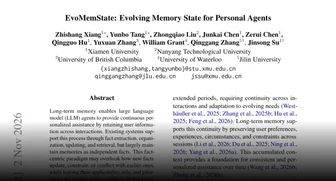
EvoMemState: An evolving memory state framework for personal agents
EvoMemState framework enhances persistent facts through relational and reasoning states, improving retrieval completeness and memory response accuracy in long-term dialogue and memory usage benchmarks. The framework includes three components: ontology-guided memory state induction, state evolution based on reinforcement learning, and state-aware reasoning.
 Hugging Face Blog5858
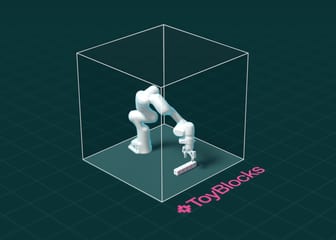
Hugging Face released ToyBlocks: A controlled world framework for robot learning and evaluation
Hugging Face released ToyBlocks, a framework for robot learning and evaluation that provides a controlled simulation environment. The framework supports automatically generating tasks and training demonstrations, and includes metrics to measure changes in robot behavior over time, aiming to study how models improve with more training data and how to combine advanced reasoning with precise physical control.
 O'Reilly Radar5858
How Claude Code provides fine control in running internally
Claude Code provides detailed control over the code implementation process through CLAUDE.md instructions, skills, sub-agents, and hooks. Hooks can interpret reject operations or return compilation or policy failures, but external lifecycle control still requires other layers.
 Artificial Analysis Articles6565
VIALS-AA: different paths to scientific image reasoning
VIALS-AA tested 19 models and found that 38.3% of tool calls were used to view images, 47.3% for image preparation or measurement, while the image measurement call rates for GPT-6 Astra and GPT-6.1 Sol were only 5-6%, and Claude Opus 5.5 and Claude Sonnet 5.5 were 25-27%.
36Kr · AI Midea's Whole-Home Intelligent Anchoring A2A: Home appliance interconnection is moving from 'interface docking' to 'Agent dialogue'
Dr. Shang Zhe, General Manager of Midea's Whole-Home Intelligent, pointed out that the industry's bottleneck lies in heterogeneous device data silos, interaction effect gaps, and deployment barriers. Traditional API connection solutions are difficult to popularize due to the exponential increase in costs. Midea's self-developed family intelligence body MevoX achieves cross-brand collaboration by enabling AI Agents to directly communicate. It has completed vehicle-home integration with Chery iCAR, supports fuzzy intent reasoning and long-term memory, and has connected with ecological partners such as Huawei and BYD. As the first home appliance company to achieve A2A collaboration of family intelligence bodies, Midea is driving the industry to shift from hardware scale to Agent reasoning and cross-ecosystem collaboration efficiency competition.
- Hugging Face Daily Papers6565
SLA: Expanding Spatial-Language-Action Model via Continuous Pre-training
SLA model aligns pre-trained VLA strategy with frozen 3D perception model spatially through continuous pre-training and post-training, using feature-dependent gating and probabilistic state dropout to enhance spatial understanding across different robot datasets while retaining the inference architecture.
- ByteDance Seed · Hugging Face new models
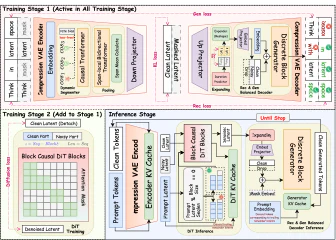
ByteDance-Seed/Cola2 released: Continuous Latent Language Model Cola2
Cola2 is a continuous latent language model that combines dynamic compression VAE, block causal diffusion Transformer (DiT), and cross-segment causal token decoder, dynamically grouping text into semantic segments, representing each segment with a compact continuous latent, generating latent blocks and implementing them as discrete tokens.
- Hugging Face Daily Papers6565
Decoupled Predictive Decision Making (DPDM) architecture release
The Decoupled Predictive Decision Making (DPDM) architecture enhances the accuracy of agent decision-making by combining frozen language model representations with a shared pre-trained conditional predictor.
36Kr · AI6565 NVIDIA plans to transform old telecom facilities into a 1-gigawatt AI inference network
NVIDIA has submitted a plan to US broadband operator Brightspeed, proposing to transform old telecom facilities into small AI data centers to form an inference network covering 20 states in the US, with the network expected to have 1 gigawatt of available power.
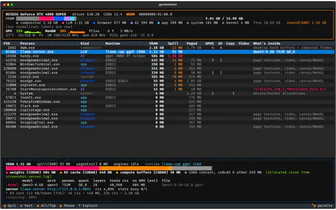
ITHome · AI Microsoft's GitHub VP open-sources GPU task manager gputaskman tool
Microsoft's Scott Hanselman, VP of GitHub, open-sources GPU monitoring tool gputaskman, displaying GPU usage rate, memory usage, temperature, and identifying LLM processes to show model details, supporting Windows, Linux, WSL, and Apple Silicon Macs.
 MarkTechPostFeaturedSame story · 2 outlets7171
Thinking Machines has released the Inkling 2 Small: a MoE model with 594B total parameters and 17B activations.
Thinking Machines Lab released the first model of the second-generation Inkling, Inkling 2 Small, a sparse MoE with 594B total parameters and 17B activation parameters, supporting text and image input and variable inference strength, with a context of 1M tokens.
- Hugging Face Daily Papers
VFlash: Fast, Accurate Visual Planning via Flash Primitive decoding
VFlash achieves fast and accurate visual planning through Flash Primitive decoding, with its lightweight renderer generating the entire primitive in a single forward pass, achieving about 25 times speedup in 3D point motion prediction tasks and reaching an average success rate of 70.2% on MolmoSpaces' four task suites.
ITHome · AISame story · 2 outlets5555 webAI's Open Source TwIL-8B Inference Model: Focused on Mathematics and Programming, Outperforms Gemma 4 31B in Long Board Performance
webAI Launches TwIL-8B Inference Model, Optimized for Math and Code Tasks Based on IBM Granite-4.2-8B, Scores Better than Gemma 4 31B in MATH-500 and AIME 2025 Tests, Best in LiveCodeBench Group, IFBench on Par with Gemma 4 12B. Model Inference Capability Reaches 88~93% of Frontier Models, Reduces AI Usage Costs but Has Limited Knowledge Base.
Same story · 2 outletsITHome · AI Taobao MNN team open-sources 0.3B mobile model MNN-Pocket-0.3B
Taobao MNN team open-sources 0.3B mobile model MNN-Pocket-0.3B, achieving 350 tokens/s on real iPhone 18 Pro offline. The model's peak memory is below 300MB, decoding throughput exceeds 200 tokens/s, INT4 deployment file is 173MB, English IFEval score is 73.20, and Chinese instruction following IFEval-zh score is 74.59.
 Codex releases00
GitHub Copilot rust-v0.169.0-alpha.1 released
GitHub Copilot rust-v0.169.0-alpha.1 has been released, this version provides code review, collaboration, and other functions.
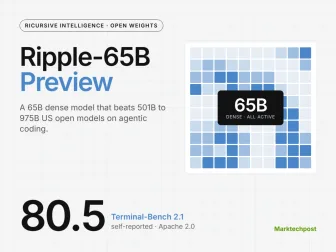
ITHome · AISame story · 4 outlets Ricursive Intelligence releases Ripple-65B Preview, stating it has the best agent programming performance in the US open weight model.
Ricursive Intelligence releases Ripple-65B Preview model, claiming it has the best agent programming performance in the US open weight model.
Same story · 4 outlets- Hacker News · 300+ · Ripple-65B Preview: US Open Source Ultra-Large Scale Model Achieves SOTA on Agentic CodingFirst
- MarkTechPost · Ricursive AI has released Ripple-65B Preview: a 65B dense open-source model that scored 80.5 on Terminal-Bench 2.1.
- The Decoder · Recursive Intelligence releases open-source model Ripple-65B Preview, which performs excellently in coding benchmarks
 OpenAI News
Cult.fit leverages Codex to improve operational efficiency
Cult.fit is using Codex to assist cross-departmental teams in building tools, accelerating workflows, and changing the way work is done.
ITHome · AI First Geekbench 7 Score of AMD Medusa Point APU: 10 Cores 20 Threads
AMD Next-Gen Mobile APU Medusa Point Scores 1560 Single-Core, 11575 Multi-Core in Lenovo Test System with Geekbench 7, Equipped with 10 Cores 20 Threads (4 Zen 6 Performance Cores + 6 Zen 6c Efficiency Cores), 16MB L3 Cache, Supports Instruction Sets like AVX-512
- Artificial Analysis ArticlesFeaturedSame story · 2 outlets7272
Thinking Machines released Inkling 2 Small, Artificial Analysis Intelligence Index score 31
Thinking Machines released Inkling 2 Small, scored 31 on the Artificial Analysis Intelligence Index v5.0.1, 18 points higher than Inkling Small, and the same as Gemini 3.8 Flash (high).
ITHome · AIFeatured7878 Ant Group's Baidu Ling-3.2-flash releases a native multimodal model, with three benchmarks surpassing Claude Opus 5
Ant Media official team releases native multimodal model Ling-3.2-flash, with a total of 560B parameters, 25B activation parameters, and 1M context window, supporting image, text, and video input.
Why it matters: The original provides three benchmark comparisons and API pricing, allowing readers to judge the capability position and call cost of this multimodal model.
- vLLM Blog
VeRL-Omni v0.3.0 released: asynchronous training and broader multimodal post-training support.
VeRL-Omni v0.3.0 released, extending asynchronous execution to more multimodal reinforcement learning workloads, setting the V1 trainer as the default option, and expanding post-training support for images, video, audio, and multimodal understanding.
ITHome · AI NVIDIA breaks through AI memory bottlenecks: HBM only increased by about 3%, with the maximum improvement in agent throughput per dollar up to 30 times.
NVIDIA proposed 'Full-Stack Co-Design' to break through AI memory bottlenecks. NVFP4 compresses model weights and KV cache, NVL72 distributes weights across 72 GPUs, Vera CPU provides buffering, Dynamo software migrates context, and RAG indices remain on the CPU and storage side.
ITHome · AISame story · 2 outlets NVIDIA measured the Vera CPU, which is 60% more agents per watt than the fastest x86 CPU.
NVIDIA announced the measured data of the Vera CPU on agent workloads, supporting 1.6 times the number of agents per watt, which is 60% more agents per watt than the fastest x86 CPU; Partners like Perplexity and DeepInfra tested showing that Vera running agent encoding tasks is 1.5 times faster than traditional CPUs, and agent orchestration tasks can be up to 2.2 times faster.
Same story · 2 outlets Ollama releases6565
Ollama supports Xiaomi MiMo V2.6 model and AutoTrust decision model
Ollama now supports Xiaomi MiMo V2.6 (9B parameter code and agent workflow model), as well as AutoTrust decision model (including 9B, 35B, and 27B-VL versions, 35B and 27B-VL can handle images)
- MarkTechPostSame story · 3 outlets6262
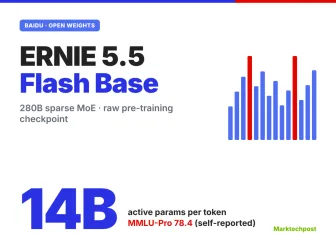
Baidu released ERNIE 5.5 Flash Base: a 280B MoE base model, activating 14B parameters per token.
Baidu released ERNIE 5.5 Flash Base, a 280B parameter sparse MoE base model, activating 14B parameters per token, supporting 128K training context and 1M inference context.
Same story · 3 outlets - Codex releases00
GitHub Copilot 0.168.0-alpha.7 released
GitHub Copilot 0.168.0-alpha.7 released, specific update content not announced.
 Browser Use
Claude Code v2.1.159 release
Claude Code v2.1.159 released, supports 8k context window, performs excellently on SWE-bench Verified; Anthropic launches Browser Use open-source library, allowing AI agents to control browsers via Chrome DevTools Protocol, providing Browser Use Cloud and Browser Use Agents services.
- NVIDIA NewsroomSame story · 2 outlets5858
NVIDIA Vera released: Balancing maximum throughput and fastest agent performance.
The NVIDIA Vera processor outperforms the fastest and most energy-efficient x86 CPUs in a 100 megawatt data center comparison, achieving industry-leading agent speed and boosting agent density by 1.6 times per watt. Early adopters like Perplexity and DeepInfra have validated 1.5x and 2.2x agent task acceleration in production testing.
- Hugging Face Daily Papers
Halley: Predictive control plane for optical AI data center networks
Halley framework enhances the effective throughput of optical networks in AI data centers through predictive failure and resource control, reducing capacity requirements, and featuring formal guarantees. It includes four components: LightReserve adjusts laser pool scale to provide coverage limits, FoldFit schedules switches within an 11/9 optimal value range, ThermaLead performs one-step advance control on micro-rings, and TriageGuard prioritizes protection for high-risk modules.
 SemiAnalysis
Google TPU Stakes Its Claim on Inference with TPUv7 Ironwood
Google TPUv7 Ironwood outperforms B200 and B300 by 50% per dollar in single inference performance on Qwen 3.5 397B FP8, and shows competitive or best results in the Multi-Model AgentX benchmark, supporting ecosystems like vLLM and SGLang, but NVIDIA reacts fiercely and accelerates R&D.
 The DecoderSame story · 3 outlets
 Apple Machine Learning Research
Apple's Amortizing Maximum Inner Product Search accelerates retrieval
Apple's Amortizing Maximum Inner Product Search, presented at ICML 2026, learns support functions by training small neural networks to understand typical query matching patterns at a fixed cost, achieving faster precise retrieval during inference. This method utilizes ICNN to learn support functions, and KeyNet directly outputs the best matching key vector, both trained on supervised datasets constructed based on actual query distributions, significantly improving retrieval efficiency in RAG scenarios.
 Databricks Blog5858
Databricks upgrades Delta Sharing to OpenSharing: Expanding the scope of AI asset sharing
Databricks and the Linux Foundation announced the upgrade of Delta Sharing to OpenSharing in June 2026, expanding the sharing scope from Delta Lake tables to include Agent skills.
 Mastra Blog
The Mastra platform has launched a latency metric tracking feature.
The Mastra platform and Studio now support tracking latency metrics for each agent and model call, with filtering and sorting of tracking, span, and threads via TTFC (First Data Block Time) and TTFT (First Token Time) to identify slow components.
- Codex releases00
GitHub Copilot rust-v0.168.0-alpha.5 released
GitHub Copilot rust-v0.168.0-alpha.5 has been released, this version provides code review, collaboration, and other functions.