Hugging Face Daily Papers6565
Live
#Image generation
- Hugging Face Daily Papers6565
- Hugging Face Daily Papers6565
Different tasks, different time steps: temporal task-aware quantization for diffusion language models T²Quant
T²Quant framework predicts accuracy sensitivity through minimal unlabeled calibration prompts, allocating activation precision within a fixed bit-width budget, improving existing quantization methods by 6.7 percentage points across 3 diffusion language models and 6 benchmark tests without increasing average accuracy budget.
- Hugging Face Daily Papers6565
RLSplat: A feedforward 3D Gaussian splatting method with linear resource budget control.
RLSplat achieves linear reduction in latency, memory, and model size for feedforward 3D Gaussian splatting by assigning Gaussians through regional allocation and using local attention decoding. In zero-shot evaluation, RLSplat outperforms previous budget-controlled methods under all budgets, surpassing the strongest baseline even with a 4x reduction in Gaussian count, and achieves a 4.1x speedup and a 9.6x reduction in peak memory at low budgets.
 The Verge · AISame story · 3 outlets7575
Canva releases its first AI image model Canva Craft, planning and designing before generation
Canva releases its first AI image model Canva Craft, planning and designing before generation; this model uses a two-stage architecture, supports 2K resolution and over 30 aspect ratios, can be used for social media and marketing content creation, and has now been launched globally.
Same story · 3 outlets- TechCrunch · AI · Design platform Canva launches its first image generation model, Canva CraftFirst
- The Decoder · Canva has released its first self-developed image model, Canva Craft.
How the accounts differ:TechCrunch states the model supports 30 aspect ratios; The Verge mentions 'over 30' aspect ratios; The Decoder specifies 30+ aspect ratios.
 TechCrunch · AISame story · 3 outlets6262
Design platform Canva launches its first image generation model, Canva Craft
Canva releases its first image generation model, Canva Craft, which works in two stages: first, it parses user prompts and creates a plan containing spatial relationships of elements, relative proportions, visual hierarchy, and text generation information; second, it generates images with the highest resolution of 2K and supports 30 different aspect ratios.
Same story · 3 outlets- The Verge · AI · Canva releases its first AI image model Canva Craft, planning and designing before generation
- The Decoder · Canva has released its first self-developed image model, Canva Craft.
How the accounts differ:TechCrunch states the model supports 30 aspect ratios; The Verge mentions 'over 30' aspect ratios; The Decoder specifies 30+ aspect ratios.
 Hugging Face Blog
Hugging Face releases OlmoEarth v1.3: Global satellite embedding model achieves new milestones
Hugging Face releases OlmoEarth v1.3, a satellite embedding model, offering global pre-computed embeddings (10m resolution, 64 and 128 dimensions), available to users without login or technical knowledge. The model performs best in 27 evaluations, with 128-dimensional embeddings scoring highest in 20 evaluations and 64-dimensional embeddings leading in 18. Training costs are reduced by 53% compared to v1.2 and 18% compared to v1, with corresponding reductions in carbon emissions. Weights, data, and code are all open source.


- Hugging Face Daily Papers6565
Future Chunk Prediction (FCP) enhances the physical plausibility of autoregressive video generation.
Future Chunk Prediction (FCP) improves autoregressive video diffusion models by introducing future chunk supervision, generating videos that better adhere to physical laws and reducing training costs. This method, under the teacher forcing framework, predicts temporally separated video chunks without relying on intermediate visual context, directly utilizing training videos for supervision, requiring no additional pre-trained visual encoder, and not altering autoregressive inference.
 NVIDIA Newsroom
European transportation leaders are building safe vehicles and autonomous taxi fleets based on NVIDIA Hyperion
European transportation leaders Bolt with Lucid, Mercedes-Benz, Volkswagen Commercial Vehicles, and Einride are showcasing autonomous traffic applications on the NVIDIA Hyperion computing platform, demonstrating potential applications for Level 3 and Level 4 vehicles and future autonomous taxi fleets.
- NVIDIA Newsroom
NVIDIA has launched the Agile ONE SN humanoid robot reference platform and new features of the Isaac platform to accelerate general robot development.
Agile Robots has released the Agile ONE SN humanoid robot reference platform, equipped with NVIDIA Isaac GR00T and Jetson Thor, plans to integrate the NVIDIA Halos safety system, providing developers with a complete humanoid robot development and validation platform.
 PyTorch Blog3030
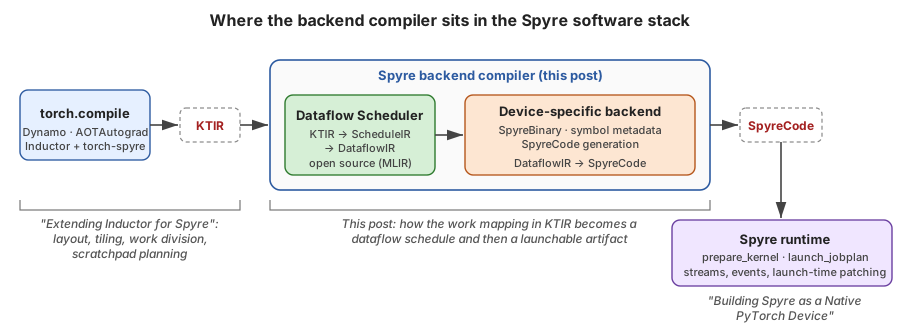
From KTIR to SpyreCode: Developing MLIR Dataflow Backend for IBM Spyre
Torch-spyre's Inductor determines how each kernel's work is allocated on Spyre's core and manages the residency of tensors between on-chip Scratchpad and off-chip memory, and the backend compiler translates these decisions into instructions that hardware can actually run.
 MarkTechPost
Nsight Python Tutorial: How to analyze GPU kernel performance
Use Nsight Python (NVIDIA's open-source Python interface) to analyze GPU kernel performance, mark code with `nsight.annotate`, decorate functions with `nsight.analyze.kernel` to obtain a DataFrame of hardware metrics for each code segment.
- Hugging Face Daily Papers6565
Can SpatialScout's VLM agents proactively explore and map 3D scenes?
SpatialScout evaluated the performance of VLM agents in active 3D object mapping, revealing significant flaws in their precision metric map construction. Claude Opus 5.5 scored an average overlap of 41.71% in this benchmark test, with 47.23% of target IoU below 0.5 and only 3.25% exceeding 0.9, showing a significant gap between recovering rough layouts and building complete, precise metric maps.
- PyTorch Blog
FlyDSL accelerates AMD MI350 series GPU computing through existing PyTorch API
PyTorch users can accelerate dense and grouped GEMM, fused multi-head attention, MXFP8/MXFP4 scaled GEMM, RMSNorm, and TopK on AMD MI350 series GPUs using FlyDSL with existing operator API without calling custom kernels
 Google Research
 releases AI-assisted ultrasound technology to empower maternal care in primary healthcare settings
Google Research's AI model is validated on JAMA Network Open for its accuracy in assessing gestational age using blind ultrasound scanning technology
- Hugging Face Blog
Hugging Face introduces system-level performance analysis of TorchNeuron on AWS Trainium
Hugging Face introduced how to use TorchNeuron for system-level inference performance analysis on AWS Trainium, capturing clean traces with torch.profiler configured for the Neuron backend, and using key_averages() to identify time-consuming operations.





 AWS Machine Learning Blog5858
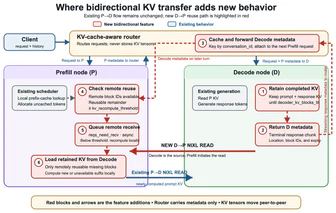
vLLM enhances the TTFT performance of multi-round agent workloads through bidirectional KV transmission.
vLLM's bidirectional KV transmission mechanism reduces redundant calculations by allowing the decoding node to return previously computed KV cache to the pre-filled node in subsequent dialogue turns. In multi-round benchmark tests on AWS EC2 P5en instances, it improved the TTFT of Qwen3-32B by 1.6x and zai-org/GLM-5-FP8 by 3.3x. This feature is implemented by extending the NIXL KV connector and utilizing a KV cache-aware router to coordinate KV reuse across dialogue turns.
- AWS Machine Learning Blog4949
vLLM launches a push-based KV transmission to improve the TTFT and TPOT of distributed inference.
vLLM introduces a push-based NIXL connector, by moving post-pre-filled transmission coordination and setup out of the critical path, reducing time to the first token (TTFT) and time per output token (TPOT), enhancing application responsiveness.
- AWS Machine Learning Blog3434
Building an AI agent semantic layer on AWS using Strategy Mosaic and Amazon Bedrock AgentCore.
Strategy Mosaic, as a semantic layer, models C360 domains on Amazon Redshift and Amazon Aurora without ETL using two linked models. Its metric syntax captures the business definition of agent reasoning and exposes the model to AgentCore-hosted Strands agents via the Mosaic MCP server, supporting user identity propagation to achieve end-to-end row-level and object-level security.
- AWS Machine Learning Blog2828
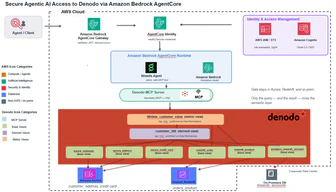
Building an AI intelligent semantic layer using Denodo and Amazon Bedrock AgentCore on AWS
Denodo platform builds a semantic layer on AWS, providing controlled enterprise data access for Amazon Bedrock AgentCore, supporting federated queries across Amazon Aurora, Amazon Redshift, and local PostgreSQL databases.
- AWS Machine Learning Blog3939
i14 on how to use native PyTorch to train and deploy Laplace 3B linear attention model on AWS Trainium2.
i14 deploys its 24-layer decoder Laplace 3B (3,072D parameters, using Gated Linear Attention architecture) to AWS Trainium2, achieving a training speed of 120,000 tokens per second and concurrent inference capability for 11,544 output tokens.
 MIT Technology Review · AI5858
Goodfire researcher Nick Cammarata releases disruptive blog: The nature of neural networks might be easier to understand than previously thought
Goodfire researcher Nick Cammarata published a blog post stating that LLMs might be easier to understand than previously thought, causing shockwaves in the AI world. Cammarata believes that the mechanisms of neural networks may not be as difficult to decipher as previously thought, a view that is particularly noteworthy against the backdrop of frequent LLM proxy out-of-control incidents.
 The Decoder7373
Kling AI released version 4.0, supporting stereo audio, multi-language lip sync, and lightweight Flash variants.
Kling AI released video generator Kling 4.0, supporting stereoscopic audio, multi-language lip synchronization, and lightweight Flash variants, capable of generating 30-second videos in a single instance and accepting up to 10 key frame images input, Prompt understanding ability increased to 8,000 tokens.
- The Verge · AI7070
Adobe Lightroom mobile fixes photo eye-blink issues with a single AI tap
Adobe Lightroom mobile app has added AI features, allowing users to fix closed eyes in photos with a single click. This feature uses generative AI to intelligently replace closed eyes with open ones, referencing other images in the user's Lightroom library to ensure the matching of eye color, size, and shape. Free users can use this feature twice for free, after which they will be prompted to subscribe to the Adobe Creative Cloud plan.
 vLLM Blog
Ant Group and the vLLM community open-source Humming: A general-purpose high-performance quantized inference kernel library
Ant Group and the vLLM community open-source Humming, a high-performance quantized inference kernel library. Humming supports NVIDIA GPUs starting from the Turing architecture and CUDA-compatible devices like the T-Head Zhenwu 810E, providing extensive quantization support covering various integer and floating-point types, bit widths, and scaling schemes. It significantly outperforms existing implementations such as vLLM Marlin, FlashInfer, and DeepGEMM on multiple representative workloads.
 Apple Machine Learning Research
TEAL: A pixel-level efficient active learning framework based on ViT
TEAL has for the first time efficiently applied active learning to the token space of ViT for low-budget pixel-level semantic segmentation, boosting mIoU by +24.36 on datasets like CamVid and Cityscapes with only one pixel labeled per image, and achieving full-supervised performance of 97% with 10 pixels labeled.
Hacker News · AI hot posts5858 Claude Code v2.1.159 release
Claude Code v2.1.159 released, supports 8k context length, generates pixel art, realistic backgrounds, and posters through Python calls, but it is difficult to avoid AI features.
 a16z News7070
OpenAI has acquired Orchestra Bio, but hardware design remains a challenge for AI.
OpenAI has acquired Orchestra Bio. Current cutting-edge models like GPT-6 Astra, Fable 5.1, and Grok 4.6 can generate CAD, design PCBs, and describe assembly, but hardware design benchmarks like CAD Arena, EE Bench, and LuxoBench show that improvements are still needed. AI in hardware design faces the lossy problem of the interface between the digital and physical worlds, even if it can generate designs, a lot of work is still required.







 Google Developers Blog
Arm used Google AI Edge Model Explorer to add visual graph debugging features to custom edge compilers.
Arm leveraged the hierarchical graph visualization and plugin architecture of Google AI Edge Model Explorer to develop open-source adapters supporting formats such as TOSA, VGF, and PTE, helping developers more easily inspect edge model conversion processes.
 Browser Use
How does Browser Harness allow Claude Code and similar tools to execute tasks through a real Chrome browser?
Browser Harness achieves a score of 60.4 in matching evaluation using 2.1M median input tokens, matching Playwright MCP and Chrome DevTools MCP, becoming the browser control tool with the lowest cost per task at $0.042. Playwright MCP and Chrome DevTools MCP are faster but use more tokens.
- Hugging Face Blog
Hugging Face launches TorchTPU: Native PyTorch backend support for TPU
Hugging Face has released TorchTPU, making TPU a native backend device for PyTorch. Transformers, Diffusers, and Kernels can now run directly on TPU. Users only need to select a model from the Hugging Face Hub and specify device_map="tpu".
 MIT News · AI7070
Teaching AI to recognize symmetry could enhance the reliability of prenatal diagnosis.
The E(3)-Pose deep learning model developed by institutions such as MIT embeds the principle of left-right symmetry of the fetal head, allowing it to capture high-resolution images during motion in prenatal MRI scans, assisting doctors in more reliably diagnosing brain abnormalities. The model integrates physical principles into the neural network architecture, effectively addressing the issue of inconsistent slice angles and coverage gaps in images caused by fetal movement. Its application could potentially be extended to other difficult-to-image anatomical structures and the field of autonomous driving, and it is currently being optimized to support imaging of early fetuses (second trimester).


- Tencent Hunyuan · Hugging Face new models
Tencent releases Hy-Memory-30B-A3B-GGUF model quantization file
The Hy-Memory-30B-A3B-GGUF model quantization file released by Tencent's Huayan uses a hybrid precision quantization scheme with imatrix calibration and MoE perception, achieving efficient local inference on llama.cpp, where the ~8 GB expert-mixed build file size is reduced to about 24.71 GB, with performance only 1.53% lower than Q6_K.
- vLLM Blog
How vLLM achieves elastic expert parallel near-zero downtime scaling
vLLM achieves a downtime reduction of DeepSeek V4 Pro from 16GB200 to 20GB200 to 0.82 seconds and from 20GB200 back to 16GB200 to 1.96 seconds through asynchronous preparation and NIXL EP technology.
 Inception Labs Blog
Mercury 2 for Search: Fast enough to run a hundred times per query.
Mercury 2 decodes over 1000 tokens per second on standard NVIDIA GPUs, nearly 2 times faster than Gemini 3.1 Flash Lite in the query planning stage, 4.7 times faster than Claude Haiku 4.5, and 10 times faster than GPT-5 Mini. Each query step is faster than other models, allowing it to complete every step of the search process within the existing latency budget.
- MIT News · AI7575
MIT researchers develop multimodal AI model to provide 'clear' view for materials science
The multimodal AI model developed by MIT researchers combines 3D atomic structures with natural language descriptions, generating rich structural language descriptions from experimental research papers and first-principles calculation databases, helping AI learn the key properties of materials. The model outperforms text-only models in identifying solid-state lithium-ion battery electrolyte materials and can learn geometric structure representations, providing new research tools for materials science.
- Google Research
Google Research explores combining AI agents with biological reality to build autonomous wet labs.
Google Research releases the VERID framework, enabling AI agents to run in physics-based, safe, and resource-efficient experiments; demonstrates closed-loop intelligent agent scientific discovery on adapter and de novo protein design prototypes; through three rounds of design-test-iterate cycles, AI-driven rational and de novo design will increase confirmed target hit rates to 33.5% and 42.1% on myoglobin and α-thrombin, respectively.
- vLLM Blog
vLLM optimizes Kimi K3: Fast and responsible model tuning practices
vLLM has built a unified CuTe DSL decoding path for Kimi K3 through intelligent agent-assisted development, achieving a batch 1 performance of 840 tokens/s on 16 NVIDIA GB300 GPUs, with a 1.5-2x increase in decoding throughput in the test configuration, and a 1.8x increase in AgentX workload P90 interactivity.
 Comfy Blog7575
Krea 3 is now officially available through Partner Nodes
Krea 3 is now officially available in ComfyUI through Partner Nodes, a model designed for reference-based image generation and editing, supporting iterative changes through descriptions and fixed elements, aiming to speed up the process while maintaining image quality and reducing costs, allowing multiple edits to be included in a single session.
- Comfy Blog
Black Forest Labs releases FLUX 3 Image Klein open-source model
Black Forest Labs releases open-source FLUX 3 Image Klein model with 5.6B parameters, outperforming Qwen-Image 2.1 on text-to-image and multi-reference generation tasks, supporting both Base and Distilled versions, with the latter offering 4.3-9.3 times speed improvement, suitable for consumer-grade GPUs.