Skip to content
Live
Nov 4Wed
  1. Hugging Face Daily Papers65

    CrossSWE: Benchmark for testing large language models in cross-repository collaborative development

    CrossSWE benchmark tests the cross-repository consistency of large language models in cross-repository collaborative software development, including 171 instances, covering 165 repositories, 20 technical fields, and 13 programming languages. The evaluation shows that the strongest GPT-6.1 Sol only achieves 58.48% Pass@1, with cross-repository inconsistency being the main failure mode.


  2. The Decoder74

    OpenAI claims GPT-6 Astra designed a hardware device from scratch in less than a week.

    OpenAI states its hardware team used GPT-6 Astra to design a device that can communicate with Codex encoding agents as a side project, completed in less than a week. Astra handled all aspects including casing design, PCB layout with component selection and routing, firmware, and user interface. Contract manufacturers produced small batches of prototypes in less than a month, but due to Astra not always considering manufacturing constraints, tolerances, and assembly details, several rounds of modifications were required.

    Why it matters: OpenAI reveals the end-to-end hardware design process for GPT-6 Astra, also pointing out its shortcomings in manufacturing constraints.

Nov 3Tue
  1. Hugging Face Daily Papers65

    SWE-Trail: A Historical Guidance Trajectory Collection Method for Coding Agent Training

    SWE-Trail leverages past execution trajectories to guide subsequent exploration without exposing historical information to coding agents, thereby enhancing the trajectory collection effectiveness for coding agent training. This method improves the average problem-solving rate by 2.33 and 1.60 percentage points on SWE-bench Multilingual and SWE-bench Pro, respectively, using a student model with 124B parameters.

  2. MarkTechPost

    Zyphra AI introduces Zyphra Hierarchical Attention (ZHA): The path to true sub-quadratic attention

    Zyphra AI has released Zyphra Hierarchical Attention (ZHA), a sparse attention method based on a tree indexer, designed to address the known issue in sparse attention where the indexer still needs to scan the entire context. ZHA can be distilled into a frozen pre-trained model of about 4B tokens, achieving performance close to dense attention in inference, smart encoding, and 256K retrieval benchmarks on Qwen3.6-35B-A3B.

  3. MarkTechPost

    The Letter Company has released Letterpress-1: an encoding agent designed for growth engineering

    The Letter Company releases Letterpress-1, an encoding intelligent agent that generates code changes and submits Pull Requests by reading websites and their market data. The agent runs on Letter's hosted platform, requiring no local GPU, and each change must be confirmed and previewed by the user before deployment. The basic plan is priced at $100/month, including 10,000 tokens, with overages charged at 5 times the list price.

  4. Hugging Face Daily Papers34

    OSWAM: An efficient single-step action generation world action model

    OSWAM achieves real-time high-quality action generation in autonomous driving and embodied control by using structured imagination tokens to initialize the diffusion process and distilling future condition privileged information into a single denoising step. The model generates high-quality actions with just one diffusion step, about 3 times faster than direct strategy world action models (WAM) that require dozens of denoising steps, achieving low latency of up to 40ms on an NVIDIA RTX 5090 GPU, supporting real-time compiled inference.

Nov 2Mon
  1. Hugging Face Daily Papers65

    HiFOR: A hierarchical predictive framework for visual language action models

    HiFOR guides action generation by hierarchically predicting future states and retrieving relevant future information, enhancing robotic manipulation capabilities. The framework jointly predicts short-term state evolution, semantic milestones, and final goal states through hierarchical dependency masks (HDM), establishing cross-temporal dependency relationships; structured perception latent world modeling organizes future potential representations along temporal, perspective, and spatial dimensions, promoting fine-grained retrieval; action-guided decomposition world retrieval adaptively retrieves relevant future information based on action representations during the denoising process, providing targeted guidance for action generation.

  2. ITHome · AI72

    Meituan LongCat releases LongCat-2.5 native multimodal model, 1.6T parameters targeted at long-range intelligent agent tasks

    Meituan Longma has released the native multimodal model LongCat-2.5 for long-range intelligent agent tasks, with a total parameter count of 1.6 trillion, activating about 48 billion parameters per token, enhancing native visual understanding and intelligent agent programming capabilities based on LongCat-2.0.

    Same story — showing the featured version《》

Nov 1Sun
Oct 31Sat
  1. Hugging Face Daily Papers45

    Co-Design Bench: Multimodal Collaborative Coding Evaluation Benchmark for Agent Models

    The Co-Design Bench benchmark includes 273 tasks and 2,331 acceptance criteria written by experts, derived from 26,314 real user coding sessions. On 10 model endpoints, gpt-6-astra averages 69.9% passing the criteria for each task, but only 26.4% of tasks are fully satisfied; Qwen3.8-27B has an overall strict completion rate of 64.4% and ranks second in the repository editing subset.

  2. MarkTechPost71

    Factory has released the Droid 1.0 encoding intelligent agent framework, with programmatic tool calls enabled by default.

    Factory has released Droid 1.0, which is the largest update to its Droid intelligent agent framework to date. The core change is that programmatic tool calls are enabled by default, and the model is changed to write JavaScript programs to run tools in a sandbox. One model request can drive hundreds of tool calls.

    Same story · 2 outlets

    How the accounts differ:Factory News states the model can execute hundreds of tool calls in one request; MarkTechPost mentions the model request drives hundreds of tool calls.

  3. MarkTechPost71

    Microsoft and UC Berkeley release TokenEconomizer plugin, coding agent costs reduced by up to 30.9%

    Microsoft Research and UC Berkeley's research team released the open-source cost controller TokenEconomizer, which can reduce the cost of encoding agents without changing model weights and agent code.

    Why it matters: The original text provides the cost reduction of the plugin on 277 SWE-Bench tasks and the change in Pass@1, which can be used to judge its impact on the coding agent workflow.

Oct 30Fri
  1. Hugging Face Daily Papers42

    WorkFactory: Transforming Professional Intent into Executable Tasks through Information Planning and Repair to Achieve Scalable Agent Training

    WorkFactory builds coherent professional tasks through information planning and repair, producing the WorkPilot model, enhancing expert-level agent performance in professional work benchmarks. The framework starts from professional intent, constructs information support graphs to guide task instantiation, and identifies support failures and guides repairs through execution detection while preserving expected work.

  2. Hugging Face Daily Papers52

    WeVisCut: An integrated smart editing agent from narration to long videos

    WeVisCut coordinates video editing tools, recovers from failures, and reduces token usage through a compact strategy trained on 9B parameters, while maintaining output quality. The system employs a four-stage data pipeline, combining editing inversion and validation replay, to generate over 130K training examples from 3,750 finished videos for training a single strategy.

  3. OpenHands Blog38

    How to set up an AI code review agent with OpenHands

    OpenHands Agent Canvas can set up an AI code review agent within minutes, automatically reviewing GitHub pull requests and adhering to coding standards. The agent uses OpenHands's `code-review` skill to prioritize identifying logic errors, security vulnerabilities, performance regressions, and missing use cases that affect production, avoiding minor formatting issues, and directly publishing feedback containing issues, severity, and suggested fixes in GitHub PRs.

  4. Factory News78

    Factory releases Droid 1.0: an intelligent agent harness for enterprise development

    Factory releases Droid 1.0, a major update to its intelligent agent harness, with programmatic tool calling enabled by default (Script mode). The model can execute hundreds of tool calls within a single request in a sandbox, executing JavaScript.

    Same story · 2 outlets

    How the accounts differ:Factory News states the model can execute hundreds of tool calls in one request; MarkTechPost mentions the model request drives hundreds of tool calls.

    Why it matters: The original text provides cost and time data for Droid 1.0 compared to Codex, Claude Code, and other harnesses on Terminal-Bench 4, which can be used to determine the selection of agent harnesses.

  5. Meta Engineering66

    Meta rolls out JiTTesting to production: Use LLM to generate tests and catch bugs before code merge

    Meta announced that Catching JiTTests has been put into internal production, using LLM to automatically generate executable tests for diffs to be merged, exposing behavioral differences before the code is landed

    Why it matters: Meta has disclosed the production deployment details and quantitative results of JiTTests, available for evaluating the implementation of LLM-generated tests in ultra-large-scale codebases.

Oct 29Thu
  1. Mistral AI82

    Mistral releases open-source model Mistral Large 4 (Le Chonk) with trillion parameters

    Mistral releases open-weight version of its flagship trillion-parameter native multimodal model Mistral Large 4 (Le Chonk), which has been in public preview for three weeks.

    Why it matters: The official provides data on the encoding, security, and inference efficiency of the trillion-parameter open-source model, as well as weight downloads and self-hosting paths.

  2. Hugging Face Daily Papers65

    Sensorimotor Alignment: A Successful Embodied Agent Metric Based on Sensorimotor Alignment

    The Sensorimotor Alignment (S²) metric finds that the alignment degree between vision and motor representations of embodied agents is positively correlated with task success rates, verifying the applicability of the Platonic representation hypothesis in the robotics field. In simulation and real robot tests, models with high S² (such as Vision-Language-Action and World Action Models) perform better and can explain the phenomenon where the VLA model ignores instructions and relies on visual features, serving as a low-cost offline proxy metric.

  3. QbitAI

    MolCell MMDesign achieves breakthrough progress in the AI pharmaceutical field

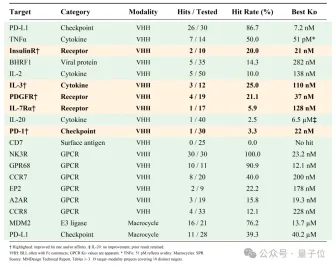
    MolCell AI's MMDesign platform completes 18 design projects with a success rate of 94.7%, hitting all six GPCR targets among them, with the best affinity reaching nanomolar level; the platform uses a 'generate-screen-verify' workflow, generating tens of thousands of candidate molecules in computational space and testing only 9-50 to achieve success, with an overall candidate hit rate of 30.7%, demonstrating efficient and precise molecular design capabilities.

  4. ByteDance Seed · Hugging Face new models

    ByteDance-Seed/GenFirst releases: A generative pre-reconstruction method for stable end-to-end latent generation modeling

    ByteDance-Seed/GenFirst trains a latent VAE and combines it with a generative prior to avoid latent collapse, which usually makes end-to-end training unstable. The two-stage plan of this method is used for prior and entropy weights: the first stage lets the prior shape the latent geometry, and the second stage reduces both weights tenfold, allowing the decoder to recover details.

  5. ITHome · AI85

    Google has released Gemini 4 Carbon, focusing on cybersecurity and topping the Artificial Analysis Intelligence Index.

    Google has officially released the next-generation cutting-edge large model Gemini 4 Carbon, featuring top-tier cybersecurity capabilities and long-range task processing, ranking first with a score of 59 in the Artificial Analysis Intelligence Index v5.0.

  6. MarkTechPost80

    Google DeepMind released Gemini 4 Carbon, emphasizing network security defense and coding.

    Google DeepMind has launched Gemini 4 Carbon, describing it as a cutting-edge model for long-period intelligent agent coding and cybersecurity defense, ranking first with 59 points on the Artificial Analysis Intelligence Index v5.0.