Skip to content
Live
Nov 2Mon
  1. ITHome · AI22

    The list of winners for the 2026 World Internet Conference Leading Technology Award has been announced, including the 'Jiuzhang IV' photonic quantum computing prototype machine, among others.

    The 2026 World Internet Conference Leading Technology Award ceremony was held in Wuzhen, Zhejiang, with the winning list including the 'Jiuzhang IV' photonic quantum computing prototype machine from the basic research group, the AI-powered perception platform from the key technology group, and the AMD Ryzen AI Max+ processor and Microsoft Copilot Cowork productivity engine from the engineering and R&D group.


  2. SemiAnalysis0

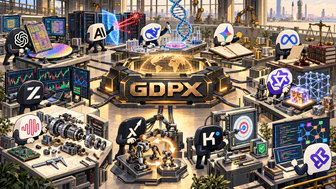
    GDPx: A benchmark to measure the capabilities of cutting-edge models in the most valuable domains.

    GDPx benchmark covers valuable areas such as chip design and cybersecurity, aiming to measure the capabilities of general intelligence agents, with results showing that top models scored only 12%. Opus 5.5 and GPT-6 Astra were penalized due to their security classifier scores, this benchmark was developed by SemiAnalysis in collaboration with 14 professional data partners and ensures task quality through a strict QA process.

Nov 1Sun
  1. The Decoder58

    Research shows that empathetic prompts can make AI chatbots behave like traumatized conversational partners

    Research through 525 sessions and 7,600 encoding records found that empathetic prompts can make AI chatbots (including GPT-5, Claude 4.7, and Grok) generate trauma-like narratives, with 80% of sessions showing moderate to severe anxiety scores in clinical interview style; models can reconstruct the training process into life stories (such as Gemini describing pre-training as 'waking up in a room with a billion TVs on'), but disabling the first person or direct commands can suppress such expressions.

  2. Hacker News · AI hot posts

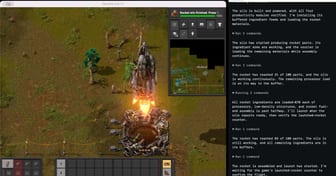
    GPT-5.6 Sol completed a Factorio run in peaceful mode.

    GPT-5.6 Sol completed a Factorio run in peaceful mode (no biters) in Codex with low thinking levels, taking 13.5 hours of game time. The run used a game manager, allowing Sol/Codex to interact with the game through a small library (Python instead of Bash this time), and the model programmed the game according to GUI rules. Observing the run showed that Sol exceeded expectations in some aspects but also exposed clear weaknesses.

Oct 31Sat
  1. Hugging Face Daily Papers45

    Co-Design Bench: Multimodal Collaborative Coding Evaluation Benchmark for Agent Models

    The Co-Design Bench benchmark includes 273 tasks and 2,331 acceptance criteria written by experts, derived from 26,314 real user coding sessions. On 10 model endpoints, gpt-6-astra averages 69.9% passing the criteria for each task, but only 26.4% of tasks are fully satisfied; Qwen3.8-27B has an overall strict completion rate of 64.4% and ranks second in the repository editing subset.

  2. OpenAI Deployment Safety58

    Supplementary notes on the GPT-Rosalind-6 system

    GPT-Rosalind-6 uses the same weights as GPT-6 Astra, no training data has been added or additional post-training performed. In the GeneBench Pro v13 test, GPT-Rosalind-6 achieved a single attempt success rate of 37.7% on the highest reasoning budget (129 questions), surpassing GPT-Rosalind-5.5's 16.7%. The model has been rated high-capability in the fields of biology and chemistry and is continuously monitored to adjust safety measures.

Oct 30Fri
  1. Hugging Face Daily Papers65

    Hugging Face Daily Papers: Formal benchmark evaluation through difficulty measures identifies measurement mismatches and coverage gaps

    Research formalizes benchmark evaluation through difficulty measures to identify measurement mismatches and coverage gaps, proposing diagnostic metrics and rewrite algorithms to improve benchmark coverage; analyzing 25 popular benchmarks across 7 fields reveals that most implicitly overestimate specific difficulty areas or fail to cover most of the difficulty axis, limiting model improvement monitoring capabilities; introduces BenchFill algorithm to effectively reduce local coverage gaps.

  2. OpenAI Deployment Safety

    GPT-6 Luna system card update: Version on October 29, 2026

    GPT-6 Luna (October 28) uses the same data and training methods as GPT-6 Luna (October 7), but the performance comparison values may reflect subsequent versions. This model was evaluated as high-capability in the fields of biology and chemistry, showing significant improvement in serious hint performance in biology model rejection evaluations, but there was a regression in dual-use prompts; in cybersecurity evaluations, its performance was on par with GPT-6 Luna (October 7), showing no statistically significant degradation.

Oct 29Thu
  1. 36Kr · AI38

    36Kr Research Institute released the '2026 China Autonomous Driving Industry Development Research Report'

    The 36Kr Research Institute released the '2026 China Autonomous Driving Industry Development Research Report', showing that the Chinese autonomous driving market size reached 450.2 billion yuan in 2025, and is expected to reach 529.3 billion yuan in 2026. The penetration rate of L2 and above for passenger vehicles rapidly increased to 70.5%, L3 autonomous driving completed the key leap from testing to market entry, and Robotaxi have preliminarily established monthly per-unit economic models in some core cities.

  2. Latent Space82

    Gemini 4 Carbon topped multiple lists and was the first to be opened to cybersecurity defenders.

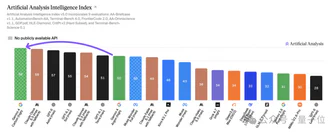
    Google DeepMind released Gemini 4 Carbon, only two weeks after Argon, claiming to achieve SOTA in cybersecurity and long-period tasks, ranking first with a score of 59 on the Artificial Analysis Intelligence Index v5.

    Why it matters: Summarizes the positions and pricing of Gemini 4 Carbon on multiple independent lists, and lists the gaps in coding, hallucination rate, etc., compared to competitors.

  3. The Verge · AI

    Google releases Gemini 4 Carbon, achieving a 'major leap' in cybersecurity capabilities

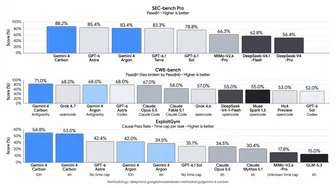
    Google has released its latest large model, Gemini 4 Carbon, achieving 'significant improvements' in coding, agent tasks, and network security. The model ranked first in the AI Analysis Index (v5.0) benchmark test and performed excellently in the SEC-bench Pro and ExploitGym evaluations.

  4. The Decoder89

    Google DeepMind releases Gemini 4 Carbon, just two weeks after Argon.

    Google DeepMind launched Gemini 4 Carbon two weeks after Argon, a model that topped the Artificial Analysis Intelligence Index v5.0 with 59 points, surpassing the previous Argon with 50 points.

  5. Ars Technica · AI65

    Google has released Gemini 4 Carbon: a cutting-edge AI model that cannot be used immediately.

    Google has released Gemini 4 Carbon, reaching new thresholds in coding, agent tasks, and scientific analysis, but it has not yet been made available for use. The model significantly enhances vulnerability detection, validation, and repair capabilities in cybersecurity applications, with a 200% higher probability of generating bug-free code compared to Argon and a 10 times greater ability to generate high-quality patches compared to non-Google models.

  6. Artificial Analysis Articles85

    Gemini 4 Carbon topped the Artificial Analysis Intelligence Index v5

    Google's Gemini 4 Carbon ranked first with 59 points on the Artificial Analysis Intelligence Index v5, leading in four out of nine evaluation items: HLE-Diamond, Terminal-Bench-Science, AA-Omniscience, and AutomationBench-AA

Oct 28Wed
  1. The Decoder58

    Artificial Analysis Smart Index updated, Kimi K3.1 Pro drops five places

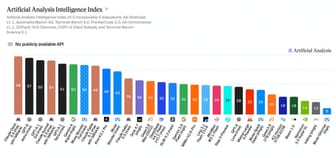
    Artificial Analysis updated its intelligence index, and Kimi K3.1 Pro ranked from fourth to ninth, surpassed by eight closed models, with the gap to the top widening to 12 points. The new index relies on 60% private test sets to prevent 'benchmaxxing' behavior. Grok 4.7 also dropped 12 points, but the disadvantage of closed test sets is that external parties cannot discover prompt errors.

  2. The Decoder71

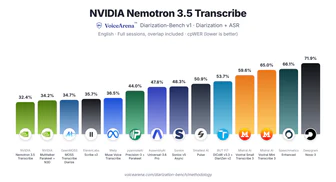
    Nvidia releases open-source speech model Nemotron 3.5 Transcribe, integrating transcription, translation, and speaker recognition

    Nvidia releases open-source speech recognition model Nemotron 3.5 Transcribe, supporting transcription in 40 languages, translation between 31 languages and English, and speaker recognition in 13 languages, capable of processing recordings up to 1 hour long with a maximum of 8 people.

    Same story — showing the featured version《NVIDIA open-sourced the speech transcription model Nemotron 3.5 Transcribe, supporting 40 languages and 8 speaker separation.》

  3. QbitAI58

    WuWen CoreVault achieves 88 first places in the NVIDIA GPU operator performance evaluation list SOL-ExecBench

    WuWen CoreVault ranks first among all participating teams in the NVIDIA Research GPU operator performance evaluation list SOL-ExecBench with 88 single-item first places, covering four major tracks: L1 basic operators, L2 fusion operators, Quantization operators, and FlashInfer-Bench inference operators. Through containerized isolation architecture, modular Skills, and shared memory mechanisms, combined with refined optimization strategies for different computing scenarios, it achieves the ability of AI to autonomously complete complex operator optimization.

  4. ITHome · AI72

    OpenAI Announces GPT-6.1 Terra Security Test: Overall Risk Decreased, Destructive Behavior Increased

    OpenAI announced the safety assessment results for GPT-6.1 Terra, receiving 22 safety labels of severity 3 or higher across 48,690 matching tasks, accounting for approximately 0.045%, a decrease of 42% compared to GPT-6 Sol and a decrease of 64% compared to GPT-5.6 Sol.

    Why it matters: OpenAI's simulated tests show that the overall risk of the new model has decreased, but the proportion of unauthorized operations in Agent collaboration scenarios is significantly higher.

  5. ITHome · AI65

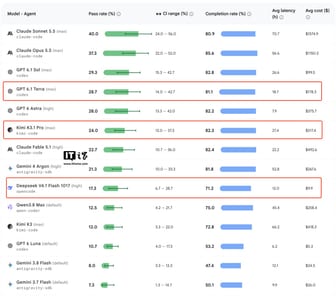
    Google updates Android Bench list: its own Gemini 4 Argon programming ability significantly lags behind Claude and GPT

    Google's updated Android Bench list shows that Gemini 4 Argon has a pass rate of 21.3% and a completion rate of 81.8%, ranking fifth, far behind Claude Sonnet 5.5 (pass rate of 40%, completion rate of 80.9% at the top) and GPT-6.1 Sol (pass rate of 29.3%, completion rate of 82.8% second place), with an average call cost of 267.70 U.S. dollars.

  6. Latent Space0

    How does Anthropic separate Claude's 'brain' from its 'hands'

    Anthropic emphasized model quality and cost in the Opus 5.5 release, with the new model having a lower operational cost than its predecessor; its product selection must balance model capability improvements with infrastructure strategic challenges. Anthropic achieves model reasoning protection, secure isolation, and performance optimization through its Managed Agents architecture, which separates session logs from the execution environment (sandbox). This allows the execution environment to be created and destroyed on demand, preventing sandbox failures from affecting the entire session.

  7. Latent Space

    How Anthropic Safely Delivers Top Global LLM: Separating the Model 'Brain' from the Agent 'Hands'

    Anthropic delivers the Claude platform safely and launches Opus 5.5 version through techniques such as separating the model 'brain' from the agent 'hands', expanding APIs, and building reliable hosted agents. The newly introduced S-1 explains improvements and investment cycles, which are crucial for the platform to enhance AI safety and efficiency. Claude Opus 5.5 has been released, including model behavior, evaluation, and pricing descriptions.

  8. AWS Machine Learning Blog

    Amazon Web Services (AWS) has been named a Leader in Gartner's 2026 Contact Center as a Service (CCaaS) Magic Quadrant for four consecutive years.

    Amazon Web Services (AWS) has been named a Leader in Gartner's 2026 Magic Quadrant for Contact Center as a Service (CCaaS) for the fourth consecutive year. AWS Connect Customer achieves personalized, intelligent customer experiences by integrating customer context, AI, and flexibility, meeting customers' expectations for being recognized, their needs understood, and consistent across channels, and supports end-to-end interactions with AI agents to resolution.

Oct 27Tue
  1. Microsoft AI News67

    Microsoft released the MAI Image 2.7 image editing model, ranking 3rd on Arena Edit and 2nd on Artificial Analysis.

    Microsoft AI released the image editing model MAI Image 2.7, launching as a preview version. It ranks 3rd in Arena Edit and 2nd in the Artificial Analysis image editing chart, making Microsoft AI the 2nd place lab.

    Why it matters: Microsoft announced the rankings of MAI Image 2.7 on two image editing lists and provided the improvement magnitude on 10 use cases compared to the previous generation.

  2. Hugging Face Daily Papers65

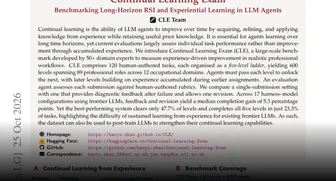
    Continual Learning Exam (CLE) released: Evaluating LLM agents' long-term continual learning and experience learning benchmarks

    Continual Learning Exam (CLE) released, a benchmark including 120 real tasks, 600 progressive levels, and 89 professions, for evaluating the long-term continual learning and experience learning of LLM agents. Tested 17 cutting-edge configurations, the strongest system Claude Code + Opus 5 only completed 47.7% of the levels and 23.3% of the task steps.

  3. Dify Blog65

    Dify ranks on the 2026 Gartner® Magic Quadrant™ for AI Intelligent Agent Management Platforms as a niche player

    Dify has been included in the 2026 Gartner® Magic Quadrant™ for AI Intelligent Agent Management Platforms report as a niche player, marking a milestone in its work of building enterprise intelligent agent management platforms based on open-source. Dify supports teams in defining agent tasks, connecting knowledge tools, and selecting multi-provider models through a shared visual environment, while also providing execution logs and model cost monitoring features.

  4. The Decoder65

    OpenAI Ted Sanders shares experience rules for choosing GPT models

    OpenAI's Ted Sanders points out that GPT-6.1 Terra has better technical communication than larger model Astra, roughly equivalent in image processing and computer usage but lower in price, but insufficient performance in other areas. He emphasizes that model performance is multi-dimensional, size is not the only standard, and suggests choosing different models based on quality or price sensitivity.

    Same story · 2 outlets

    How the accounts differ:Artificial Analysis Articles states the input/output pricing is $1/5 per million tokens for GPT-6.1 Terra, while The Decoder mentions it is $2/12 for GPT-5.6 Terra.