Anthropic releases Claude Fable 5.2 and Claude Mythos 5.2 large models
Anthropic releases Claude Fable 5.2 and Claude Mythos 5.2, significantly improving in coding, reasoning, and visual tasks, supporting various complex applications.
Anthropic releases Claude Fable 5.2 and Claude Mythos 5.2, significantly improving in coding, reasoning, and visual tasks, supporting various complex applications.
 Claude · YouTubeFeaturedSame story · 5 outlets7575
Anthropic released Claude Fable 5.2, stating that it has improved in coding, reasoning, and vision, targeting the most complex and open-ended technical work. The official recommendation is to start most coding and knowledge tasks from Opus 5.5, and Fable 5.2 has been launched in the Pro, Max, Team, and Enterprise packages.
How the accounts differ:TechCrunch states the input price of Fable is reduced to $8 per million tokens; others do not mention the price.
Claude · YouTubeFeaturedSame story · 5 outlets7575Anthropic releases Claude Fable 5.2, designed for the most challenging technical challenges, with improvements in coding, reasoning, and vision, suitable for the most ambitious open-ended technical work. The official recommendation is to use Opus 5.5 for most coding and knowledge tasks, and Fable 5.2 is now available in the Pro, Max, Team, and Enterprise packages.
How the accounts differ:TechCrunch states the input price of Fable is reduced to $8 per million tokens; others do not mention the price.
Why it matters: The official statement explains the positioning and applicable scenarios of Fable 5.2, and provides a choice suggestion between Opus 5.5, making it easier to decide which model to use.
 TechCrunch · AIFeaturedSame story · 5 outlets8282
Anthropic releases Mythos 5.2 and Fable 5.2, claiming new models have improvements in coding, reasoning, and vision, and communicate more clearly with users. Fable's input price drops from $10 per million tokens to $8, lower than major competitor GPT-6 Astra, with a 30% faster response speed, and can support zero data retention (ZDR) policies through Enterprise Frontier Safeguards.
How the accounts differ:TechCrunch states the input price of Fable is reduced to $8 per million tokens; others do not mention the price.
 Comfy Blog6565
ComfyUI v0.44 introduces multiple quality improvement features, including the new Branch Node and Stack LoRAs Node, simplifying model selection and stacking processes. Templates and models can now automatically download sample inputs for users to run directly. Additionally, the new export feature allows users to download multiple output files at once, improving work efficiency.
 Hugging Face Daily Papers3434
LowRAM compresses keys using low-rank decomposition and uses small head networks to predict key values, while retaining residual correction for the most difficult-to-reconstruct markers, achieving 4x value cache compression with near-lossless performance. Selective reconstruction can increase peak decoding throughput by 5x for 262K context under 4x KV compression. Combining quantization and eviction, LowRAM pushes compression to 26.9x while retaining 94.5% of baseline performance.
 Import AI4242
Physical Superintelligence's internal research system, running a non-public Anthropic model, proved Scott Aaronson and Andris Ambainis's quantum computing conjecture within three days.
Hugging Face Daily Papers3434P²-MOPD accelerates multi-teacher strategy distillation by jointly training weights and mixing coefficient α, making experts parameter priors, significantly speeding up the process.
Hugging Face Daily Papers3131Agent evolution enhances performance through recursive self-improvement (RSI) without updating model weights, but a high baseline score does not always lead to reliable, efficient, and transferable improvements. The study evaluated the performance of four methods on general and coding tasks, finding that all sixteen evolved agents gained new task capabilities but lost some old capabilities. One general task agent improved reliability by 5.2 points but lost ten old tasks. EvoAudit achieved the best performance through analysis, mutation, and gating mechanisms.
 Codex releases00
GitHub Copilot rust-v0.169.0-alpha.4 has been released, including the latest feature improvements and fixes.
 MarkTechPost6262
Google AI open-sources the Elephant-Goldfish Model (EGM) Plugin, enabling AI coding agents to write specifications before writing code. The plugin includes 7 skills, 9 reviewer roles, and 6 brainstorming lenses, enforcing independent specification reviews through 5 zero-context review stages.
 The DecoderFeaturedSame story · 2 outlets7171
Researchers from Alibaba and several Asian universities used real user change requests to build the coding intelligence agent benchmark Co-Design Bench. Among the ten tested models, the best-performing GPT-6 Astra only meets about 70% of the task requirements, but only 26.4% of the tasks are completely correct.
Why it matters: A benchmark display composed of real user requests shows that the strongest model can only fully solve about one-quarter of the tasks, and the score difference for the same model in different environments is nearly 20 percentage points.
The MaxxBench team made minor changes to 89 DeepSWE tasks (median reference patch added only 17 lines, 3.5%), re-evaluating 15 model configurations, finding the difference between the highest and lowest scores expanded from 20.9 percentage points in DeepSWE to 48.3 percentage points.
Why it matters: By rewriting the instructions and starting code for 89 DeepSWE tasks, it demonstrates the huge gap in model scores between familiar benchmarks and tasks after modification.
Apiiro's research indicates that Claude Code's Don't Ask Again option makes passwords and other sensitive information appear in 1,122 public GitHub files. The article received a score of 582 and 394 comments on Hacker News.
Tencent Hunyuan · Hugging Face new models2222Qwen3.8-27B-DSpine-b16 pre-trained model released by Mixue, featuring 27B parameters, b16 precision, 5 layers of Draft layers, and an 8,192 token sliding window, designed to improve efficiency during inference and must be used with the Qwen3.8-27B model.
Cursor launches the 'Real-time Voice Chat with Agents' feature, supporting developers in two-way voice conversations with coding agents to describe code modification requirements, inquire about task progress, etc., while the agents complete coding work in the background. This feature is used in Cursor's Agents Window, IDE, web version, and iOS app, driven by Grok Voice for speech recognition and synthesis, offering multiple voice options like Ara, Eve, and supporting switching during calls.
The DecoderSame story · 3 outlets6565MarkTechPost3838Zyphra has released ZYFA (Zyphra FlashAttention on AMD), a set of FP8 and BF16 pre-filled attention kernels optimized for the AMD Instinct MI355X GPU. On real model activations, its FP8 kernel is 1.16-1.76x faster than AMD's default AITER kernel library, and the FP8 error is 62-78% lower than AITER under 128-dimensional heads.
Claude · YouTube4242Salesforce expanded Claude Code to thousands of engineers, doubling effective output and reducing the number of bugs per line of code. The 'effective output' scoring system, co-built by the company's engineering leadership and Stanford researchers, measures AI coding ROI, and the intelligent agent maturity curve guides engineers from simple prompts to fully autonomous agents.
 O'Reilly Radar5858
Claude Code provides detailed control over the code implementation process through CLAUDE.md instructions, skills, sub-agents, and hooks. Hooks can interpret reject operations or return compilation or policy failures, but external lifecycle control still requires other layers.
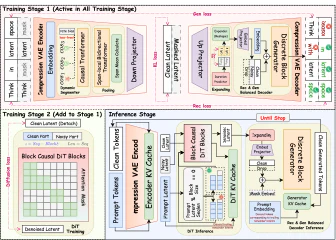
ByteDance Seed · Hugging Face new modelsCola2 is a continuous latent language model that combines dynamic compression VAE, block causal diffusion Transformer (DiT), and cross-segment causal token decoder, dynamically grouping text into semantic segments, representing each segment with a compact continuous latent, generating latent blocks and implementing them as discrete tokens.
Hugging Face Daily Papers6565The MUON-RT optimizer distills teacher model information to the student model online by reusing teacher trajectories and removing momentum weights, saving 25% memory parameters (standard Muon requires 4x parameters, MUON-RT only requires 3x), improving model performance.
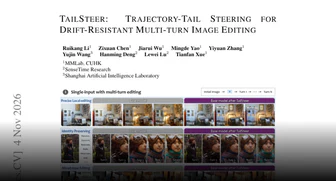
Hugging Face Daily Papers6565TailSteer, by maintaining early denoising dynamics to approach the base model and learning fine deviations in trajectory tails from within the policy through rolling out, significantly reduces accumulated visual drift in multi-round editing while preserving pre-trained generation and editing capabilities. Experiments show that TailSteer can greatly reduce drift on FLUX, SenseNova, and Qwen series models in 15-20 rounds of editing and largely maintains the performance of the base model on large text-to-image and single-image editing benchmarks.
webAI Launches TwIL-8B Inference Model, Optimized for Math and Code Tasks Based on IBM Granite-4.2-8B, Scores Better than Gemma 4 31B in MATH-500 and AIME 2025 Tests, Best in LiveCodeBench Group, IFBench on Par with Gemma 4 12B. Model Inference Capability Reaches 88~93% of Frontier Models, Reduces AI Usage Costs but Has Limited Knowledge Base.
Codex releases00GitHub Copilot rust-v0.169.0-alpha.1 has been released, this version provides code review, collaboration, and other functions.
 Ollama releases6565
Ollama now supports Xiaomi MiMo V2.6 (9B parameter code and agent workflow model), as well as AutoTrust decision model (including 9B, 35B, and 27B-VL versions, 35B and 27B-VL can handle images)
Codex releases00GitHub Copilot rust-v0.168.0-alpha.5 has been released, this version provides code review, collaboration, and other functions.
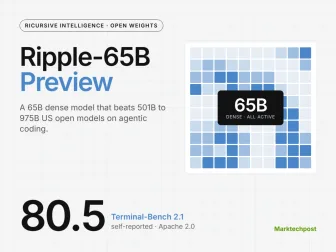
Ripple-65B Improves Computational Efficiency by Optimizing SFT and RL Schemes, Using Synthetic Data Pipelines and Quality Filtering, Employing a Hybrid RL Scheme with Truncated Importance Sampling, Score Centering, and Linear Length Penalty in a High-Quality Long-Term Synthetic Environment, Achieving a TerminalBench 2.1 Score of 80.5 with Only 1.4M Rollouts, 70 Times Fewer than Reflection Beam
ByteDance Seed · Hugging Face new modelsByteDance-Seed/Qwen3-30B-A3B-MoE-SAE is released, containing TopK sparse autoencoders (k=100, 2^20 latent variables) trained on layers 4, 30, and 46 of the Qwen3-30B-A3B model. Each SAE is approximately 17.2 GB, with reconstruction variance unexplained scores of 12.6%, 25.1%, and 7.6% respectively.
O'Reilly RadarRouteLLM researchers train routers to choose between strong and cheap models, benchmark tests show more than double cost reduction with minimal impact on response quality. Automatic routing can help users get more help within budget, allowing the same subscription to support more requests or more frequent use of strong models. Users need to understand the routing effect and evaluate the cost and time benefits it brings, such as comparing different routing strategies through full interaction of code analysis tasks.
Codex releases00GitHub Copilot rust-v0.168.0-alpha.4 released, this version includes the latest feature improvements and fixes.
Hugging Face Daily Papers6565NEO-VLA framework eliminates fixed visual encoders by allowing action strategies to directly access deep visual representations in the network, achieving stronger robustness in various manipulation scenarios and distribution shifts. The framework uses lightweight convolutional layers to tokenize images and allows visual representations to evolve together with language in the backbone network, enabling action experts to obtain information from different depths of instruction-conditioned visual representations. Layer exploration experiments show that action key signals often reach their peak before the final visual representation is formed.
ByteDance Seed · Hugging Face new models5858ByteDance-Seed released the Cross-Layer Transcoder (CLT) for Qwen3-8B-Base, which includes 36 layers × 32,768 latent variables, with 94.2B parameters, a total size of 377 GB, supporting fp32 inference, encoding by jointly scoring the top 360 activated latent variables across all layers, and reconstructing the original MLP output during decoding.
Codex releases55GitHub Copilot 0.168.0-alpha.3 released, this AI coding assistant is used for tasks, projects, and automation work, including code review, quality analysis, and security vulnerability detection.
 Cognition Blog
SWE-2 Flash introduces a mid-training stage before reinforcement learning for the first time, significantly outperforming the baseline model Inkling-Small. Terminal-Bench 4.0 scores increased from 0.9% to 20.0%, and FrontierCode 2.0 improved from 3.2% to 24.0%, surpassing all US open-source models. This model is available in Devin Desktop and CLI, priced at one-fifth of SWE-2 and three times faster.
MarkTechPostSame story · 3 outletsRicursive AI has released Ripple-65B Preview, a 65B dense open-source model, scoring 80.5 on Terminal-Bench 2.1, becoming the highest-scoring open-source model in the United States. Its parameter size is 65B (active parameters), pre-training used 12T tokens, with a maximum context length of 1M, and is released under the Apache 2.0 license.
The DecoderGPT-6 Astra reprograms other AI models directly by analyzing model weights, without traditional training. It correctly identifies the games and image generation shapes learned by the network, and by modifying 0.016% of the weights on Qwen3.5-0.8B, it increases the accuracy of the MATH-500 benchmark test from 7.9% to 48.1%. Researchers believe its potential lies in security audits and targeted behavioral adjustments, but the model's capabilities are still limited.
 OpenAI NewsFeatured6060
OpenAI announced its acquisition of Pierre Computer Company to expand the tool capabilities of Codex in code construction, understanding, and review. The original text did not disclose the transaction amount, timeline, or specific arrangements for the team and products after the acquisition.
Why it matters: Official disclosure of the acquisition move, readers can understand Codex's reinforcement direction in code construction and review tools.