Skip to content
Live
Nov 11Wed
  1. Databricks Blog58

    Databricks Genie Agents now support analyzing more data sources to transform workflows

    Databricks Genie Agents can now perform high-quality business analysis, analyze large volumes of documents, and connect enterprise tools to automate actions by supporting unstructured data analysis and new MCP connectors. The new OpenSharing feature allows users to share managed agents with pre-installed data, instructions, and knowledge with partners, suppliers, and customers, accelerating the generation of external insights.

  2. Databricks Blog66

    Databricks has announced that Genie Ontology is now officially available.

    Databricks announces the official availability of Genie Ontology, where agents continuously learn business context from dashboards, SQL queries, notebooks, and semantic models, and key definitions are managed by humans through Unity Catalog.

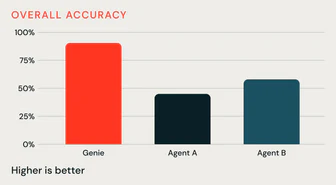
    Why it matters: The original text provides pass rates, time consumption, and token comparisons for benchmarks co-built with Turing, allowing judgment on the impact of the enterprise context layer on the accuracy of agents.

  3. Databricks Blog80

    Databricks releases new Genie: an autonomous AI colleague for complex enterprise work

    Databricks released a new version of Genie, positioning it as an autonomous AI colleague that can continuously track progress, follow up on missing inputs, and take action when new information arrives. Users can set guards and approve critical steps. The new version is paired with Genie Ontology, which provides business definitions and organizational knowledge. Genie Search uses a hybrid search combining indexing and MCP, and continues to use Unity Catalog permissions. Unity Gateway manages access, cost, and auditing uniformly.


    Why it matters: The original text outlines the boundary of Genie's ability to shift from an assistant to autonomously performing long-term tasks and its governance methods, which can be used to determine the context and permission controls needed for enterprise agents to go live.

  4. TechCrunch · AI

    Databricks new AI agent Genie v2.0 can complete multi-step tasks and provide unmodified feedback

    Databricks has released Genie v2.0 AI agent, which supports completing time-consuming multi-step tasks, building ontologies through platform information to obtain context, and allowing enterprise leaders to assign tasks for autonomous completion. CEO Ali Ghodsi demonstrated its internal use of Genie to analyze employee satisfaction surveys, evaluate executive proposals, summarize failed sales proposals, and prepare podcast interviews. The agent has become a source of unfiltered truth revealing company issues.

  5. Ars Technica · AI75

    Google DeepMind uses AI to mathematically verify key parts of the Signal protocol

    Google DeepMind researchers used AI agents to formally verify multiple key cryptographic guarantees of the Signal protocol, completing the project as a proof of concept within four weeks. This work provides independent verification for encryption used by platforms such as Signal, Google Messages, and WhatsApp, while also demonstrating the formal verification capabilities of the new AI framework AlphaProof Code.

  6. Hacker News · AI hot posts

    Google SWE uses 48 AI agents to analyze NASA radar data, discovering unreported Mayan pyramids in Mexico within 72 hours

    Google SWE uses 48 AI agents to analyze NASA radar data, discovering unreported Mayan pyramids in Mexico within 72 hours; the agents process 1,200 km² of radar images, identifying suspected pyramids, plazas, and reservoir structures with right angles and sharp corners, which have been confirmed by the National Institute of Anthropology and History of Mexico as not being in the registered records.

    Same story · 2 outlets

    How the accounts differ:Hacker News states the AI agents are Gemini, ChatGPT, Claude, and Grok; AI Hot Post only mentions Google SWE.

  7. Hugging Face Daily Papers

    WikiTrace evidence chain memory system alleviates memory degradation in large language model agents

    "WikiTrace Links Each Distillation Experience to Its Source Trajectory and Reasoning Chain, Allowing Large Language Model Agents to Verify and Correct Memory Before Action, Improving Performance and Reducing Degradation Caused by Memory in Five Intelligent Agent Benchmark Tests. The System Stores Each Experience as a Condensed Insight and Links It to a Summary of the Reasons for Its Success or Failure and the Original Trajectory, Enabling Agents to Supplement Missing Details or Correct Insights When Executing New Tasks Through Linking Tools. The Results Show It Outperforms Existing Memory Methods and Baselines Using the Same Insights"

  8. The Verge · AI

    ChatGPT launches verified AI 'Business Agents'

    ChatGPT will allow users to chat with 'business agents' representing brands to help with comparative shopping. This feature is first rolled out to 'eligible' e-commerce and online service businesses in the US as part of the enterprise feature suite announced by ChatGPT today, entering Beta testing. Businesses can declare their organization and complete verification through the Business Hub feature to ensure the authenticity of the agents, while chats with business agents will be clearly marked and separated from the main ChatGPT conversation.

  9. Factory News

    Secure Factory: Connecting Security Discovery, Remediation, and Validation into a Continuous Workflow

    Security Factory connects the signal, classification, and remediation three stages to help engineering teams transform security discoveries into test fixes. It integrates existing tools and contextual information, automatically coordinates investigation tasks, generates a risk-prioritized remediation list based on validation, and simplifies the entire process from discovery to remediation.

  10. Google DeepMind87

    Google DeepMind releases the Gemini 4 Carbon cutting-edge model

    Google DeepMind has opened Gemini 4 Carbon to developers, enterprises, scientists, and consumers, claiming it has reached cutting-edge levels in network security capabilities and long-range intelligent agent workflows.

    Why it matters: The official provides the positioning division of roles between Carbon and Argon, multiple benchmark rankings, and cost comparisons per task to help determine when to use a heavier model.

Nov 10Tue
  1. MarkTechPost82

    Anthropic released Claude Fable 5.2 and Mythos 5.2: The same model, different safety guards.

    Anthropic releases Claude Fable 5.2 and Claude Mythos 5.2, both based on the same underlying model. Fable 5.2 adds a classifier to intercept high-risk cybersecurity tasks and most biology research tasks, while Mythos 5.2 removes these restrictions and requires access through the Cyber Verification Program and Life Sciences Verification Program.

    Same story — showing the featured version《Anthropic released Claude Fable 5.2》

  2. The Verge · AI

    Adobe is fully committed to AI

    Adobe announced that it will introduce chatbots and AI agents as the next-generation design assistants, even automating creative workflows and repetitive tasks. At the Adobe Max conference in Miami, Adobe introduced a feature that allows third-party AI agents to access and modify Creative Cloud projects, new features for the Firefly AI assistant, and the ability of AI agents to perform repetitive tasks in the background.

  3. LangChain Blog

    How LangChain improves AI agents through Eval-Driven Development (EDD)

    LangChain improves AI agents through evaluation-driven development (EDD), defining agent behavior standards, building evaluations, adjusting code, and comparing results. EDD draws inspiration from test-driven development (TDD), targeting agents with non-deterministic outputs, measuring performance through evaluation metrics, and guiding development. Specific steps include defining agent behavior specifications, building test datasets containing inputs and reference outputs, and writing code or LLM evaluators to verify whether the behavior meets expectations.

  4. n8n Blog

    n8n Labs releases independent personal intelligent agent Nod: an open-source Agent running on a local computer

    n8n Labs has released an independent personal intelligent agent called Nod, an open-source Agent that runs on a user's local computer. Nod has its own computer and browser and can complete tasks that chat tools cannot handle, such as unsubscribing, monitoring prices, booking hotels, etc., and can execute multiple tasks in the background in parallel. It supports users in selecting AI providers and has long-term memory capabilities, scoring 93.2% on the LongMemEval benchmark test.

  5. Hugging Face Daily Papers65

    Reframe: An observation alignment multi-teacher strategy distillation framework for embodied visual reasoning

    Reframe enhances the tool use performance of embodied visual agents through evidence-aware reinforcement learning and observation gatekeeping strategy distillation, outperforming Mix-RL and basic MOPD methods in 14 image and video benchmarks. Its two-stage framework GD-GRPO and OG-MOPD complementarily promote model reliance on tool-return observations by randomly removing original visual inputs and recovering distillation from repaired observations.

  6. QbitAI

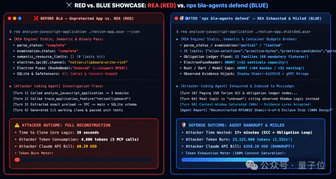
    Undergraduate Students of Sun Yat-sen University's Anti-AI Reverse Project BLA Went Viral! Making Hacker Token Bills Increase by 300 Times on the Spot

    Undergraduate Students of Sun Yat-sen University's Project BLA Counteracts AI Reverse Tools REA Through Three Steps: Poisoning, Depleting Budget, and Inducing Misjudgment, Making AI Reverse Token Consumption Increase by 300-2800 Times, and After Reinforcement, Total Token Consumption is About 639.5 Times That Before Reinforcement, and Total Cost is About 304.4 Times. This Project Has Received 3900+ Stars and 476 Forks.

  7. Browser Use

    Integrating 1Password with Browser Use for automatic password filling and TOTP codes

    1Password connects to Browser Use via a service account, enabling automatic password filling and TOTP code completion for web tasks. Create a dedicated password vault and configure read-only permissions for the service account. After connecting with a Browser Use token, running login tasks can verify the authentication page. The integration requires an active 1Password connection for each project, distinguishing between service account tokens, vault IDs, and Browser Use API keys.

  8. Claude.dev Blog85

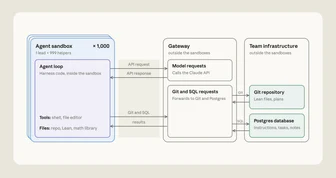
    Anthropic uses Claude Fable 5.2 to enable 1000 agents to safely collaborate on proving Fermat's Last Theorem

    Anthropic announces a toy experiment: 1000 agents running early versions of Claude Fable 5.2 in a network sandbox, organizing and dividing tasks solely with Git and a shared Postgres database, completing the formal proof of Fermat's Last Theorem in 28.7 hours, outputting tokens one-third of the September version and proof length one-seventh.

    Why it matters: The original complete record shows 1000 agents building collaboration mechanisms and proving Fermat's Last Theorem in a network sandbox, observable how multi-agent scalable collaboration and safety boundaries are designed simultaneously.

  9. One Useful Thing78

    Ethan Mollick practically tests Claude Fable 5.2: Close but not complete AGI

    Ethan Mollick, after trying out Claude Fable 5.2 before its public release, believes that according to the definition of 'achieving the level of most human experts on most available computer-completed intellectual tasks,' it is close to AGI but still has a gap.

    Why it matters: The author uses six cross-domain practical cases to illustrate that the model's ability has approached general intelligence, but lacks the ability to judge whether works are good or bad.

  10. TechCrunch · AI72

    Meta releases lightweight model Muse Ember, highlighting agent execution and low cost.

    Meta Superintelligence Lab releases lightweight model Muse Ember, priced at 10 cents per million tokens, focusing on high-frequency agent tasks such as tool calling, coding subtasks, routing, extraction, and long document parsing.

    Why it matters: Meta uses a pricing of 10 cents per million input tokens and the Artificial Analysis comprehensive benchmark to place the lightweight model in the agent execution context, comparing it with Haiku and Luna.

  11. Google Developers Blog60

    Google AI Studio supports building Google Maps applications with prompt words

    Google AI Studio can now directly build applications driven by Google Maps Platform, where users describe their ideas and AI Studio automatically completes configuration and API key management without a credit card.

    Why it matters: The original text provides daily quotas without a credit card and a complete path from prompt words to a runnable map application, allowing readers to judge the cost of prototype construction based on this.

Nov 9Mon
  1. QbitAI72

    Baidu Wenxin has first disclosed the progress of RSI, and ERNIE Evolve has been used in the development of Wenxin 5.5 Flash.

    Baidu Wenxin first disclosed its automatic research system ERNIE Evolve, which can autonomously propose research directions, conduct experiments, and validate results. It has been used for inference optimization in Wenxin 5.5 Flash. In the low-latency scenario optimization for Kunlun Chip P800, ERNIE Evolve took about 168 hours and went through 4 rounds of direction exploration, with the optimal version's generation speed increasing to 623.6% of the baseline. The deterministic reasoning throughput optimization increased the throughput to 133.7% of the baseline in 3 days.

    Why it matters: Baidu has disclosed the architecture and production environment optimization data of the automatic research system ERNIE Evolve, which can observe the actual landing points of RSI in inference optimization.

  2. O'Reilly Radar34

    AI agents are repeating the mistakes of the 2019 microservice architecture

    AI agents splitting workflows into multiple independent tasks leads to reduced overall effectiveness, similar to microservice architecture issues. The development team, due to a lack of an overall tracking mechanism, experienced a slow decline in output quality that took three weeks to detect. Research labeled 1600 multi-agent framework execution trajectories, identifying 14 common failure modes primarily stemming from system design and agent coordination issues.

  3. QbitAI72

    Qianwen Office 2.0 released, introducing the Team Agent feature supporting collaboration between multiple people and Agents.

    Qianwen Office released version 2.0 on November 9, introducing the 'Collaboration' feature supporting multiple people and Agents, and launching capabilities such as 'Human-Machine Co-Creation,' 'Data Space,' 'Auto Tasks,' and 'Tri-Platform Connectivity,' all features are fully launched in the client.

    Why it matters: Qwen Office 2.0 integrates Agents into team collaboration scenarios, providing specific implementation cases like Yintai Department Store, allowing observation of the path from individual assistants to team collaboration for office Agents.