Skip to content
Live
Oct 29Thu
  1. ByteDance Seed · Hugging Face new models

    ByteDance-Seed/GenFirst releases: A generative pre-reconstruction method for stable end-to-end latent generation modeling

    ByteDance-Seed/GenFirst trains a latent VAE and combines it with a generative prior to avoid latent collapse, which usually makes end-to-end training unstable. The two-stage plan of this method is used for prior and entropy weights: the first stage lets the prior shape the latent geometry, and the second stage reduces both weights tenfold, allowing the decoder to recover details.

  2. Hugging Face Daily Papers65

    DTCA: A Noise-Aware Label Credit Assignment Framework for Diffusion Language Models using Reinforcement Learning

    DTCA performs label-level credit assignment through confidence enhancement and entropy calibration, improving the mathematical reasoning ability of diffusion language models. The framework, when tested on LLaDA-8B-Instruct, shows significant performance improvement in mathematical reasoning under different generation budgets, with the MATH500 metric increasing by 9.0 points and the GSM8K metric improving by 5.3 points.

  3. ITHome · AI

    Tencent Mixuan Hy4, Hy4 flash AI model to be released soon, introducing visual understanding capabilities for the first time

    Tencent announces the upcoming release of the Hunyuan Hy4, which offers a comprehensive upgrade compared to the Hy4 preview, introducing visual understanding capabilities for the first time, and enhancing long-range and productivity tasks; the Hy4 flash AI model will also be launched, providing excellent cost performance, inheriting the visual and Agent capabilities of Hy4.

  4. OpenRouter Blog

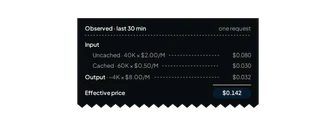
    OpenRouter has refactored its supplier routing algorithm to improve reasoning performance and speed.

    OpenRouter has released a new supplier routing algorithm that selects the best cost-performance solution for each request by evaluating price, latency, throughput, and error rate in real time, significantly improving reasoning speed (TTFT improved by 16.9%), throughput (improved by 16.3%), and reliability (error rate reduced by 67%), with only a slight increase in cost of 6.0%. This algorithm rewards suppliers that provide high-quality reasoning without requiring users to modify their code, ensuring a continuously optimized experience.

  5. OpenRouter Blog

    How to Use LLM to Extract Tables from PDFs

    The Anthropic/claude-haiku-5.5 model paired with a strict JSON schema can extract tables from PDFs and return typed rows. Tested five PDFs (including scans) successfully extracted all 644 cells; failure cases were due to PDF processing paths, not model capability. Note empty results and output length limits.

  6. 36Kr · AI

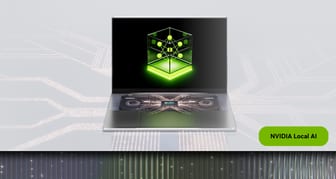
    NVIDIA has launched a local AI speech model, with new models and agent tools added to RTX Spark.

    The Nemotron 3.5 Transcribe open-weight speech model now supports RTX Spark, enabling speech transcription, speaker recognition, and translation, supporting 40 languages. The Liquid AI LFM3 series models have also been supported and can be run locally and fine-tuned. The RTX Spark laptop starts at $2599, with the highest configuration of 128GB unified memory, and FP4 AI computing power up to 1 petaflop.

  7. ITHome · AI

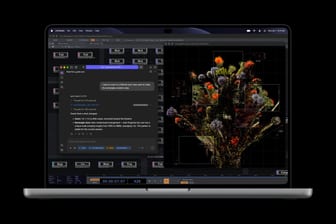
    Apple's first Touch MacBook Pro is released, featuring up to 128GB unified memory capable of locally running AI models with billions of parameters.

    Apple released its first touchscreen MacBook Pro equipped with a PROLED XDR display, featuring the M5 Max chip version with up to 128GB unified memory, capable of locally running large language models with billions of parameters, supporting applications like LM Studio, starting at 22,999 yuan.

  8. Google Developers Blog58

    How Agents CLI optimizes Agent quality through Hill-Climbing

    Agents CLI v1.8.0 achieves Hill-Climbing optimization of Agent quality through commands like eval generate, eval grade, etc., using the custom_response_quality metric to rate 4 cases from 1 to 5, finding that changing the system prompt to a chef role reduced the average score from 4.0 to 2.75. This tool supports model backend experiments and automatic alerts, improving Agent performance through iterative cycles.

  9. Artificial Analysis Articles85

    Gemini 4 Carbon topped the Artificial Analysis Intelligence Index v5

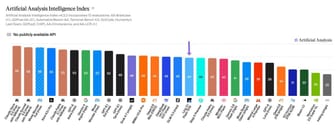
    Google's Gemini 4 Carbon ranked first with 59 points on the Artificial Analysis Intelligence Index v5, leading in four out of nine evaluation items: HLE-Diamond, Terminal-Bench-Science, AA-Omniscience, and AutomationBench-AA

  10. Baseten Blog

    Optimizing Baseten for Qwen3-ASR 1.7B to achieve low-cost high-throughput batch speech transcription

    Baseten achieved the lowest cost per minute for batch speech transcription by optimizing Qwen3-ASR 1.7B (175B parameters, 5.4% WER) on Baseten. Its vLLM stack supports 7 times the throughput of standard vLLM on RTX PRO 6000, with a maximum real-time factor of 3,128, enhanced by native audio decoding, FP8 KV cache quantization, and reduced host-device synchronization.

  11. Hugging Face Daily Papers

    EvidenceConnect framework and Zooming without Zooming v2 model released

    The EvidenceConnect framework generates comparative, aggregated, or chained visual evidence queries by synthesizing image region thumbnails, enhancing the evidence connection capability of VLMs. The ZwZ2 model is trained based on this framework, without targeting any downstream benchmarks but improving fine-grained and spatial perception, and achieving progress in embodied spatial reasoning, multimodal long-context understanding, multimodal agent tasks, and general visual reasoning

Oct 28Wed
  1. ITHome · AI

    MooreThread open-sources Megatron-MUSA-Titan, focusing on trillion-parameter MoE model training for multi-thousand node clusters.

    MooreThread open-sources Megatron-MUSA-Titan project, supporting trillion-parameter MoE model training for multi-thousand node clusters, covering pre-training and reinforcement learning scenarios, achieving high MFU and long-stable training. The project supports blockwise FP8 training, combining DeepEP and ACE asynchronous communication engines to accelerate token distribution and result merging, improving end-to-end training efficiency.

  2. QbitAI58

    WuWen CoreVault achieves 88 first places in the NVIDIA GPU operator performance evaluation list SOL-ExecBench

    WuWen CoreVault ranks first among all participating teams in the NVIDIA Research GPU operator performance evaluation list SOL-ExecBench with 88 single-item first places, covering four major tracks: L1 basic operators, L2 fusion operators, Quantization operators, and FlashInfer-Bench inference operators. Through containerized isolation architecture, modular Skills, and shared memory mechanisms, combined with refined optimization strategies for different computing scenarios, it achieves the ability of AI to autonomously complete complex operator optimization.

  3. Hugging Face Daily Papers65

    Memory Tax: Analyzing the net value of intelligent agent memory

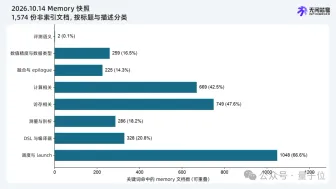
    Large-scale evaluations show that dedicated memory systems are often weaker than simple retrieval-enhanced generation. The Memory Benefit and Memory Tax framework is introduced to evaluate the net value. Memory is becoming increasingly common in long-term intelligent agents, but the net value of building memory compared to directly retrieving from raw history remains unclear.

  4. Hugging Face Daily Papers

    PDRVLA: A Visual-Language-Action Model Integrating Physical Dynamics Representation

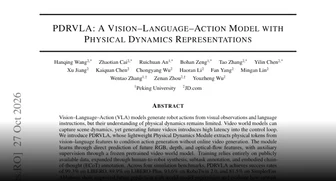
    PDRVLA improves robot action generation by integrating a lightweight physical dynamics module that predicts future visual features under the supervision of a physical world model, avoiding latency caused by online video generation. PDRVLA achieves success rates of 99.3% (LIBERO), 89.9% (LIBERO-Plus), 93.6% (RoboTwin~2.0), and 81.5% (SimplerEnv) on four simulation benchmarks.

  5. Hugging Face Daily Papers65

    Extended Research on Looped Transformers with Truncated Backpropagation: Should the training loop be truncated?

    Looped Transformers train better than truncated backpropagation with the same computational cost through full backtracking, extended regularity shows that when the model size is adjustable, two loops are the best. Looped Transformers increase computational depth by reusing shared layers without increasing the number of trainable parameters, usually using backtracking training (BPTT), but are often truncated to the last few loops to save training computational cost, which may lead to gradient bias and weaken the loop advantage.

  6. QbitAI

    Ants AI Open-sources Ling-3.1-flash-1019, helping Personal Agent move towards real tasks

    Ant Group's Baoling large model has open-sourced Ling-3.1-flash-1019, scoring 1524 Elo in the intelligence index AA-Briefcase, an increase of 3 points compared to the previous version; the basic model Ling-3.1-flash-base adopts a hybrid linear MoE architecture.

  7. Hugging Face Daily Papers

    How to Harness Self-Evolution: Adapting Skills to Improve Personal Evolution

    Harness Self-Evolution improves LLM agents by guiding skill adaptation without parameter updates, enhancing the performance of weak models. The study found that skills are beneficial for strong models but potentially harmful for weak models. In seven models and three benchmark tests, 103 task-skill pairs improved GPT-5.6-luna by 31.1 points but reduced Gemma-4-E4B by 8.8 points.

  8. Hugging Face Daily Papers65

    ThinkWorld model enhances dynamic reasoning ability through world imagination

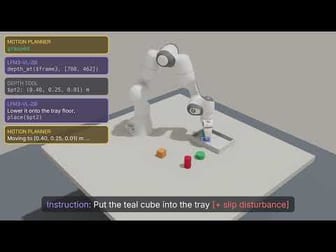
    The ThinkWorld model enhances robot generalization by representing actions as dynamic chains and learning from unlabeled human videos using world imagination. This VLA framework represents each action reasoning as a dynamic reasoning chain (CoD), combining reinforcement learning with world imagination to reinforce reasoning, allowing unlabeled videos to provide direct supervision for state transitions, achieving a shared reasoning space for human and robot experiences. Experiments prove its effective implementation of human-robot transfer and generalization to unseen tasks and environments on both simulation and real robots.

  9. Hugging Face Daily Papers

    OvisOCR3 Technical Report

    OvisOCR3 is a 0.8B visual language model that unifies multiple OCR tasks through multi-mentor distillation and reinforcement learning, achieving SOTA results on document parsing, general OCR, key information extraction, image-text description, and cross-page table reconstruction tasks. It scored 96.74 on OmniDocBench v1.6, ranked first in OCRBench v2 English and Chinese split, and surpassed baseline models in multiple benchmark tests.

  10. Hugging Face Daily Papers

    ChronoReplay training framework enhances the spatiotemporal reasoning ability of streaming visual language models.

    ChronoReplay training framework organizes heterogeneous spatiotemporal supervision into time-ordered interaction segments, preserves specific task answer formats, and balances learning from different supervision signals, enabling a single model to learn complementary spatiotemporal capabilities while maintaining temporal consistency. It achieves improvements on OVO-S-Bench, OST-Bench, and UCS-Bench benchmarks, with a 13.41-point increase on OST-Bench, while optimizing streaming inference performance through adaptive frame selection.