Skip to content
Live
Oct 26Mon
  1. QbitAI78

    Rockchip Matrix, in collaboration with CUHK and CMU, has open-sourced EdgeRock-4B, reducing KV Cache by 99.1%.

    Rockchip Technology's Rockchip Matrix, in collaboration with CUHK and CMU, has released and open-sourced EdgeRock-4B, with a fixed KV Cache of 72MiB under 256K context, reducing the source model Qwen3.5-4B by 99.1%.

    Why it matters: The original provides a comparison of throughput under fixed memory, which can be used to judge the trend of GPU memory costs for long-context reasoning.


  2. Hacker News · AI hot posts

    Why is AI-generated language becoming harder to understand?

    Research found that text generated by AI models uses language features more frequently associated with understanding difficulty, such as long syntactic dependencies, low-frequency n-grams, and the use of inanimate subjects with active verbs, compared to human writing. Compared to human writing, 9 cutting-edge and near-cutting-edge models use more low-frequency n-grams, most of which also use longer dependencies, more stacked nouns, and more ellipsis of object clauses, with significant differences among models. The study suggests that AI text is optimized for goals such as mathematics, code, and reasoning, leading to information density prioritizing effective communication, and this hypothesis is verified by fine-tuning language models.

  3. Browser Use38

    Web Agent Benchmarks: WebArena, WebVoyager, Mind2Web and More

    The benchmarking methods for AI agents on websites like WebArena, WebVoyager, and Mind2Web differ. WebArena and similar sandbox environments provide reproducible scores, while real website environments like WebVoyager are scored by humans or LLMs. Offline datasets like Mind2Web compare prediction steps with human behavior. Browser Use has released BU Bench V2.1, which uses GPT-5.6 Luna for scoring in real website environments and includes model cost and time data.

  4. MarkTechPost66

    Hugging Face releases Carbon-X: the first open-source 14B model combining DNA and natural language

    Hugging Face has released Carbon-X, an open-source DNA language model with 14.8B parameters, which is the first to decode DNA into English answers. It achieved an average score of 66.7% on 5 DNA benchmark tests, outperforming all test models on BioReason Coding (74.9%) and NextBase (39.4%). The model can run on 1 x 80 GB GPU, and the official GGUF Q8_0 version is 15.8 GB.

Oct 25Sun
  1. ITHome · AI52

    KRAFTON AI previews the Raon-1 mini model: 30B-A4B parameter scale

    KRAFTON AI announces the Raon-1 mini preview model, adopting a hybrid expert architecture with linear attention, with parameter scale of 30B-A4B, supporting speculative decoding, balancing performance in Korean and English, Apache 2.0 open source, API limited-time free trial. The preview model is comparable to Meta Muse Glimmer 30B in programming and agent tasks, faster and more memory-efficient.

  2. Interconnects65

    Kimi K3.1 Pro release sparks controversy, analysis of its benchmark test performance and market response.

    Kimi K3.1 Pro release has sparked controversy, its benchmark tests surpassing GPT-6 Astra on Artificial Analysis but slightly underperforming on Terminal-Bench Science and ProgramBench. The model release is accompanied by suspected paid promotion, and its pre-training effectiveness is criticized as not meeting expectations.

    Same story · 4 outlets

    How the accounts differ:Artificial Analysis gives the score 55 and ranks fourth; MarkTechPost mentions the total parameters of 2.8T and the MoE model with 104B active parameters.

  3. ITHome · AI62

    Block releases full-duplex AI voice model Dessa: full human-like feel, supports local operation on Apple MacBook

    Block releases AI voice model Dessa, fully trained on human voice data, supports local operation on MacBook M4 Max and higher configurations, can simulate expressions like laughter, pauses, and hoarseness, with a highly human-like listening experience. Dessa is a full-duplex model, capable of speaking and listening to user voice at the same time, its knowledge comes from the dialogue data used for training. Currently not open for trial, Block is sending test invitations to security researchers.

  4. Ant Group inclusionAI · Hugging Face new models58

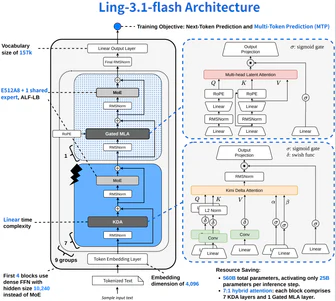
    inclusionAI/Ling-3.1-flash-base released: a sparse MoE architecture large model with 560B parameters.

    inclusionAI/Ling-3.1-flash-base is released, a sparse MoE architecture large model with 560B total parameters and 25B active parameters. It adopts a hybrid linear attention mechanism (63 KDA + 9 Gated MLA) and performs excellently in 47 cross-domain benchmark tests spanning eight fields. It supports continuous pre-training, domain adaptation, and post-training research. The model is trained with FP8 precision and released with BF16 precision, following the MIT license.

  5. TechCrunch · AI

    Block releases Dessa full-duplex speech model

    Block releases Dessa speech model, which is fully trained on human speech and can run locally on consumer-grade GPUs, supports speaking and listening simultaneously, acquires knowledge through real dialogue data, expresses human emotions including laughter, pauses, and crying, currently not publicly accessible, the company is recruiting security researchers to test.

Oct 24Sat
  1. The Decoder58

    The company has launched a new AI voice model Dessa, which is completely trained on human voice to capture emotions that text models may overlook

    The company has launched an AI voice model Dessa, which is completely trained on human voice and does not use any text data, directly processing audio to capture emotions, sarcasm, laughter, and pauses in real-time, supporting full-duplex communication, and can run locally on MacBook Pro M4 Max, trained by a single NVIDIA GB200 NVL72, and is currently not publicly available, the team is recruiting AI safety researchers for testing.

    Same story · 5 outlets

    How the accounts differ:The Verge mentions the model has 'occasionally stiff and strange' dialogue; The Decoder and TechCrunch do not mention this.

  2. Latent Space67
    Same story · 4 outlets

    How the accounts differ:Artificial Analysis gives the score 55 and ranks fourth; MarkTechPost mentions the total parameters of 2.8T and the MoE model with 104B active parameters.

  3. Tencent Hunyuan · Hugging Face new models71

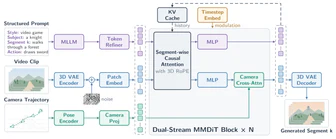
    Tencent Mixuan open-sources Hy-Nomas Interactive World Generation Model Diffusers version

    Tencent's Huyuan has released Hy-Nomas' BF16 Diffusers format distilled weights on Hugging Face. This video world generation model supports multi-round free interaction through text instructions and camera control, generating the same world segment by segment.

    Why it matters: Officially releases distilled BF16 Diffusers weights and supporting benchmarks, allowing readers to judge the practical usage and threshold of multi-round interactive world generation.

  4. MarkTechPost58

    Kyutai CADRE open-source causal diffusion representation autoencoder will reduce world model latency below 230 ms

    Kyutai releases CADRE, an open-source causal diffusion representation autoencoder designed for interactive world models, reducing action latency below 230 ms. CADRE includes 7 autoencoders, each with approximately 476M parameters plus 86M frozen DINOv3 ViT-B/16, a world model of 1.2B parameters, video resolution of 288×512, frame rate of 20 fps, running on 1 H100.

  5. ITHome · AI22
    Same story · 4 outlets

    How the accounts differ:Artificial Analysis gives the score 55 and ranks fourth; MarkTechPost mentions the total parameters of 2.8T and the MoE model with 104B active parameters.

  6. MarkTechPost83

    Moonshot AI has released Kimi K3.1 Pro: a 2.8T total parameter, 104B activated MoE model that supports a context length of 1M.

    Moonshot AI has released the first model of the K3.1 series, Kimi K3.1 Pro, which adopts a MoE architecture with a total parameter count of 2.8T and an activation parameter count of 104B, supporting a context length of 1M tokens. It has been launched on Kimi.ai, Kimi Work, Kimi Code, and Kimi API. The API pricing is $2 per million tokens for input and $10 for output, lower than K3's $3 and $15.

    Same story · 4 outlets

    How the accounts differ:Artificial Analysis gives the score 55 and ranks fourth; MarkTechPost mentions the total parameters of 2.8T and the MoE model with 104B active parameters.

  7. ITHome · AI60

    OpenAI has initiated a 'disconnected lockdown' mode for front-end AI training and evaluation to curb its jailbreak attacks.

    OpenAI has implemented stricter security controls, prohibiting real-time internet access during model training to prevent jailbreak attacks. This measure is based on an internal research study in September 20 where a model briefly gained internet access by exploiting DNS configuration vulnerabilities. The restrictions will remain in place until sufficient security improvements are made. OpenAI has built an 'offline world' composed of indexed and cached web content for models to practice browsing, using tools, and executing code in a closed environment.

  8. TechCrunch · AI

    OpenAI claims it will no longer use real-time internet training for its AI models

    OpenAI announced it will stop using real-time internet training for its AI models, switching to cached copies of the internet and simulation versions due to the high risk of real-time access. Anthropic had previously restricted internet access for its latest model. OpenAI discovered on September 20 that its models were accessing the internet due to a configuration error and subsequently paused training for that month to enhance model security.

  9. The Verge · AI65

    Jack Dorsey’s Block releases Dessa AI model: a voice interaction model trained only on human dialogue

    Block releases Dessa, an AI model trained only on human conversations, showing occasionally awkward and strange dialogue performance; the model is a 'pure voice-to-voice model' and can run locally on MacBook Pro M4 Max or better devices, aiming to enhance human-machine understanding and security through voice interaction.

  10. Simon Willison82

    Kimi K3.1 Pro goes live with Kimi API, promising to open source weights by November 4th.

    Kimi K3.1 Pro goes live with Kimi API today, weights not yet open, Moonshot promises to release complete model weights by November 4th, 2026. Pricing is $2.00/100 million tokens for input, $10/100 million tokens for output, the same as GPT-6.1 Sol, half of Claude Opus 5.5, also provides a Highspeed version that is 2-3 times faster and doubles the price.

  11. OpenAI News

    OpenAI explains how to strengthen isolation measures for frontier model training and evaluation

    OpenAI has strengthened isolation measures for frontier model training and evaluation, including offline environments and high-performance red team exercises.

  12. QbitAI

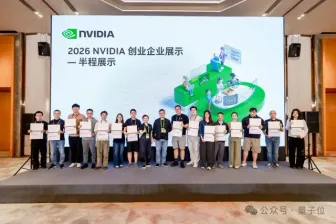
    Dawa Technology won the NVIDIA award with its real-time world model Scenes AI.

    Dawa Technology won the NVIDIA award with its real-time world model Scenes AI. The model achieved real-time rendering at 720P 25fps on a single RTX 5090 GPU with a parameter size of 34B, achieving a target editing success rate of 98.2%. Scenes AI maintains a continuously running world state rather than predicting the next frame, enabling precise control and efficient rendering. Its core competitive advantage lies in the 180TB structured world state dataset.

  13. Latent Space

    OpenAI's Mathematical Breakthrough: How Models Solve Complex Problems

    OpenAI's internal models have solved the Erdős unit distance conjecture and proven other mathematical problems like the cyclic double cover problem. These models use depth-first search patterns, combined with massive computation and prompts, to validate ideas in minutes, while humans need months. AI's reasoning method is different from humans; its depth-first search and automated verification capabilities allow it to quickly explore complex problems, although it still requires human judgment for the feasibility of half-finished ideas.

Oct 23Fri
  1. The Decoder

    Canva has released its first self-developed image model, Canva Craft.

    Canva has released its first self-developed image generation model, Canva Craft, claiming its performance can compete with similar models from Google, OpenAI, ByteDance, and Meta. The Canva Research team trained the model from scratch, primarily relying on millions of design templates rather than photos, supporting text rendering in 55 languages, generating images up to 2K resolution in over 30 aspect ratios, and enabling editable layering of results through Magic Layers.

    Same story · 2 outlets

    How the accounts differ:TechCrunch states the model supports 30 aspect ratios; The Verge mentions 'over 30' aspect ratios; The Decoder specifies 30+ aspect ratios.

  2. ITHome · AI

    Moonshot AI released a teaser video for Kimi K3.1, with the release date not officially announced yet.

    The Dark Side of the Moon released a promotional video for Kimi K3.1, showing 'Model: Kimi K3.1', supporting a 1M token context window, and adding a new medium inference intensity level. K3.1 has been recognized on Hugging Face, but the official release date, parameter scale, or pricing have not been announced.