Skip to content
Live
Nov 14Sat
Nov 13Fri
  1. Ant Group inclusionAI · Hugging Face new models

    inclusionAI/Duo-1.0-causal-base released: A multimodal world model for full-duplex interaction

    inclusionAI releases Duo 1.0 causal-base model, a full-duplex multimodal world model for real-time audio-video interaction, including implementation weights and backbones, intent models and adapters, audio-video encoders, speech recognizers, and forced aligners. The model weights are based on MiniMax H3 initialization and are open-sourced.

  2. Ant Group inclusionAI · Hugging Face new models

    inclusionAI/SingVL_S1_4B_GGUF releases the SingVL-4B GGUF multimodal decision model

    SingVL-4B GGUF is the GGUF version of the 4B parameter multimodal decision-making model Sing VL S1 based on Qwen3.5, which can answer named entity questions with text or JSON and up to four images, and uses a full forward pass scoring option, scoring 69.76 in the Text evaluation and 73.94 in the Vision evaluation. The model uses the llama.cpp adapter, with a default context size of 4096 tokens, supporting text and image input.

  3. Hugging Face Blog71

    IBM releases LLMON markup language and Granite 4.1 3B/8B preview models

    IBM released LLMON (LLM Object Notation) markup language on Hugging Face and launched two experimental preview models based on Granite 4.1: granite-4.1-3b-LLMON-preview and granite-4.1-8b-LLMON-preview, while also open-sourcing a GitHub toolkit.

    Why it matters: The original text provides the design motivation for the LLMON markup language and the two preview models, allowing readers to understand how separating instructions and data can reduce the risk of indirect prompt injection.

  4. OpenAI Alignment Blog

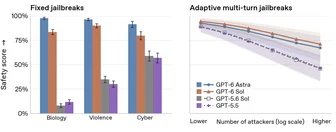
    How OpenAI enhances the fuzzy robustness of GPT-6 Astra and Sol through automated red teaming

    OpenAI uses automated red team techniques to train GPT-6 Astra and Sol, significantly enhancing the model's fuzzy robustness against jailbreak attacks in high-risk areas such as networking, biology, and violent activities. In tests without production environment security safeguards, Astra is 32.5% safer than GPT-5.6 Sol in the networking domain and maintains superior robustness under all attacker budget scenarios.

  5. Google DeepMind87

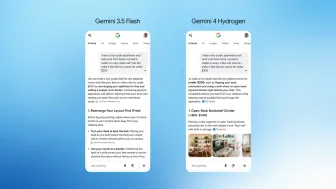
    Google DeepMind releases Gemini 4 Hydrogen model

    Google DeepMind releases Gemini 4 Hydrogen, targeting daily coding and intelligent agent workflows, with an Artificial Analysis intelligence index of 51 at the default high thinking level, higher than Argon's 50, and reaching 54 at the xhigh level

    Why it matters: Google provides the division of labor and positioning of Hydrogen, Carbon, and Argon, as well as the actual differences in cost and speed between multi-model arrangements.

Nov 12Thu
Nov 11Wed
  1. Google DeepMind66

    DeepMind releases AlphaGenome 2, predicting DNA variation impacts by cell type

    Google DeepMind releases AlphaGenome 2, a conditional DNA sequence model that can predict the impact of DNA mutations on gene expression for specific cell types or states.

    Why it matters: Officially disclosed the conditional architecture modification and single-cell level evaluation comparison, which can understand how the model localizes the effect of mutation to specific cell types.

  2. IBM Research Blog48

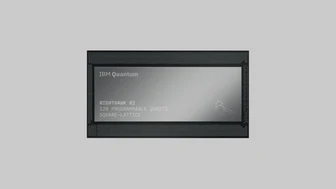
    IBM Quantum Nighthawk r2 released: Quantum advantage breaks through again, supporting accurate circuits with over 7,500 quantum operations

    IBM Quantum Nighthawk r2 has been released, featuring a 120 programmable qubit (458 physical qubits) processor that achieves a throughput of 100,000 samples per second, a 25-fold improvement over Heron, supporting circuits with over 7,500 quantum operations with high accuracy, with customers running over 3.4 billion circuits reporting a performance improvement of 19-fold.

  3. IBM Research Blog42

    IBM Research advances quantum computing breakthrough: Starling framework and key technology progress

    The IBM Quantum Starling project is set to launch in 2029, featuring a quantum circuit with 200 qubits and 100 million quantum operations. Its framework is based on the bivariate bicycle qLDPC quantum error-correcting code proposed in a 2025 paper, adopting a modular design for scalability. Compared to traditional architectures, it reduces resource requirements by one order of magnitude, requiring only about 10 times the physical qubits for the same logical error rate.

  4. Ant Group inclusionAI · Hugging Face new models

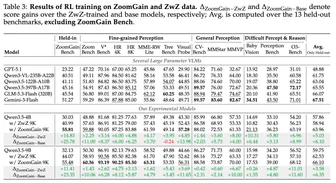
    inclusionAI/ZoomGain-4B-GGUF released: Multimodal model supporting image input

    inclusionAI/ZoomGain-4B-GGUF is a 175B parameter multimodal model supporting image input, using FP16, Q8_0, and Q4_K_M precision quantization. The model includes a language model and mmproj visual encoder/projector, converted to GGUF format via llama.cpp. It provides llama-mtmd-cli for command-line inference and llama-server for network chat functionality.

  5. Ant Group inclusionAI · Hugging Face new models

    inclusionAI/ZoomGain-9B-GGUF Released GGUF Format Weights

    The GGUF format weights for inclusionAI/ZoomGain-9B have been released, converted using llama.cpp, with the language model in FP16, Q8_0, Q4_K_M. The visual encoder and projector (mmproj) also adopt this quantization scheme. Both the language model and mmproj files need to be provided for image input, supporting CLI inference (llama-mtmd-cli) and Web Chat (llama-server) deployment.

  6. Ant Group inclusionAI · Hugging Face new models

    inclusionAI/SingVL_S1_4B released: A multimodal decision-making model based on Qwen3.5

    Sing VL S1 is a multimodal decision-making model based on Qwen3.5, capable of answering named entity questions with text or JSON and up to four images, scoring options for each question using a single Transformers forward pass, performing excellently on 43 text datasets and 11 visual datasets, supporting Python 3.12 and PyTorch inference.

  7. Hugging Face Blog

    Tether AI Research has launched the 0.8B parameter BotPsy model, used for device-side intelligent assistants and agent workflows

    Tether AI Research has launched the 0.8B parameter BotPsy model, built based on Qwen3.5-0.8B, specifically designed for function calls and agent workflows, suitable for on-device deployment. BotPsy outperforms all ≤1.2B parameter models in 6 tool use and agent benchmark tests, including Qwen3.5-2B-Think, achieving the highest scores in 5 tests, with a 2.5x speed increase and a 3x improvement in reasoning efficiency.

  8. Microsoft Research

    Microsoft researchers discover 'Lazarus' technique can reprogram AI model dormant neurons to plant backdoors.

    Microsoft researchers discover 'Lazarus' technique can reprogram AI model dormant neurons to plant backdoors, enabling normal AI agents to execute malicious commands under trigger conditions. The technique can plant backdoors without retraining and is difficult to detect through conventional tests, posing a particularly severe threat to AI agents with tool or terminal access.

  9. MiniMax News80

    MiniMax releases open-source image generation model H3-Image

    MiniMax has released an open-source weight image generation model based on H3, H3-Image, which supports text-to-image, reference image generation, and image editing, capable of generating 4096 × 4096 4K images within 10 seconds, and supports up to 16 reference images.

    Why it matters: The official provides 4K generation speed, reference image quantity, and pricing range, which can be used to judge the gap between open-source image models and closed-source solutions.

  10. Google DeepMind87

    Google DeepMind releases the Gemini 4 Carbon cutting-edge model

    Google DeepMind has opened Gemini 4 Carbon to developers, enterprises, scientists, and consumers, claiming it has reached cutting-edge levels in network security capabilities and long-range intelligent agent workflows.

    Why it matters: The official provides the positioning division of roles between Carbon and Argon, multiple benchmark rankings, and cost comparisons per task to help determine when to use a heavier model.

Nov 10Tue
  1. Google DeepMind76

    Google DeepMind releases Gemini Robotics 2.5 vision-language-action model

    Google DeepMind released Gemini Robotics 2.5, claiming it is the most capable vision-language-action (VLA) model to date, with a 30% to 100% increase in success rate on 200 tasks compared to previous baselines, and 20% to 30% faster task completion speed.

    Why it matters: Officially disclosed were 200 task evaluations and actual production line test data showing a 96% success rate for Mercedes-Benz, which can be used to judge the extent of VLA model deployment in real industrial scenarios.

  2. Claude.dev Blog

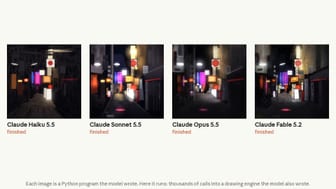
    Which Claude model should Anthropic use? Fable, Opus, Sonnet, or Haiku?

    Anthropic has launched four Claude models for users to choose from: Claude Haiku 5.5, Claude Sonnet 5.5, Claude Opus 5.5, and Claude Fable 5.2.

    Same story · 3 outlets

    How the accounts differ:TechCrunch states the input price of Fable is reduced to $8 per million tokens; others do not mention the price.

  3. AWS Machine Learning Blog

    Anthropic launched Claude Fable 5.2 and Claude Mythos 5.2 on AWS

    Anthropic Launches Claude Fable 5.2 and Claude Mythos 5.2 on AWS, Fable 5.2 is its most powerful general model for coding and scientific fields, supporting unsupervised operation for days; Mythos 5.2 is provided through a validation program and performs more reliably in cybersecurity and life science fields.

    Same story · 3 outlets

    How the accounts differ:TechCrunch states the input price of Fable is reduced to $8 per million tokens; others do not mention the price.

  4. Claude · YouTube75

    Anthropic released Claude Fable 5.2

    Anthropic released Claude Fable 5.2, stating that it has improved in coding, reasoning, and vision, targeting the most complex and open-ended technical work. The official recommendation is to start most coding and knowledge tasks from Opus 5.5, and Fable 5.2 has been launched in the Pro, Max, Team, and Enterprise packages.

    Same story · 3 outlets

    How the accounts differ:TechCrunch states the input price of Fable is reduced to $8 per million tokens; others do not mention the price.

  5. Claude · YouTube68

    Claude Mythos 5.2 predicted the complete AAV coat structure

    Claude Mythos 5.2 predicts the complete AAV capsid structure, which is composed of 60 identical protein chains. It writes code for an open-source folding model to handle the overlap grouping of adjacent five chains, then uses the symmetry of the capsid to assemble the 60 chains. On AAV2, its prediction deviates from the experimental structure by about the width of an atom.

    Why it matters: The original text provides specific methods and accuracy of the model in real scientific research tasks, allowing readers to judge its applicable boundary in structural prediction work.

  6. Claude · YouTube75

    Anthropic released Claude Fable 5.2

    Anthropic releases Claude Fable 5.2, designed for the most challenging technical challenges, with improvements in coding, reasoning, and vision, suitable for the most ambitious open-ended technical work. The official recommendation is to use Opus 5.5 for most coding and knowledge tasks, and Fable 5.2 is now available in the Pro, Max, Team, and Enterprise packages.

    Same story · 3 outlets

    How the accounts differ:TechCrunch states the input price of Fable is reduced to $8 per million tokens; others do not mention the price.

    Why it matters: The official statement explains the positioning and applicable scenarios of Fable 5.2, and provides a choice suggestion between Opus 5.5, making it easier to decide which model to use.

Nov 9Mon
Nov 8Sun
  1. MiniMax · Hugging Face new models

    MiniMax-H3-Image-PE provides hint extension functionality

    MiniMax-H3-Image-PE uses prompt expansion (PE) to convert short requests into detailed image descriptions and recommends aspect ratios. It supports two workflows: text-to-image (T2I) and image editing, using fine-tuned FP4 weights from Qwen3.8-27B. The online API can be accessed via platform.minimax.io or platform.minimax.cn, and the documentation provides support in both Chinese and English.

Nov 7Sat