Skip to content
Live
Oct 22Thu
  1. Databricks Blog55

    Hamlet platform uses Databricks Lakebase Postgres to test production data changes

    Hamlet platform uses Databricks Lakebase Postgres to create production data branches for each pull request, allowing engineers and AI coding agents to test changes without touching the production environment, while still requiring manual approval to merge. The platform indexes and transcribes meetings of thousands of city councils, planning commissions, and zoning commissions across the United States, enabling real estate developers, journalists, researchers, and citizens to instantly search meeting records, track local policy developments, and set real-time alerts.

  2. Tencent Hunyuan · Hugging Face new models72

    Tencent Mixuan open-sourced the real-time simultaneous translation model Hy-SimulMT-30B-A3B

    Tencent Mixuan has released and open-sourced the real-time simultaneous translation model Hy-SimulMT-30B-A3B, supporting bidirectional Chinese-English voice-to-voice translation, capable of continuously outputting translated text and speech during speech, and supporting real-time voice cloning.

    Why it matters: The official provides a comparison of latency and quality for real-time simultaneous translation, and opens up multiple quantitative versions and inference deployment scripts, which can be used to evaluate the deployment cost.

  3. NVIDIA Blog

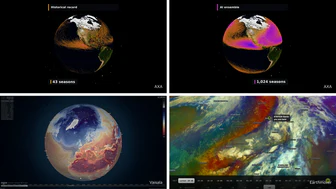
    European pioneers deploy the open-source NVIDIA Earth-2 model to empower real-world weather and climate prediction.

    StormScope EU has become the latest model to join NVIDIA Earth-2, which is trained using European weather and climate data and supports global weather forecasting, detailed regional forecasting, and environmental research. Developers can use the Earth-2 model to combine with their own data and create customized applications through the NVIDIA computing platform, including short-term weather forecasting (StormScope), weather data enhancement with local details (CorrDiff), and air quality modeling, among others.

  4. NVIDIA Blog

    NVIDIA helps Europe's retail industry transform: from digital discovery to physical operations.

    European retailers are leveraging open models and physical intelligence, such as e-commerce platforms that reduce inference costs by 90%, and distribution centers that simulate collaboration of different robot fleets through digital twins. Shopify uses NVIDIA-accelerated open models to integrate NVIDIA Nemotron 3.5 Lightning into the GraphQL sub-agent of Sidekick through post-training, achieving a 90% cost reduction and a 7-fold increase in response speed.

  5. NVIDIA Blog

    NVIDIA Cosmos platform expands new tools to train, evaluate, and deploy world models

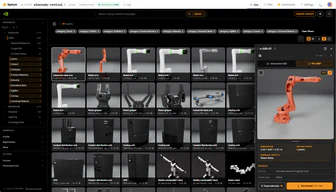
    NVIDIA expands the Cosmos platform with new training tools, simulation checkpoints, and Cosmos Data Factory blueprints to help developers quickly build world models. Cosmos Data Factory provides 5 cloud-native blueprints, supporting tasks such as autonomous driving data generation and image attribute enhancement through channels like GitHub and Azure, with Porsche and ANYbotics already applying them to accelerate physical AI development.

  6. LangChain Deep Agents releases40

    LangChain Deep Agents v0.7.30 released

    LangChain Deep Agents v0.7.30 released, supporting asynchronous sub-agent queues to follow up on tasks without interrupting current work, fixes issues such as asynchronous sub-agent check report problems during server cancellation, thread read failure retries, removal of summary-related reasoning blocks, and local Shell backend output limits

  7. Claude Code releases15

    Claude Code v2.1.307 Released

    Claude Code v2.1.307 is released, fixing over 20 bugs including API version migration, security event tracking, model alias error handling, prompt cache scope, MCP server authentication and timeout issues, and WebFetch tool error reporting, improving browser login, tool call retry, and self-hosted runner stability.

  8. Hugging Face Blog

    How to reduce inference cost by 77% in real-world applications using a specialized SLM vocabulary list.

    Qwen3-4B's specialized vocabulary list VocabX reduces inference cost by 77% by focusing on the cost of each token rather than frequency, without changing the base model. This method for the Portuguese essay scorer reduces the output layer vocabulary from about 152,000 lines to about 65,000 lines, significantly reducing the computational overhead of token splitting and unused vocabulary items.

Oct 21Wed
  1. Ant Group inclusionAI · Hugging Face new models35

    inclusionAI/Ling-3.0-tiny-UBTree release: A fine-tuned model based on UBTree technology

    inclusionAI released the UBTree fine-tuned version of Ling-3.0-tiny, Ling-3.0-tiny-UBTree-B16, with 183.1M parameters, combining a five-layer DFlash backbone and a bigram selector, achieving 2.6-3.5 times speed improvement on benchmarks like GSM8K and MATH-500. This model needs to be used in conjunction with the target model. The UBTree adaptation for the open-source version of SGLang has not yet been released.

  2. IBM Research Blog

    IBM vLLM-Hook MIA Plugin enables rapid runtime monitoring and control

    IBM releases vLLM-Hook MIA Plugin, implementing runtime monitoring and control in the vLLM inference engine, 20 times faster than its predecessor vLLM-Hook and 14 times faster than similar methods inserting code inside the model, with only a 2%-6% increase in latency. The plugin allows developers to observe and adjust model states in real-time, such as rejecting malicious prompts, marking hallucinatory facts, or editing response tone and accuracy, while almost not reducing performance.

  3. NVIDIA Blog62

    NVIDIA expands its family of open models to cover language, robotics, biology, and quantum computing

    NVIDIA expands its family of open models to cover language, robotics, biology, and quantum computing, including the new Nemotron 3.5 Super VL and Nemotron 3.5 Bolt.

    Why it matters: NVIDIA has rolled out open models across four lines: language, robotics, biology, and quantum, allowing readers to judge the coverage of its open-source ecosystem based on this.

  4. NVIDIA Blog62

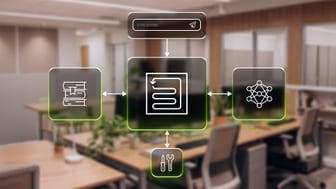
    NVIDIA expands Agent Toolkit to enable enterprise agents to access company data

    NVIDIA expands its open-source Agent Toolkit, adding components such as Agent Knowledge Foundation, the OpenShell secure runtime, and the NemoClaw blueprint, enabling enterprises to customize and govern agents with their own data.

    Why it matters: The original article lists the new components of Agent Toolkit and details of deployments at multiple enterprises, showing how enterprise agents connect to their own data and are constrained by the runtime.

  5. Mistral AI50

    Mistral collaborates with NVIDIA to advance AI in engineering

    Mistral is collaborating with NVIDIA to integrate AI models with NVIDIA accelerated computing and physics modeling tools, accelerating engineering simulations and enabling closed-loop AI-driven design. The collaboration will launch public benchmarks and open datasets, standardizing the evaluation of physics and agent AI in computer-aided engineering, and leveraging NVIDIA Omniverse for 3D simulations and resource creation.

  6. NVIDIA Blog58

    NVIDIA European partners expand computing capabilities, building sovereign, open, and secure AI agent cloud ecosystems.

    NVIDIA European partners are expanding regional computing capabilities to support model training and inference, helping developers build agentic and physical AI applications. Nscale achieves 37% more GPUs and 50% higher inference throughput using the NVIDIA DSX platform, Crusoe develops a liquid-cooled AI factory for low-latency inference, and Nebius adopts the NVIDIA Groq 3 LPX to accelerate sensitive applications.

  7. NVIDIA Blog

    NVIDIA showcased its full lineup of local AI hardware: RTX Spark, DGX Spark, and DGX Station, helping to power next-generation intelligent agents.

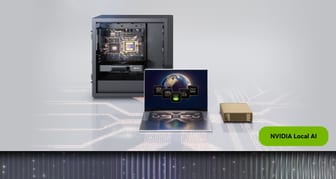
    NVIDIA showcased its full lineup of local AI hardware at GTC Berlin, with RTX Spark now available to support personal agents on Windows PCs, DGX Spark enabling developers to build and scale Linux applications, and DGX Station designed for Linux enterprise teams to run cutting-edge workloads, with the Windows version launching in December.

  8. Databricks Blog

    Databricks AI Runtime officially released

    Databricks releases AI Runtime (AIR), bringing managed GPU infrastructure directly into its platform, allowing customers to train high-demand models at their enterprise data location. AIR provides GPU infrastructure, developer tools, and data governance features, supporting large-scale training, rapid iteration, and load safety, with customers not needing to manage a separate GPU stack.