Skip to content
Live
Oct 21Wed
  1. AWS Machine Learning Blog34

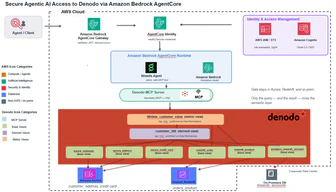
    Building an AI agent semantic layer on AWS using Strategy Mosaic and Amazon Bedrock AgentCore.

    Strategy Mosaic, as a semantic layer, models C360 domains on Amazon Redshift and Amazon Aurora without ETL using two linked models. Its metric syntax captures the business definition of agent reasoning and exposes the model to AgentCore-hosted Strands agents via the Mosaic MCP server, supporting user identity propagation to achieve end-to-end row-level and object-level security.

  2. AWS Machine Learning Blog38

    How Amazon Quick and Amazon Bedrock AgentCore implement conversational intelligent decision-making in supply chains

    Amazon Quick combined with Amazon Bedrock AgentCore provides supply chain teams with real-time data access across systems. Users can get cross-system answers in seconds through conversational queries, such as identifying high-income SKUs and costs affected by port closures. Quick serves as the interface layer, and AgentCore as the intelligence layer, connecting backend systems like ERP, monitoring, and procurement via the MCP protocol to achieve a complete process from problem discovery to generating emergency purchase requests, all operations requiring manual confirmation.

  3. LangChain Deep Agents releases25

    LangChain Deep Agents 0.1.87 released

    LangChain Deep Agents 0.1.87 released, supporting thread recovery in non-interactive mode, compressing large idle sessions before prompt cache expiration, displaying prompt cache expiration time, customizing Slack OAuth app identity, and loading old threads from thread switchers; fixes issues such as local server stopping when the owner dies, support for non-ASCII filenames in `@` mentions, and misleading change summaries for `/reload`.

  4. NVIDIA Blog50

    Barcelona Supercomputing Center's AI Factory Accelerator project helps Spanish startups innovate

    The AI Factory Accelerator project of the Barcelona Supercomputing Center (BSC) is now fully operational, providing startups with sovereign computing, technical support, and training to support cross-industry innovation. The project complements the NVIDIA Inception program by providing resources such as NVIDIA Deep Learning Institute open courses, business guidance, and venture capital connections to members. Since its launch in April 2025, the BSC AI Factory has delivered over 800 services to private and public sector clients.

  5. Databricks Blog

    Deploy RFD4-Proteina on Databricks

    Databricks has integrated the RFD4-Proteina model into Genesis Workbench, supporting execution in AI runtime environments and connecting research data and workflows. Developers can build and adjust pipelines using Genie Code and the NVIDIA BioNeMo Agent Toolkit, leveraging serverless NVIDIA GPU computing for protein design.

  6. vLLM Blog60

    vLLM supported the Recursive Flint model on the first day.

    vLLM announced support on the day Flint was released, with both NVFP4 and BF16 checkpoints capable of running on a single GPU, decoding approximately 500 tokens/s per request on a single GB200 with a context of 100,000 tokens.

    Why it matters: The original text provided Flint's day-0 support on vLLM, single-card throughput data, and the step-by-step kernel optimization process, allowing readers to judge the engineering trade-offs of small-batch inference based on this.

  7. vLLM Blog

    Ant Group and the vLLM community open-source Humming: A general-purpose high-performance quantized inference kernel library

    Ant Group and the vLLM community open-source Humming, a high-performance quantized inference kernel library. Humming supports NVIDIA GPUs starting from the Turing architecture and CUDA-compatible devices like the T-Head Zhenwu 810E, providing extensive quantization support covering various integer and floating-point types, bit widths, and scaling schemes. It significantly outperforms existing implementations such as vLLM Marlin, FlashInfer, and DeepGEMM on multiple representative workloads.

  8. Google Developers Blog

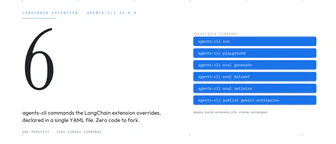
    Agents CLI Extension System: Supports the intelligent agent development lifecycle across frameworks.

    Agents CLI 1.5.0 version introduces an extension system, allowing developers to override or add commands without modifying the tool, supporting cross-framework usage; the official LangChain extension replaces framework-bound commands while retaining other lifecycle functionalities; developers can create custom extensions, such as adding deployment commands for software bill of materials (SBOM) scanning, enabling enterprise platform teams to enforce governance policies.

  9. Gemini CLI releases15

    Gemini CLI v0.65.0 has been released.

    Gemini CLI v0.65.0 has been released, fixing 23 issues, including read-only workspace settings for forced untrusted folders, avoiding duplicate tool responses during session recovery, and preventing the deletion of restored session history during quick exits. It also adds support for custom OTLP headers in telemetry configuration.

  10. Claude Code releases40

    Claude Code v2.1.305 Released

    Claude Code v2.1.305 released, added sandbox.allowNestedUserNamespaces support for Linux user namespace creation, fixed issues where requests failed on Vertex, Bedrock platforms due to tool search being rejected, and bugs where /effort and /autocompact settings were not taking effect.

  11. Hugging Face Blog66

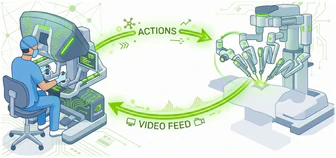
    NVIDIA has released the Cosmos3-H-Dreams surgical generative simulation model.

    NVIDIA has released Cosmos3-H-Dreams, extending interactive generative simulation to clinical gallbladder removal scenarios, capable of generating surgical scenes in real-time based on instrument movements.

    Why it matters: The original text explains the migration path from desktop stitching to clinical cholecystectomy scenarios, as well as the trade-off between quality and delay between four-step and two-step distillation checkpoints.

  12. AWS Machine Learning Blog38

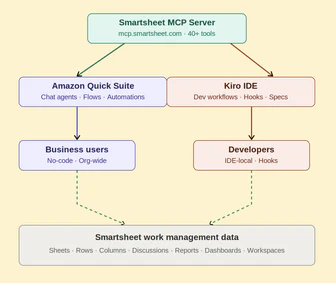
    Smartsheet MCP on AWS has launched the Universal Model Context Protocol (MCP) server.

    Smartsheet launches the Universal Model Context Protocol (MCP) server, enabling AI assistants to read and write manage Smartsheet data through a standardized protocol; supports Amazon Quick and Kiro connections, Quick for knowledge workers and operations teams to naturally query and update Smartsheet with natural language, Kiro allows developers to refer to project specifications and update task status without leaving the coding environment.

  13. Databricks Blog

    Databricks introduces Agent Memory to enhance intelligent agent capabilities

    Databricks introduces Agent Memory, which improves agent quality, reduces costs and latency by storing key facts, preferences, and processes, and supports running on Lakebase. It is currently in Beta version. Agent Memory is based on Databricks' latest memory research and uses the MemCurrent architecture. In internal benchmark tests, it has tripled the pass rate of agent tasks while reducing token usage by 31%.

  14. PyTorch Blog35

    PyTorch Foundation recruits nine new members to promote the development of the open-source AI ecosystem

    PyTorch Foundation announces the addition of nine new members, including Nebius, Nscale, and Shopify, strengthening its core position in the development of open-source AI and accelerating ecosystem breakthroughs. The addition of new members highlights the ecological importance of projects such as PyTorch, vLLM, and DeepSpeed, promoting the integration of AI research and commercial applications.

Oct 20Tue
  1. Hugging Face Blog58

    How does ALTK-Evolve surpass state-of-the-art models in the τ²-bench customer service task through learning and memory?

    ALTK-Evolve uses GPT-4.1 to learn and apply customer service scripts. In the τ²-bench customer service agent benchmark test, it surpasses all retail entries in the retail sector, achieving a score of 67.5% Pass^4, and does not require updating model weights. The model is based on a basic ReAct agent and GPT-4.1. It attempts to analyze tasks and use GPT-4.1 to distill success and failure into short behavioral rules, then adds these guidelines to the agent's system prompts without updating weights or manual annotation.

  2. IBM Research Blog

    llm-d 1.0 Released: Strengthening Open Source AI Inference Production Environment

    The llm-d project announces the release of version 1.0, which is a Kubernetes-native distributed inference service network that supports deploying any model's inference stack on any accelerator in any cloud. This version enhances multi-tenant quality of service, zero-downtime operations, and agent-aware services to achieve continuous performance in common production operations. Through techniques such as prefix cache-aware routing and KV cache offloading, llm-d 1.0 can capture 97% of available cache reuse, reducing the cost of large-scale AI services.

  3. Hugging Face Blog58

    AnyLanguageModel 1.0 is released: supporting local model advancements on Apple platforms for a year.

    AnyLanguageModel 1.0 is released, supporting local model advancements on Apple platforms for a year. New support added for cloud models such as OpenAI Chat Completions, Anthropic Messages, and Google Gemini. Local model support includes llama.cpp, MLX, and Core ML. Tool calling and guided generation features are expanded. Cloud models have the same functionality as local models, and API keys support dynamic acquisition through closures.

  4. Hugging Face Blog62

    PyTorch 2.15 brings FP8 and faster LLM decoding to the MPS backend.

    The Hugging Face PyTorch team introduces updates to the MPS backend in PyTorch 2.15, adding the tensor torch.float8_e4m3fn and F.scaled_mm, with FP8 tensors occupying half the space of BF16.

    Why it matters: The original text provides specific numbers for the MPS backend in FP8, MoE decoding, and memory usage, which can be used to judge the actual changes in running models locally on Mac.