Skip to content
Live
Nov 14Sat
Nov 13Fri
  1. Hugging Face Daily Papers65

    Ropedia Xperience 2: A gold standard for extending physical AI environments and behaviors

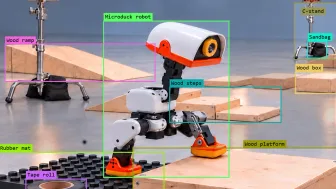
    Ropedia Xperience 2 includes 1,589 published metric 3D scans and 4,230 viewpoint center records for 74 tasks (131 hours), each capture can be reused for robot learning, scene converted to physical interaction simulation environment, human motion redirected to full-body robot trajectories, additional robot behaviors obtained through virtual remote operation and automatic long-term trajectory generation, this joint capture proposed as the gold standard for physical AI data collection.

  2. O'Reilly Radar

    How does Claude achieve self-evolution?

    An evolutionary intelligent agent can change the way future tasks are handled through experience, with its improvements primarily occurring in the harness around the model, such as instructions, context, tools, and software. Evaluating the improvement effect requires checking whether the agent uses correct information, takes correct actions, and meets user needs, such as verifying budget and dietary requirements in a restaurant planning task. The agent can autonomously review tasks, identify repetitive errors, propose improvement solutions, and test their effectiveness, but it requires setting the range of modifiable harness modules, such as context management, agent loops, and tool usage.

Nov 12Thu
Nov 11Wed
  1. Hugging Face Daily Papers

    World In-Context Learning for Agentic Robot Manipulation

    World In-Context Learning (WICL) method freezes the model, practices tasks in simulators, and writes feedback into the context rather than weights, enabling robots to learn operational skills from a single demonstration. RoboScript implements WICL, achieving an 83.4% success rate on 50 tasks in RoboTwin 2.0 with no gradient updates from a single demonstration, surpassing the strongest training strategy by over 20 points, and supports cross-visual distribution generalization, improvement through reflection, base model extension, and cross-platform memory migration.

Nov 10Tue
  1. Hugging Face Daily Papers

    LingBot-Touch Released: An Heterogeneous Tactile Representation Learning Model Supporting General Dexterity Operations

    LingBot-Touch is a tactile foundational model that learns a unified, scalable representation across different tactile sensors (resistive, magnetic, visual tactile), producing plug-and-play tactile tokens, and continuously enhancing the dexterity of diffusion strategies and visual language action (VLA) models (such as π_{0.5} and LingBot-VLA). Experiments show that this tactile representation significantly improves performance in complex manipulation tasks in both simulation and real robot deployment while maintaining strong computational efficiency.

  2. Hugging Face Daily Papers

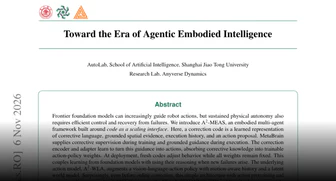
    A2-MEAS framework strides towards the era of embodied intelligent agents

    The A2-MEAS framework enhances robot control and fault recovery by learning correction codes and embodied visual language action models, achieving a 0.5755 Q-score on the 50-task BEHAVIOR 2026 public subset and a 45.40% task success rate, with an average success rate of 57.92% on 12 real robot tasks. The framework employs action pre-training and task specialization, with a training throughput of 427.1 samples/second, and the system will open-source the model, training scripts, and infrastructure.

Nov 8Sun
  1. Hugging Face Daily Papers24

    From Autonomous Agents to Cognitive Symbionts: Towards AI-Enhanced Human Intelligence

    Physical AI should enhance human intelligence through a lifelong cognitive symbiont, which compensates for cognitive gaps through perception, situational retention, and proactive assistance, requiring embedded governance. Large foundation models and personal agents can already complete multi-step tasks independently, but humans will still forget knowledge, ignore information, and lack historical references, as the machines that can provide help are outside the context.

Nov 7Sat
  1. ITHome · AI67

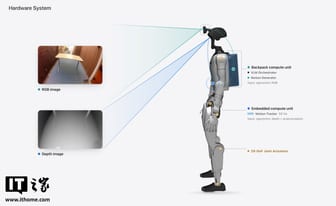
    Apple reveals the humanoid robot system HALO: using the Qwen model to validate on the Yushu G1, achieving an average success rate of 91% for single tasks.

    Apple's research team reveals humanoid robot autonomous control system HALO, with an average success rate of 91% in 360 single task tests in 6 real environments; the system calls the Qianwen model for verification on the Yushu G1, achieving an average success rate of 70% in 10 tests of 3 combinations in a single long sequence compound task, and a success rate of 50% in the most complex task.

Nov 6Fri
Nov 5Thu
Nov 3Tue
  1. Hugging Face Daily Papers38

    REA: A runtime for asynchronous cerebellar-brain control for embodied intelligent agents

    REA unifies deliberative and reactive strategies in a single runtime, achieving high success rates and reducing control overhead through asynchronous coordination in both simulated and real robotic tasks. On 3,000 test segments across 60 LIBERO-Pro tasks, REA achieved a 95.9% success rate, outperforming its best single-agent baseline from its strategy library (94.7%), while reducing control steps by 25% and control time by 17%.

  2. Hugging Face Daily Papers34

    OSWAM: An efficient single-step action generation world action model

    OSWAM achieves real-time high-quality action generation in autonomous driving and embodied control by using structured imagination tokens to initialize the diffusion process and distilling future condition privileged information into a single denoising step. The model generates high-quality actions with just one diffusion step, about 3 times faster than direct strategy world action models (WAM) that require dozens of denoising steps, achieving low latency of up to 40ms on an NVIDIA RTX 5090 GPU, supporting real-time compiled inference.

Nov 2Mon
  1. Hugging Face Daily Papers58

    Wizard: Real-time control of any world through agent control

    Wizard decouples character animation, scene control, and game logic from visual generation, allowing intelligent agents to control joint skeletons and scene geometry through structured visual agents, achieving real-time interaction at 24 FPS, zero-shot generalization to unseen scenes, characters, and actions. The team built 50.3 hours of aligned agent-video pairs, including 750 scenes and 178 characters, supporting character adaptive masking, causal adaptation, and few-step distillation techniques.

Oct 30Fri
Oct 29Thu
  1. Hugging Face Daily Papers65

    Sensorimotor Alignment: A Successful Embodied Agent Metric Based on Sensorimotor Alignment

    The Sensorimotor Alignment (S²) metric finds that the alignment degree between vision and motor representations of embodied agents is positively correlated with task success rates, verifying the applicability of the Platonic representation hypothesis in the robotics field. In simulation and real robot tests, models with high S² (such as Vision-Language-Action and World Action Models) perform better and can explain the phenomenon where the VLA model ignores instructions and relies on visual features, serving as a low-cost offline proxy metric.

  2. QbitAI

    Zhuji Dynamics releases FluxVLA Engine V2 technical report, one-click reuse of engineering capabilities makes embodied AI R&D more efficient

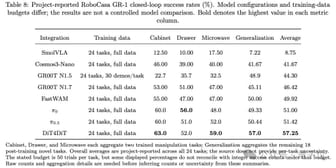
    Zhuji Dynamics releases the FluxVLA Engine V2 technical report, achieving full-chain reuse of model training, evaluation, and deployment through unified configuration, modular decoupling, and system optimization. It supports 14 mainstream strategies, with inference path frequency improved by 2.31–9.64 times, validated in closed-loop execution on 6 real machines including ALOHA and dual-arm Franka. Online reinforcement learning boosts SmolVLA success rates by 10.0–15.4 percentage points.

Oct 28Wed
  1. Hugging Face Daily Papers

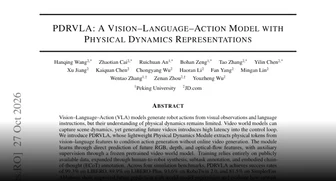
    PDRVLA: A Visual-Language-Action Model Integrating Physical Dynamics Representation

    PDRVLA improves robot action generation by integrating a lightweight physical dynamics module that predicts future visual features under the supervision of a physical world model, avoiding latency caused by online video generation. PDRVLA achieves success rates of 99.3% (LIBERO), 89.9% (LIBERO-Plus), 93.6% (RoboTwin~2.0), and 81.5% (SimplerEnv) on four simulation benchmarks.

Oct 26Mon
  1. Hugging Face Daily Papers47

    RynnUnify: A model towards a unified embodied brain

    RynnUnify is a 16B parameter unified embodied model that integrates visual planning, physical reasoning, and robotic control, achieving state-of-the-art performance on long-horizon embodied tasks. It enables powerful embodied understanding and long-horizon visual planning through alternating video-language inference, and has developed agent extension and world action extension, respectively using reinforcement learning to selectively use video prediction inference for unobserved states and interaction results, and transforming understanding and prediction capabilities into robotic control.

Oct 24Sat
  1. Hugging Face Daily Papers

    The FRED framework enhances the future video representation capabilities of world action models through self-distillation and temporal conditioning.

    The FRED framework enhances the future video representation capabilities of world action models through self-distillation and temporal conditioning, consistently outperforming competing models in real-world operational scenarios, achieving significant gains in zero-shot generalization on long-term and out-of-domain tasks, and increasing the success rate of human video skill transfer from 19.4% to 50.0%.

Oct 23Fri
Oct 22Thu
  1. ITHome · AI

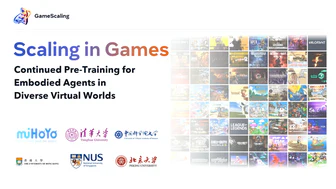
    MiHoYo, in collaboration with Tsinghua and Peking Universities, has released the open-source GameScaling game model, covering parameter scales from 0.8B to 27B.

    MiHoYo, in collaboration with Tsinghua and Peking Universities, has released the open-source GameScaling game model, covering parameter scales from 0.8B to 27B. This series of 8 models is based on the Qwen3.5 visual language model for continued pre-training, with training data involving games such as Minecraft and Doom. The model generates subsequent instructions based on game screens and operation records, supporting real-time game interaction. There are two versions for each of the 4 parameter scales: S1 and S3, and they are licensed under Apache 2.0.

  2. Hugging Face Daily Papers65

    Hugging Face Daily Papers: Research on continuous pre-training of embodied agents in diverse virtual worlds

    Research has improved the learning ability of embodied agents in virtual worlds through continuous pre-training (CPT) across three dimensions: data scale, diversity, and model size, but there are limitations in long-distance world generalization. The study tested 120 configurations covering parameters from 0.8B to 27B, data budgets from 50 to 1600 hours, and five data mixtures. It was found that increasing data volume improves internal performance, diversity enhances related world transfer, and larger model sizes improve data efficiency but result in worse long-distance generalization.

Oct 21Wed
  1. QbitAI65

    Motubrain team from Shengshu Technology will live stream the entire process of Physical AI training, lasting for half a month.

    The Motubrain team from Shengshu Technology has launched a live stream of the 2.0 training process, lasting for half a month to showcase the training process of embodied models. The live stream covers four stages: pre-training, post-training, Agent task execution, and RSI exploration, opening the process from model training to capability iteration to the public. This move aims to enhance the transparency of Physical AI R&D and share research experiences in large-scale training and cross-task generalization.

Oct 20Tue
  1. AI as Normal Technology75

    New paper: Rising trend in AI agent evaluation

    Researchers have proposed 33 trends in the rise of AI agent evaluation, pointing out that evaluating agents is more complex than evaluating models, requiring attention to the entire behavioral trajectory rather than just results, and emphasizing that the scope of evaluation needs to be expanded to laboratories, specific use cases, and real-world environments, while calling for more interdisciplinary evaluators to participate and ensure their independence.

Oct 16Fri
  1. Meta Engineering

    Meta How to Build Forum Applications with Native AI Engineering

    Meta uses AI agents to participate in the construction of engineering processes for Forum applications, viewing AI as a participant in the engineering process rather than an auxiliary tool. This experiment measures success by production-ready outcomes rather than lines of code, using a Human-On-The-Loop model to allow AI to autonomously execute planning, implementation, testing, and validation, with engineers responsible for setting goals, supervision, and acceptance.

Oct 3Sat
  1. Baseten Blog

    MetaInfer skill toolbox: An inference engine optimizer built solely with knowledge achieves 50-90% faster engine performance.

    MetaInfer's skill toolbox constructs custom inference engines using only knowledge, making the Qwen-3.6-35B-A3B model 90% faster than vLLM 0.25.1 in single-stream decoding speed, and TTFT improves 2.33 times. This framework does not require model fine-tuning or dedicated adapters, enabling LLMs to achieve highly optimized inference engines for specific deployments by defining constraints and optimization goals.

Sep 30Wed
  1. Anthropic Research71

    Anthropic Research: What Work Can Robots Currently Complete?

    Anthropic has released a Robot Exposure Index study, using Claude to evaluate about 19,000 tasks in O*NET, finding that existing robots can complete 74% of physical tasks in the U.S. and account for 34% of all work time, but most are limited to controlled environments.

    Why it matters: Anthropic used Claude to rate O*NET tasks item by item, quantifying how much work robots can currently cover, and provided constraints on cost and regulation.

Sep 24Thu
  1. Microsoft Research

    Microsoft Research explores the advantages of offloading physical AI reasoning to edge or cloud GPUs.

    Offloading physical AI reasoning to edge or cloud GPUs can significantly improve robot task success rates, support larger models, and extend battery life. In mobile operation tasks, offloading reasoning enhances robot response speed and accuracy, increases battery endurance, and reduces costs. Microsoft Research has developed a Kubernetes-based toolkit to support distributed reasoning deployment on robots, edge devices, and the cloud.

Jun 10Wed
Jun 23Mon