Toward the Era of Agentic Embodied Intelligence
Toward the Era of Agentic Embodied Intelligence
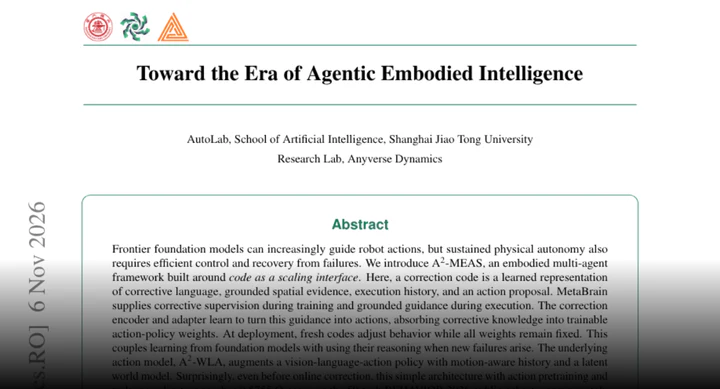
The A2-MEAS framework enhances robot control and fault recovery by learning correction codes and embodied visual language action models, achieving a 0.5755 Q-score on the 50-task BEHAVIOR 2026 public subset and a 45.40% task success rate, with an average success rate of 57.92% on 12 real robot tasks. The framework employs action pre-training and task specialization, with a training throughput of 427.1 samples/second, and the system will open-source the model, training scripts, and infrastructure.
Published on Nov 6
Authors:
,
,
,
,
,
,
,
Abstract
An embodied multi-agent framework uses learned correction codes and a vision-language-action model with motion-aware history and latent world modeling to improve robot control, failure recovery, and training efficiency.
Foundation models increasingly guide robot actions, yet sustained autonomy requires efficient control and failure recovery. We introduce A2-MEAS, an embodied multi-agent framework built around code as a scaling interface. Learned correction codes combine corrective language, spatial evidence, execution history, and action proposals. MetaBrain provides training supervision and runtime guidance. A correction encoder and adapter absorb this knowledge into policy weights during training, while fresh codes adapt behavior with frozen weights at deployment. The action model, A2-WLA, adds motion-aware history and a latent world model to a vision-language-action policy. Surprisingly, this simple design with action pretraining and task specialization reaches 0.5755 Q-score on the 50-task BEHAVIOR 2026 public subset before online correction, 2.21x the 2025 winner's reported 0.2605 across different benchmark editions and training configurations. On all 100 BEHAVIOR 2026 public tasks, A2-MEAS achieves 0.6411 Q-score and 45.40% task success. On RoboTwin 2.0, A2-WLA achieves 93.98% average success, rising to 95.05% with the complete system. Across 12 real-robot tasks in five household settings, A2-WLA achieves 57.92% average success versus 26.67% for pi0.5. In long-horizon pour-over coffee preparation, a history-conditioned adapter raises post-failure completion at two filter-handling steps from 14% to 94% and from 8% to 82%, compared with A2-WLA retries. Our training infrastructure delivers 427.1 samples per second, 4.03x the throughput of a pi0.5 reference implementation on matched hardware. We will release the system, models, training scripts, and infrastructure to support efficient embodied learning.
View arXiv page View PDF Project page GitHub 1 Add to collection
Get this paper in your agent:
hf papers read 2611.09124
Don't have the latest CLI?
curl -LsSf https://hf.co/cli/install.sh | bash
Models citing this paper 0
No model linking this paper
Cite arxiv.org/abs/2611.09124 in a model README.md to link it from this page.
Datasets citing this paper 0
No dataset linking this paper
Cite arxiv.org/abs/2611.09124 in a dataset README.md to link it from this page.
Spaces citing this paper 0
No Space linking this paper
Cite arxiv.org/abs/2611.09124 in a Space README.md to link it from this page.
Collections including this paper 0
No Collection including this paper
Add this paper to a collection to link it from this page.
Source: Hugging Face Daily Papers · huggingface.co