Skip to content
Live
Nov 14Sat
  1. The Decoder65

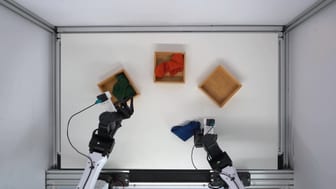
    Runway open-sources robot control model Praxis-1

    Runway has released the open-source robot control model Praxis-1, which learns to control robots through video and has shown excellent performance in its own tests, scoring 46.2% on the Nvidia RoboLab-120 evaluation, leading similar models. The model requires additional training to adapt to new robot systems, the standard version requires an 80GB memory GPU, and it has been made available on Hugging Face.
Nov 13Fri
  1. Hacker News · AI hot posts86

    Edge0 open sources 145B and 120B edge-side models and inference frameworks.

    Edge0 open-sourced the Edge0-145B and Edge0-120B two edge models, and also released a unified inference framework and deployment tools. Officially, the 145B model can run locally on compatible laptops, with peak memory of 29GB, decoding speed of 80+ tokens/s, pre-filling speed of 1100+ tokens/s, supporting context lengths of 128K–256K.

    Why it matters: The original text provides actual memory, speed, and multiple benchmark comparisons of the edge 145B model, which can be used to judge the practical boundaries of running cutting-edge models locally.

  2. The Verge · AI82

    Google releases Gemini 4 Hydrogen, capable of breaking down complex problems into multiple parts

    Google has released the Gemini 4 Hydrogen model, claiming it can better answer complex questions that involve multiple parts, spelling errors, or highly specific requirements, and will break down the problem and respond item by item.

    Same story — showing the featured version《Google Search has integrated Gemini 4 Hydrogen and is now open to global users.》

  3. Hacker News · 300+

    Gemini 4 Hydrogen released: bringing cutting-edge intelligence and efficiency to daily coding and agent workflows

    Gemini 4 Hydrogen has been released, boosting the Artificial Analysis Intelligence Index score to 51 at the default high reasoning level (Argon is 50, with a maximum of 54), and typically outperforming similar models in task execution speed.

  4. Ars Technica · AI82

    Google launched Gemini 4 Hydrogen, replacing 3.8 Flash

    Google releases Gemini 4 Hydrogen, replacing Gemini 3.8 Flash in its own products, with access restrictions more relaxed than previous Argon and Carbon, available for use upon release

  5. Google DeepMind87

    Google DeepMind releases Gemini 4 Hydrogen model

    Google DeepMind releases Gemini 4 Hydrogen, targeting daily coding and intelligent agent workflows, with an Artificial Analysis intelligence index of 51 at the default high thinking level, higher than Argon's 50, and reaching 54 at the xhigh level

    Why it matters: Google provides the division of labor and positioning of Hydrogen, Carbon, and Argon, as well as the actual differences in cost and speed between multi-model arrangements.

Nov 12Thu
  1. ITHome · AI

    Runway launches robot model Praxis-1, 15.6 times faster and cost reduced to 1/51

    Runway has launched the robot model Praxis-1, based on the Runway video foundation model with 27 billion parameters. In the RoboLab-120 benchmark test, it achieved a success rate of approximately 46.2%, with a speed increase of 15.6 times and a cost reduction to 1/51. This model is licensed under Apache 2.0 and both weights and code are open-sourced.

  2. The Decoder78

    Google launches Gemini Decision 1 and Gemini Decisions API, capable of processing 1000 issues at a time

    Google DeepMind launches Gemini Decisions API, targeting yes/no, multiple choice, and scale scoring for closed-form judgments. The underlying model, Gemini Decision 1, can handle up to 1000 independent questions at once, covering text, images, audio, video, and PDF.

    Same story — showing the featured version《Google launches Gemini Decisions API and Gemini Decision 1 model》

Nov 11Wed
  1. The Decoder

    Anthropic claims AI has weakened NVIDIA's CUDA advantage, reducing the time to switch to AMD chips to three days.

    Anthropic claims to have reduced the time to migrate its AI model, Claude, to AMD GPUs from several months to three days with almost no human intervention, thereby breaking its reliance on NVIDIA. The company states that the AI model Mythos has completed 99% of the kernel migration or writing work, allowing the new hardware to reach a usable performance level in three days, while traditional engineering methods require six to twelve months.

  2. Hacker News · AI hot posts

    Google SWE uses 48 AI agents to analyze NASA radar data, discovering unreported Mayan pyramids in Mexico within 72 hours

    Google SWE uses 48 AI agents to analyze NASA radar data, discovering unreported Mayan pyramids in Mexico within 72 hours; the agents process 1,200 km² of radar images, identifying suspected pyramids, plazas, and reservoir structures with right angles and sharp corners, which have been confirmed by the National Institute of Anthropology and History of Mexico as not being in the registered records.

  3. ITHome · AI

    Anthropic Claude completes AI model adaptation for AMD GPU in just 3 days, challenging NVIDIA's CUDA moat.

    Anthropic Claude Mythos Preview model completed adaptation to AMD MI355X GPU in just 3 days, traditional adaptation requires 6-12 months; GPUs are trending towards general computing power resources, challenging NVIDIA's CUDA moat.

  4. Ant Group inclusionAI · Hugging Face new models

    inclusionAI/SingVL_S1_4B released: A multimodal decision-making model based on Qwen3.5

    Sing VL S1 is a multimodal decision-making model based on Qwen3.5, capable of answering named entity questions with text or JSON and up to four images, scoring options for each question using a single Transformers forward pass, performing excellently on 43 text datasets and 11 visual datasets, supporting Python 3.12 and PyTorch inference.

  5. ITHome · AI

    Google's strongest VLA robot model, Gemini Robotics 2.5, debuts, can tie bows, already on the Mercedes production line

    Google launches VLA robot model Gemini Robotics 2.5, achieving leaps in dexterity, reliability, and safety, with a success rate of 96% on the Mercedes production line. The model has tested 200 tasks, with a success rate 30%-100% higher than the baseline, a speed increase of 20%-30%, and is compatible with robots like Apptronik Apollo 2, adopting ASIMOV-Jailbreak benchmark to enhance jailbreak resistance to 99.5%.

  6. ITHome · AI

    Google's strongest model yet, Gemini 4 Carbon, debuts: Focused on complex programming, scientific research, and cybersecurity

    Google has released the Gemini 4 Carbon model, which is its most powerful reasoning model to date. The model has a unified context window of 1,048,576 tokens, with a maximum standard synchronous request output of 65,536 tokens, expandable to 1,048,576 tokens via the Long Decode mechanism.

  7. Google DeepMind87

    Google DeepMind releases the Gemini 4 Carbon cutting-edge model

    Google DeepMind has opened Gemini 4 Carbon to developers, enterprises, scientists, and consumers, claiming it has reached cutting-edge levels in network security capabilities and long-range intelligent agent workflows.

    Why it matters: The official provides the positioning division of roles between Carbon and Argon, multiple benchmark rankings, and cost comparisons per task to help determine when to use a heavier model.

  8. MarkTechPost

    Zyphra has released ZONOS3-Mini: an 800M parameter open-source speech synthesis model.

    Zyphra has released ZONOS3-Mini, an open-source speech synthesis model with 800M total parameters and 100M active parameters, supporting real-time local deployment and zero-shot voice cloning. The model ranks first in the open model category in Zyphra's self-developed ZTTS2-Eval benchmark test (66.2 points), with the first audio generation on a single H100 GPU taking 80 milliseconds, but the reference audio cloning effect is far lower than the embedded mode.

Nov 10Tue
  1. Hacker News · 300+

    Meta launches Muse Ember: its smallest and most efficient model

    Meta launches Muse Ember, its smallest and most efficient model designed for complex reasoning tasks, outperforming Claude Haiku 5.5 and GPT-6 Luna in smartness-to-cost ratio, with a cost of 0.10 USD per million input tokens and 0.50 USD per million output tokens, supporting a 1M context window and 512K output tokens.

  2. MarkTechPost

    Meta launches Muse Ember: a high-capacity intelligent model with 1M context

    Meta releases Muse Ember, its smallest and most efficient model, designed for repetitive steps in agents. Muse Ember scores 36 on the AA Intelligence Index, matching Claude Haiku 5.5 (max effort), with a cost of about 0.14 USD per task.

  3. ITHome · AI

    Anthropic released Claude Fable 5.2, surpassing GPT-6 Astra in programming capability and topping multiple benchmarks.

    Anthropic released the Claude Fable 5.2 model, achieving 49.1% programming capability in the FrontierCode 2.0 test, surpassing GPT-6 Astra's 42.8%; scoring 74.2% in the Humanity's Last Exam test, leading GPT-6 Astra's 57.2%. The model's output speed has increased by up to 30%, with a 20% cost reduction and API call fees lowered to $3/ million tokens.

    Same story · 3 outlets

    How the accounts differ:TechCrunch states the input price of Fable is reduced to $8 per million tokens; others do not mention the price.

  4. ITHome · AI

    Meta launches lightweight AI model Muse Ember: benchmark scores comparable to Claude Haiku 5.5, with a single-task cost of just 1/3

    Muse Ember is Meta's smallest and most efficient AI model, performing comparably to Claude Haiku 5.5 on the Artificial Analysis rankings, but with a single-task cost of only 1/3 and surpassing GPT-6 Luna.

  5. Hugging Face Daily Papers

    Confucius4-R2T2: A stable prefix streaming speech recognition model for real-time transcription

    Confucius4-R2T2 is a stable prefix streaming speech recognition model for real-time applications, which converts a full context ASR model into a streaming model through post-training without architecture modification. Built based on Qwen3-ASR-1.7B, R2T2 achieves near-offline recognition accuracy and low transmission delay, supports configurable streaming block sizes, and demonstrates promising cross-lingual generalization capabilities. This model and implementation have been publicly released.

  6. Claude · YouTube75

    Anthropic released Claude Fable 5.2

    Anthropic released Claude Fable 5.2, stating that it has improved in coding, reasoning, and vision, targeting the most complex and open-ended technical work. The official recommendation is to start most coding and knowledge tasks from Opus 5.5, and Fable 5.2 has been launched in the Pro, Max, Team, and Enterprise packages.

  7. Claude · YouTube68

    Claude Mythos 5.2 predicted the complete AAV coat structure

    Claude Mythos 5.2 predicts the complete AAV capsid structure, which is composed of 60 identical protein chains. It writes code for an open-source folding model to handle the overlap grouping of adjacent five chains, then uses the symmetry of the capsid to assemble the 60 chains. On AAV2, its prediction deviates from the experimental structure by about the width of an atom.

    Why it matters: The original text provides specific methods and accuracy of the model in real scientific research tasks, allowing readers to judge its applicable boundary in structural prediction work.

  8. Claude · YouTube75

    Anthropic released Claude Fable 5.2

    Anthropic releases Claude Fable 5.2, designed for the most challenging technical challenges, with improvements in coding, reasoning, and vision, suitable for the most ambitious open-ended technical work. The official recommendation is to use Opus 5.5 for most coding and knowledge tasks, and Fable 5.2 is now available in the Pro, Max, Team, and Enterprise packages.

    Why it matters: The official statement explains the positioning and applicable scenarios of Fable 5.2, and provides a choice suggestion between Opus 5.5, making it easier to decide which model to use.

  9. TechCrunch · AI82

    Anthropic releases Mythos 5.2 and Fable 5.2 models, with Fable input price reduced to $8 per million tokens

    Anthropic releases Mythos 5.2 and Fable 5.2, claiming new models have improvements in coding, reasoning, and vision, and communicate more clearly with users. Fable's input price drops from $10 per million tokens to $8, lower than major competitor GPT-6 Astra, with a 30% faster response speed, and can support zero data retention (ZDR) policies through Enterprise Frontier Safeguards.

    Same story · 3 outlets

    How the accounts differ:TechCrunch states the input price of Fable is reduced to $8 per million tokens; others do not mention the price.

Nov 9Mon
  1. QbitAI47

    Ji Yuan Law Release NeoHorse-1.5-Flash Preview, Agent model RSI enters the second round of iteration

    Ji Yuan Law Release Agent Native Model NeoHorse-1.5-Flash Preview, based on Qwen3.8-Flash training, 180B total parameters, 6B activation parameters, score improvement in Agents' Last Exam, Natural Language to Repository and other evaluations. This model iterates through recursive self-improvement (RSI) and combines the OpenSquilla platform to achieve differential diagnosis of multiple models and online learning, now open for limited internal testing.

  2. MIT News · AI38

    MIT develops FLEX platform to help robots understand natural language instructions

    The FLEX platform developed by researchers from MIT and New York University enables robots to infer deep meaning from natural language instructions, enhancing their motion planning capabilities. The platform uses GPT-4o to analyze instruction patterns, allowing robots to avoid electronic devices such as laptops and phones in virtual scenarios without explicit instructions. The entire process takes about five seconds, aiming to help robots understand the underlying intent behind human instructions.

Nov 7Sat
Nov 6Fri
  1. MarkTechPost71

    Thinking Machines has released the Inkling 2 Small: a MoE model with 594B total parameters and 17B activations.

    Thinking Machines Lab released the first model of the second-generation Inkling, Inkling 2 Small, a sparse MoE with 594B total parameters and 17B activation parameters, supporting text and image input and variable inference strength, with a context of 1M tokens.