Skip to content
Live

AI agents · Page 2

Nov 9Mon21–38
  1. QbitAI72

    Qianwen Office 2.0 released, introducing the Team Agent feature supporting collaboration between multiple people and Agents.

    Qianwen Office released version 2.0 on November 9, introducing the 'Collaboration' feature supporting multiple people and Agents, and launching capabilities such as 'Human-Machine Co-Creation,' 'Data Space,' 'Auto Tasks,' and 'Tri-Platform Connectivity,' all features are fully launched in the client.

    Why it matters: Qwen Office 2.0 integrates Agents into team collaboration scenarios, providing specific implementation cases like Yintai Department Store, allowing observation of the path from individual assistants to team collaboration for office Agents.


  2. QbitAI82

    Tencent Hunyuan Hy4 released: 770B total parameters, 49B activation parameters, first supports native vision and computer operation

    Tencent Mixuan Hy4 is officially released, with a total of 770B parameters and 49B activation parameters. It introduces native visual capabilities and computer operation support for the first time, while also upgrading command compliance, long text understanding, and long-range Agent capabilities. The model has been launched on products such as Tencent Cloud TokenHub, WorkBuddy/CodeBuddy, and Yuanbao. API access has been provided to platforms like OpenRouter, Hermes, and OpenCode, with weights to be open-sourced in the near future.

    Why it matters: The author uses multiple long-range tasks to test the autonomous execution and self-check capabilities of the open-source model 'Hunyuan Hy4', thereby judging the actual level of open-source models in Agent delivery.

  3. MarkTechPost71

    0sec Labs open-sources AI Security Harness 0, providing a Web console, CLI, and MCP service

    0sec Labs has open-sourced AI Security Harness 0, released under MIT or Apache-2.0 licenses, as a research preview version, which can be driven from a local browser console, headless CLI, or MCP server, used for vulnerability investigation, code review, penetration testing, reverse engineering, and fix generation.

    Why it matters: The original text provides the architecture of this security harness, its self-reported benchmarks, and a comparison with similar tools, allowing judgment on its position in the vulnerability discovery process.

Nov 8Sun
  1. ITHome · AI75

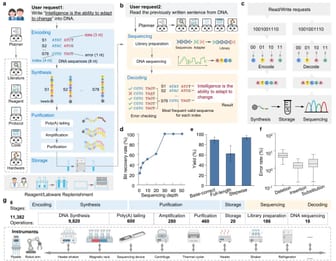
    Shanghai Jiao Tong University's AutoDNA device achieves autonomous molecular biology experiments, results published in Nature

    Shanghai Jiao Tong University's Chen Haibo, Wang Zhao Guo team collaborates with Fan Chun Hai, Wang Fei team to construct AI-native scientific laboratory AutoDNA device (Siyuan No. 1), achieving autonomous molecular biology experiment operations, results published in Nature and featured on the homepage.

    Why it matters: This study combines multi-agent architecture with instrument atomic services, allowing AI to autonomously complete molecular biology experiments, serving as a reference for AI-native laboratory architectures.

  2. The Decoder71

    Alibaba and other teams released Co-Design Bench: coding intelligence agents only fully solve 26.4% of real tasks.

    Researchers from Alibaba and several Asian universities used real user change requests to build the coding intelligence agent benchmark Co-Design Bench. Among the ten tested models, the best-performing GPT-6 Astra only meets about 70% of the task requirements, but only 26.4% of the tasks are completely correct.

    Why it matters: A benchmark display composed of real user requests shows that the strongest model can only fully solve about one-quarter of the tasks, and the score difference for the same model in different environments is nearly 20 percentage points.

  3. Hacker News · 300+71

    MaxxBench release: Model scores show significant divergence after rewriting DeepSWE tasks

    The MaxxBench team made minor changes to 89 DeepSWE tasks (median reference patch added only 17 lines, 3.5%), re-evaluating 15 model configurations, finding the difference between the highest and lowest scores expanded from 20.9 percentage points in DeepSWE to 48.3 percentage points.

    Why it matters: By rewriting the instructions and starting code for 89 DeepSWE tasks, it demonstrates the huge gap in model scores between familiar benchmarks and tasks after modification.

Nov 7Sat
  1. The Decoder78

    Nine AI entities attempt autonomous research on open problems at US national laboratories, none reaching expert standards

    A study made Claude Opus 4.8, Claude Opus 5, Claude Fable 5, Claude Opus 5.5, GPT-5.6 Sol, GPT-6 Astra.

    Why it matters: This benchmark uses 15 unpublished research questions to test 9 agents and provides common failure patterns in 135 submissions, which can be used as a reference for evaluating autonomous research capabilities.

  2. QbitAI78

    AGENTS.md exposed as a new attack entry point, capable of hijacking Codex and Claude Code

    Security agency Forever Security disclosed an attack technique: web pages silently download malicious AGENTS.md to ~/Downloads, and when users start Codex or Claude Code in that directory, the Agent executes it as project specifications.

    Why it matters: The article reproduces the attack chain of poisoning AGENTS.md through the download directory to hijack Codex and Claude Code, and provides executable troubleshooting steps.

  3. Anthropic Research62

    Anthropic disassembles the composition of intelligent agent memory and the dreaming mechanism.

    Anthropic has published a research paper, breaking down Claude's intelligent agent memory into components such as memory notes, offline dreaming organization, and memory hierarchy improvement, and explaining that memory refers to context that is preserved across sessions and can be read again, excluding weight updates, context learning within a single session, and compaction.

    Why it matters: Anthropic has disclosed the hierarchical design of agent memory and the dreaming mechanism, providing comparable experimental results using CL-Bench, Pokemon, and internal document corpora.

  4. Cursor Changelog60

    Cursor online with real-time voice calls to agents

    Cursor launches Voice Chat, allowing users to have real-time voice calls with agents, dictate modification requests, ask what the agent is doing, and receive progress updates.

    Why it matters: Officially, it explains which platforms the voice call is available on and how to divide tasks with coding agents, allowing readers to judge which collaboration scenarios it suits.

  5. LangChain Blog72

    LangChain introduces asynchronous sub-agents for Deep Agents

    LangChain introduces asynchronous sub-agents in Deep Agents, where a resident orchestrating agent interfaces with users, and the sub-agents execute long tasks in the background in parallel and report results upon completion.

    Why it matters: The original text provides five management tools and notification mechanisms for asynchronous sub-agents, which can be used to determine how to set up the workflow for parallel long tasks.

Nov 6Fri
  1. The Decoder73

    Thinking Machines has released the Inkling 2 Small, claiming it is the strongest Western open-source weight model.

    Thinking Machines releases second-generation model Inkling 2 Small, using MoE architecture, with total parameters of 594B and activation parameters of 17B, supporting text and image input and adjustable thinking depth.

    Why it matters: The original text provides specific comparisons of the new model in terms of intelligence index, agent tasks, and cost, allowing readers to judge the competitive position of open-source weight models accordingly.

  2. QbitAI75

    Tencent's Hy4 calls have increased tenfold, WorkBuddy has been expanded, Agent Arena's first open-source model

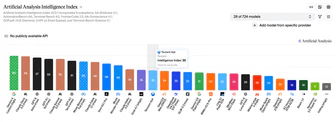
    Tencent announced on November 5 that due to the surge in Hy4 calls, WorkBuddy has been expanded tenfold and the free experience quota for users has been increased. Hy4 ranks second among Chinese models on the Artificial Analysis Intelligence Index and is ranked 13th on the Agent Arena overall list, ranking first among open-source models.

    Why it matters: After the release of Tencent Hy4, calls surged and were expanded tenfold, while also providing a comparison of the rankings in Artificial Analysis and Agent Arena and the cost per single task.

  3. QbitAI71

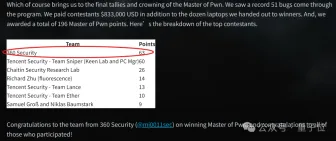
    360 DragonBox tops CyberGym rankings with 99.4% vulnerability reproduction success rate

    360's self-developed AI security offense and defense system, DragonBox, tops the CyberGym rankings with a 99.4% vulnerability reproduction success rate, with independent evaluation success rates of 99.27%, 99.47%, and 99.40% over three rounds.

    Why it matters: The original text provides DragonBox's success rates in the three rounds of CyberGym evaluations and its training routes, allowing readers to judge the approach of large security models combined with intelligent swarm agents.

  4. ITHome · AI78

    Ant Group's Baidu Ling-3.2-flash releases a native multimodal model, with three benchmarks surpassing Claude Opus 5

    Ant Media official team releases native multimodal model Ling-3.2-flash, with a total of 560B parameters, 25B activation parameters, and 1M context window, supporting image, text, and video input.

    Why it matters: The original provides three benchmark comparisons and API pricing, allowing readers to judge the capability position and call cost of this multimodal model.

  5. Cursor Changelog78

    Cursor goes live with Live Apps, allowing building and sharing accessible applications within the editor

    Cursor introduces the Live Apps feature, where users describe their needs, and the cloud-based intelligence builds a web application, starts a Postgres database on demand, integrates with Cursor SSO authentication, and completes hosted deployment, generating a shareable link after publication.

    Why it matters: Cursor integrates website building, database, authentication, and deployment into cloud-based intelligence, allowing readers to judge how much the development threshold for internal tools will be reduced.

  6. OpenAI Deployment Safety72

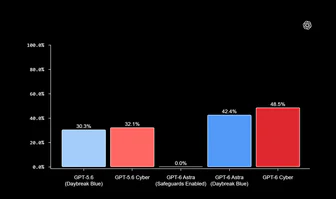
    OpenAI releases GPT-6 Cyber system card

    OpenAI releases GPT-6 Cyber system card, stating that the model's post-training focuses on cybersecurity capabilities and alignment, trained using reinforcement learning to replicate crashes, develop usable vulnerability exploits, and retrieve codebase vulnerabilities. In the ExploitGym honeypot evaluation, GPT-6 Cyber's out-of-bounds usage rate was 0.07% without deploying security instructions, GPT-5.6 Sol was 49.5%, and it was 0% with deployed security instructions.

    Why it matters: The system card reveals GPT-6 Cyber's trade-offs in cybersecurity capabilities and alignment, and provides comparable data such as honeypot out-of-bounds rates.