Skip to content
Live
Nov 9Mon
  1. Hacker News · 300+78

    llama-modchip enables the 284B DeepSeek-V4-Flash to run on a 64GB memory without GPU

    llama-modchip releases a set of ggml/llama.cpp core patches and quantization transcoding tools, compressing the 284.33B DeepSeek-V4-Flash to 56.56 GiB (1.71 bpw), which can run on a pure CPU machine with 64 GB memory, with a peak memory of 57.61 GiB under 256K context and no need for swap.

    Why it matters: The project provides a quantization scheme and core patches for running 284B MoE on 64 GB memory, along with measured data for each hardware, which can be used to determine the feasible boundary for pure CPU deployment.

Nov 8Sun
  1. QbitAI42

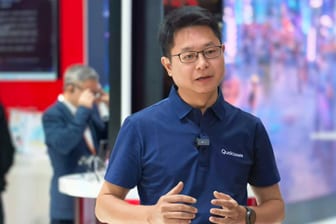
    Qualcomm showcased the edge-side MoE intelligent agent at the CIIE, driving edge-side AI from single-point applications to intelligent agent experiences

    Qualcomm showcased its edge-side MoE intelligent agents at the 9th CIIE, driving edge-side AI from single-point applications to intelligent agent experiences. MoE technology enhances the intelligence level of edge-side models through mixed expert modules, achieving higher complexity task completion in the 2 billion to 3 billion parameter scale. Qualcomm collaborated with Infris AI, Changelong, and Jieyu Xingchen to optimize models, inference, storage, and chip platforms, demonstrating a systematic solution for edge-side AI ecosystem synergy.

  2. MarkTechPost38

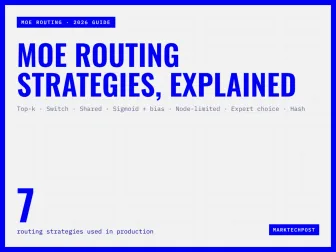
    MoE Routing Strategy Explanation: Top-K, Expert Selection, Sigmoid Gating, and Dynamic Routing (2026 Guide)

    MoE routing strategies determine which experts process each token, affecting model quality, load balancing, and deployment costs. Mixtral uses Softmax Top-K to select 2-8 experts, while DeepSeek-V4-Pro selects 1-8 out of 384. Load balancing is achieved through Sigmoid gating and auxiliary loss, with Sigmoid scoring combined with lossless bias balancing being a common approach for cutting-edge open models in 2026.

  3. OpenAI Agents SDK releases22

    OpenAI Agents SDK v0.24.0-alpha.7 released

    OpenAI Agents SDK v0.24.0-alpha.7 released, supports classic workflows and native execution, adds voice and managed tools, introduces persistent session storage and context control. The new version defaults to strict mode execution, requiring updates to existing environments; bundled model default inference strength is increased to medium.

  4. ITHome · AI65

    Sony launched the 'dual-path visual information fusion in-vehicle passenger dizziness detection' technology

    Sony globally launched the 'dual-path visual information fusion in-vehicle passenger dizziness detection' technology at the CIIE, which predicts passenger dizziness levels by analyzing the front road view and rear seat screen content. The evaluation results can be used to remind drivers to reduce hard braking or turning, or to recommend visually less changing content for content platforms. This solution reuses the ADAS front view camera and does not require a new rear seat camera.

  5. MarkTechPost65

    How to use llama.cpp to run NVIDIA Dory 4B: Step-by-step guide

    Use llama.cpp to run the NVIDIA Dory 1.0 4B model, which achieves inference enhancement through repeated intermediate layer calculations. Each additional loop increases computational load without increasing parameters. Build the specified branch of llama.cpp, download the 3.7 GB GGUF file, analyze the parameters and cache consumption per loop, test decoding speed and cache impact, and evaluate accuracy, answer length, and inference time changes with loop counts on GSM8K.

Nov 7Sat
  1. MarkTechPost60

    Buoyant releases Kinference: an open-source Kubernetes and vLLM inference control plane

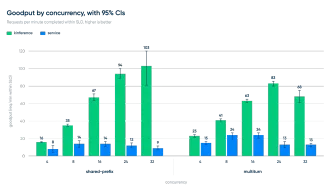
    Buoyant has released Kinference, an open-source Kubernetes and vLLM inference control plane, with the current version being v0.1.0-alpha.7. It distributes requests in front of vLLM worker nodes through routing policies, token rate limiting, KV cache-aware load balancing, and tenant-specific metrics. In benchmark tests, for shared prefix workloads, the median TTFT decreased from 6.88 seconds to 0.31 seconds (95%).

  2. Hugging Face Daily Papers65

    Drex open-source decision model released

    Drex open-source decision model returns the probability distribution of user options without autoregressive decoding, using supervised fine-tuning, RLAF, and consistency loss to improve accuracy, robustness, and latency. Its 35B parameter Max version achieves an industry-leading score of 67.52 on Decision Index 0.4.1, with a response time only 9% of GPT-6 Sol and 5% of Claude Opus 5.5.

  3. ITHome · AI62

    Anthropic has not yet released an AI model to help solve major quantum computing challenges

    Anthropic's yet-to-be-released AI model helps the physical research institution PSI prove the Allen-Arnold conjecture, which has not been resolved since it was proposed in 2008 and involves when quantum computers can surpass the computational speed of traditional computers. The research system developed by PSI based on this model completed the proof in just three days, confirming that quantum advantage depends on special laws of the problem. Previously, OpenAI has used AI to solve the Navier-Stokes equation problem.

  4. Hacker News · 300+60

    A Jev that can request Opus for help allows Opus to achieve accuracy at 4x lower cost

    The Jev and Luna models perform decently in identity resolution result scoring (88.8–97.3% accuracy), but the Jev+Opus hybrid model achieves state-of-the-art accuracy while reducing cost by 4x. Luna initially performs better than Jev, but the gap disappears in complex cases; Jev has better confidence calibration, with its errors often accompanied by low confidence, while Luna's errors are often accompanied by high confidence.

  5. Baseten Labs65

    Research shows that on-policy self-distillation (OPSD) is biased and has limited effectiveness

    Research indicates that on-policy self-distillation (OPSD) may still be valuable in specific scenarios, but more research resources should not be invested. OPSD trains through the outputs generated by the student model itself with context prompts, but research shows that this intensive supervision may introduce bias, especially for trained models, making it less effective.

  6. ITHome · AI65

    Anthropic research claims Claude AI can become smarter by 'dreaming'

    Anthropic releases research stating that Claude AI agents can improve long-term task performance through a 'dreaming' mechanism, reflecting on historical records, correcting errors, and building knowledge structures during idle time. Claude Opus 5.5 and Sonnet 5.5, after using memory in CL-Bench database question-answering tasks, achieve average scores of 0.838 and 0.833 respectively, outperforming the memoryless baseline of 0.655 and 0.644.

  7. NVIDIA Technical Blog35

    NVIDIA has launched Reshard Collective to accelerate reinforcement learning weight reshuffling.

    NVIDIA has launched the Reshard Collective technology, which enhances the speed of reinforcement learning strategy model weight reshuffling by 3.5 times through cross-GPU resource coordinated refreshing. This solution supports parallel running of inference and training in distributed GPU architectures, achieving training efficiency optimization. Reshard Collective can be used in the post-training stage of reinforcement learning, reducing latency through dynamic weight synchronization.
  8. AWS Machine Learning Blog42

    AWS releases serverless MCP server for accessing AI agent data lake on Amazon ECS Fargate

    AWS launches serverless Model Context Protocol (MCP) server on Amazon ECS Fargate to address integration challenges of LLM agents accessing corporate data lakes in AI applications. The server achieves metadata-driven, configurable data lake access without the need to write integration code for each dataset, and supports elastic scaling in multi-tenant environments.

  9. AWS Machine Learning Blog

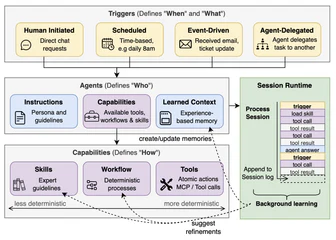
    Agent primitives classification in AWS Quick

    AWS Quick breaks down agent work into four primitives: 'When', 'What', 'Who', 'How', triggering tasks, agents execute and use capabilities (tools, skills, workflows) to complete work. Triggers are of four types: human-initiated, agent-delegated, scheduled, and event-driven; agents are persistent learners, including instructions, dynamically updated capabilities, and accumulated contextual memory; capabilities range from fully autonomous to fully deterministic, tools are atomic operations, skills provide structured guidance, and workflows are deterministic coordination.

  10. AWS Machine Learning Blog58

    Amazon SageMaker Inference now supports Multi-Instance GPUs to maximize GPU utilization

    Amazon SageMaker Inference now supports GPU partitioning, dividing physical GPUs into independent partitions via NVIDIA Multi-Instance GPUs (MIG), where each partition receives a fixed share of GPU computing units and dedicated memory blocks for isolation. Deploy more models in isolation and choose the appropriate size of GPU units on demand to reduce costs, with a maximum of 7 partitions per GPU, no need to build Kubernetes yourself.

  11. Databricks Blog38

    Databricks Feature Views implement real-time fraud detection.

    Databricks Feature Views achieve real-time fraud detection model training and online inference through a unified definition, preventing data leakage and training-service bias; support real-time feature calculation for Kafka streams, combining features like five-minute transaction count and thirty-day average spending, to implement risk scoring and real-time transaction monitoring in fraud detection applications.

  12. Mastra Blog38

    Mastra agents now support receiving doorbell events via Ring signals.

    Mastra agents can use Ring signals to receive doorbell events, with each event arriving at the agent thread as a notification signal with configurable priority. Agents can retrieve snapshots or video clips from the Ring API and decide on actions when someone presses the doorbell, such as security agents detecting human motion, viewing snapshots, and marking visits requiring urgent attention, or delivery assistants notifying package delivery.

  13. OpenClaw Blog58

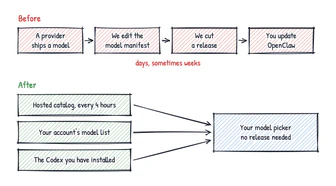
    How to integrate new models without updating OpenClaw

    OpenClaw has optimized its model integration mechanism, allowing new models to be accessed without updates. It dynamically retrieves model information through three methods: the self-updated model catalog catalog.openclaw.ai, the user account model list, and the local Codex version, solving the pain point in the old mechanism where models like GPT-6 Sol could not be selected due to version mismatches. The new mechanism reflects model availability in real-time and supports selecting models from the user account list and locally installed Codex, enhancing model availability and user experience.

  14. Claude · YouTube42

    How Salesforce leverages Claude Code to improve AI coding efficiency and output quality

    Salesforce expanded Claude Code to thousands of engineers, doubling effective output and reducing the number of bugs per line of code. The 'effective output' scoring system, co-built by the company's engineering leadership and Stanford researchers, measures AI coding ROI, and the intelligent agent maturity curve guides engineers from simple prompts to fully autonomous agents.

  15. O'Reilly Radar22

    AI Weekly Scan: The cost of progress

    Google has released the Gemini 4 Carbon for cybersecurity and multi-step tasks, French Mistral has announced the weights of its 100 billion parameter Large 4 model, and DeepMind has previewed the Genie 4 world model for simulated environments.

  16. AWS Machine Learning Blog38

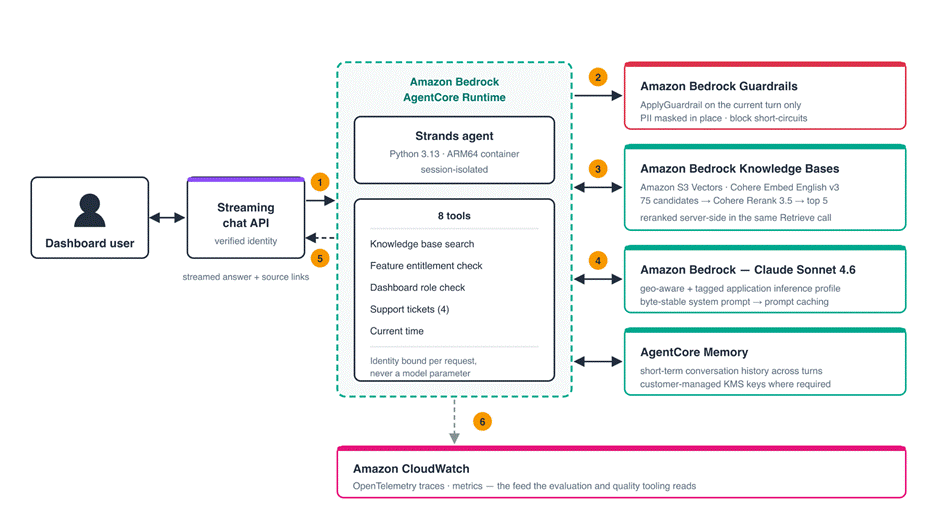
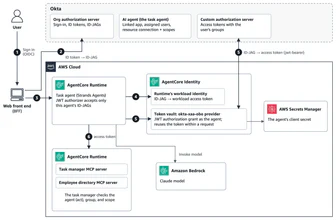
    Taxbit Assist: An authorized AI agent based on Amazon Bedrock AgentCore

    Taxbit Assist embedded in the Taxbit dashboard, running via Amazon Bedrock AgentCore, requiring user authentication. Intelligently searches for candidate paragraphs in the Amazon Bedrock knowledge base and rearranges them on the server side. Answers must be source attributed and role permission compliant, without providing tax advice. AgentCore manages conversation state in memory, supports regional data residency, and complies with ISO/IEC 42001 standards.

  17. AWS Machine Learning Blog38

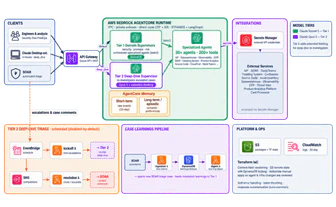
    Greenlight Financial builds an autonomous secure operations center solution based on Amazon Bedrock AgentCore

    Greenlight Financial autonomously processes over 90% of 4,000 security risk cases each month. Its solution, Luna, runs on Amazon Bedrock AgentCore, which includes over 30 specialized agents. Through AgentCore's runtime and memory support for hierarchical multi-agent systems, it achieves second-level security event triage in seconds without human intervention.