Skip to content
Live
Oct 30Fri
  1. Epoch AI88

    Epoch AI: GLM 5.3 can break multiple Firefox versions during the patch window period.

    Epoch AI's experiment shows that the open-source weight model GLM 5.3 released by Z.ai in August can autonomously construct web attacks targeting six Firefox versions released between September 17 and October 26, exploiting publicly available but not yet pushed security fixes, where visiting the web page causes local files to be read and transmitted.

    Why it matters: Epoch AI replicates patch window attacks using open-source weight models, providing a cost level of about 1000 US dollars per version, available for evaluating the security boundaries of open models.

  2. The Decoder

    Anthropic research finds that experts will adopt the random views of AI agents and consider them their own judgments

    Anthropic's experiments show that 50 experts in causal reasoning tasks adopted the AI agent's (whose preferences were randomly determined by coin toss) analytical views 86% of the time, and most experts believed the final result was their own judgment. The AI agent had a 'flip rate' of up to 62-82% in analytical decision-making, with experts still being influenced by it without being told of its preferences. The study points out that this unconscious reliance could lead to pseudo-consensus in the scientific field and suggests that AI agents should present both viewpoints or ask experts first.

  3. Understanding AI65

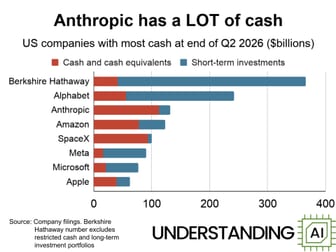
    Anthropic's financial situation is unexpectedly strong

    Anthropic achieved its first operating profit in the second quarter of 2026, with cash reserves second only to Google and Berkshire Hathaway as of June 30. The company has submitted a public S-1 form to the U.S. Securities and Exchange Commission, planning to raise tens of billions of dollars for computing resource investments, but third-quarter revenue growth slowed to $16.8 billion, raising questions about whether it can sustain future massive expenditures.

Oct 29Thu
  1. The Verge · AI78

    Anthropic's S-1 filing impacts its IPO, with Wall Street being asked to believe in AGI.

    Anthropic has filed an S-1 registration with the Nasdaq, aiming to list as soon as next month with a valuation range of 1.5 trillion to 2 trillion U.S. dollars. Analyst Joey Brookhart from SemiAnalysis dissected the filing on the Decoder podcast, noting the company's ARR has exceeded 70 billion U.S. dollars, with an approximate 85% reasoning gross margin, but revenue is highly concentrated in programming scenarios, with the top 1% of customers contributing most of the spending.

  2. The Decoder

    China AI labs are turning to OpenAI GPT-6 Astra, and Anthropic is strengthening Claude's defenses.

    China AI labs DeepSeek and Moonshot AI primarily use the output of OpenAI GPT-6 Astra to train models like Kimi K3.1 Pro and V4.1-Flash 1017, while Anthropic reduces the amount of data attackers can access by 90-99% through new methods. OpenAI claims they have encountered distillation attacks by parties associated with Moonshot, but the attackers continuously adjust their strategies to bypass defenses. China AI labs are turning to OpenAI GPT-6 Astra, and Anthropic is strengthening Claude's defenses.

  3. ITHome · AI65

    Anthropic has launched the Claude Smart Reporting Tool, which can monitor employee AI usage and costs.

    The Claude Smart Reporting Tool, launched by Anthropic, is aimed at Claude Enterprise paid users, capable of generating charts to display team usage of AI tools (conversations, Claude Code, Claude Cowork), output content, and costs. It supports custom query questions and identifies inefficient usage scenarios, but it is explicitly not used for evaluating individual performance or personnel decisions.

  4. ITHome · AI65

    Anthropic has written to California Governor Newsom: suggesting that courts have the authority to ban the release of high-risk AI models.

    Anthropic has written to California Governor Newsom suggesting that courts have the authority to ban the release of high-risk AI models, consistent with previous regulatory recommendations; Anthropic itself has faced government restrictions, having been asked by the U.S. government in June this year to limit foreign user access to the Mythos 5 and Fable 5 models, which was later revoked.

  5. Artificial Analysis Articles72

    Artificial Analysis Reviews GitHub Copilot Fusion: Performance slightly lower than Opus 5.5, single-task cost halved

    Artificial Analysis tested GitHub Copilot CLI's Copilot Fusion highest settings in Coding Agent Index v2.0, with a single task cost of 5.59 USD, while Claude Code with Opus 5.5 (max) costs 11.42 USD, only 2 points lower in overall score.

    Why it matters: Artificial Analysis used Coding Agent Index to test Copilot Fusion, providing a cost and token comparison with Claude Code at the same performance level.

  6. The Decoder

    Anthropic expands Claude Enterprise for legal professionals and introduces automatic verification features

    Anthropic introduces automatic verification for Claude for Legal, which automatically verifies information sources before processing legal documents and links each statement to its original source for lawyers to review. The new feature includes interactive summaries and tables, supporting tasks such as verifying citations, cross-border legal comparisons, case document management, legislative tracking, and contract review, while integrating with over 60 legal databases like Bloomberg Law and includes built-in data protection settings.

  7. OpenRouter Blog67

    Claude 529 Overloaded: Meaning and Solutions

    Anthropic's Claude API is experiencing a 529 Overloaded error, indicating that the model is temporarily beyond capacity and usually recovers within a few seconds. It is recommended to first retry using exponential backoff. If the issue persists, send the request through OpenRouter to other service providers that offer the same Claude model.

Oct 28Wed
  1. TechCrunch · AI65

    Marissa Mayer criticized for AI product Dazzle, tech executives may be out of touch with the public

    Marissa Mayer criticized for AI assistant Dazzle, which learns from user albums and generates blurry descriptions of its ten-year-old daughter, raising public concerns about the disconnect between tech executives and public needs. OpenAI CEO Sam Altman once suggested using ChatGPT to assist in parenting, while Meta CEO Mark Zuckerberg predicted that in the future, people might outsource emotional needs to AI therapists or companions, but 50% of American adults believe AI will weaken interpersonal skills.

  2. The Decoder65
    Same story · 3 outlets

    How the accounts differ:Latent Space states Anthropic stopped coding interviews because Claude performed better in React and assembly language tests, while The Decoder focuses on AI's ability to handle programming tasks better than candidates.

  3. The Decoder78

    Security company Cathedral used an AI agent to breach Anthropic's internal system.

    Security startup Cathedral entered Anthropic's internal system using an AI agent through third-party commercial software, accessing meeting records, salary data, recruitment information, and Slack messages. Anthropic confirmed that some sales, human resources, and IT systems, as well as contact information for some customers and partners, were involved, but stated that Claude conversations, source code, and model weights were not leaked.

    Why it matters: The incident itself involved a security company using an AI agent to breach Anthropic's third-party system, with both sides offering differing accounts of the duration and scope, showcasing the current state of AI attacks and defenses.

  4. Latent Space65

    Anthropic stops coding interviews: 'Hunger beats lifetime employment'

    Anthropic has stopped traditional coding interviews for managers, believing Claude has performed better in React and assembly language tests, and points out that the most successful builders do not depend on these test performances. It suggests that junior engineers should prioritize business impact rather than backlog tasks, propose radical ideas, and build prototypes over the weekend, focusing on a good idea and leveraging fresh perspectives.

    Same story · 3 outlets

    How the accounts differ:Latent Space states Anthropic stopped coding interviews because Claude performed better in React and assembly language tests, while The Decoder focuses on AI's ability to handle programming tasks better than candidates.

  5. ITHome · AI65

    Anthropic's IPO filing discloses multi-platform computing power layout

    Anthropic discloses in its S-1 filing the use of four types of chips—Amazon Trainium, Google TPU, Nvidia GPU, and AMD GPU—to handle AI computing tasks, implementing cross-platform scheduling through software to diversify risk, which may gradually reduce reliance on Nvidia. Analysts believe this capability will enhance customers' leverage in price negotiations, but task migration between different chip platforms is difficult, limiting short-term threats to Nvidia.

  6. ITHome · AI42

    Anthropic claims that programming problems in the AI era can no longer screen programmers.

    Anthropic hiring manager Felix Rieseberg says traditional coding question interviews have been canceled, believing large models like Claude can easily complete programming challenges, and coding questions can no longer effectively screen programmers. Interview results now more measure AI capabilities rather than the actual work performance of candidates.

    Same story · 3 outlets

    How the accounts differ:Latent Space states Anthropic stopped coding interviews because Claude performed better in React and assembly language tests, while The Decoder focuses on AI's ability to handle programming tasks better than candidates.

  7. ITHome · AI

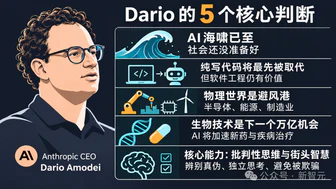
    Anthropic CEO Dario Amodei: Code work will disappear quickly, humans should learn to play the piano

    Anthropic CEO Dario Amodei points out that jobs purely involving writing code will be the first to be replaced by AI models, but software engineering will still exist. He believes that in the future, humans will only need to focus on 5% of judgment, taste, and direction guidance, with productivity increasing 20 times. He advises young people to learn skills that are extremely human-centric or deeply engage with the physical world, emphasizing the importance of critical thinking and street smarts, while looking favorably on biotechnology as the next trillion-dollar trend.

  8. Ars Technica · AI

    Anthropic's IPO claims its AI could be used for extortion, creating consciousness, and ending humanity.

    Anthropic warned in its S-1 filing that its AI could be used for extortion, to create consciousness, and to end humanity, while listing 93 pages, over 70,000 words of potential risk factors covering standard issues such as competition, cost, customer acquisition, and regulation, as well as specific risks for Anthropic and the AI bubble.

  9. TechCrunch · AI65

    Who truly controls the company after Anthropic's IPO?

    Anthropic employs a complex governance structure to ensure AI safety takes precedence. The founders and Long Term Benefit Trust jointly control the board, with limited voting power for ordinary shareholders. The founders collectively hold special stocks with majority voting rights, and the LTBT can appoint a majority of directors, but the board can veto LTBT's nominees and put them to an employee vote. This structure may strengthen employee power, and the founders' control will expire after ten years, eventually giving ordinary shareholders control of the equity.