Skip to content
Live
Apr 8Mon
  1. Dify Blog

    Dify launched the AI Workflow feature

    Dify launched the AI Workflow feature, achieving expected multi-step logic outputs through an intuitive drag-and-drop interface. This feature can be used as a standalone application or activated as Chatflow within Chatbot applications, supporting nodes such as LLM, tools, question classifiers, knowledge retrieval, code execution, and conditional logic, and can be integrated into existing systems via API.

Mar 15Fri
Mar 11Mon
  1. LangChain Blog

    How does Dosu improve the reliability of large language models through evaluation-driven development?

    Dosu enhances the reliability of large language models through evaluation-driven development (EDD), using LangSmith to monitor and search activities to address challenges brought by growth. The team adopts the EDD process to improve core logic, models, or prompts, ensuring maintenance of performance and improvement of weak points. The LangSmith SDK provides the necessary fine-grained control and customization, supporting the management of prompts as code and tracking metadata.

Feb 22Thu
Feb 4Sun
  1. Dify Blog65

    How Dify builds an AI travel advisor

    Dify enables developers to quickly build AI applications through visual prompt composition, operation, dataset management, and an integrated RAG engine. Users can input their destination, number of days, or budget, and the AI travel advisor can generate itineraries by combining Wikipedia and Google searches, providing local accommodation and dining information, prices, and reviews. Dify supports deploying functionalities similar to Assistants API, running based on any popular LLM, and performs better with the gpt-4-1106-preview model.

Jan 26Fri
  1. Dify Blog65

    Dify introduces the Agent Assistant mode: Build an AI financial investment analysis assistant.

    Dify v0.5.0 introduces the Agent Assistant mode, supporting the use of mainstream LLMs from the market to build complex, multi-step problem-solving solutions. Users can generate investment analysis reports for any listed company based on the Yahoo Finance tool (News, Analytics, Ticker) through this mode, achieving automated research, improving efficiency, and reducing information search time.

Jan 24Wed
Jan 10Wed
Jan 3Wed
  1. Dify Blog65

    Dify v0.4.1 release: Refactoring of the model runtime architecture.

    Dify has released version v0.4.1, refactoring the model runtime architecture to replace the old LangChain-based interface, aiming to simplify the development process and enhance the robustness of the codebase and the friendliness to contributors; the new architecture reduces external dependencies, aligns more closely with development needs, and supports model providers such as OpenAI, Anthropic, Azure, and Google Gemini, simplifying model deployment through YAML configuration.

Dec 26Tue
  1. Dify Blog65

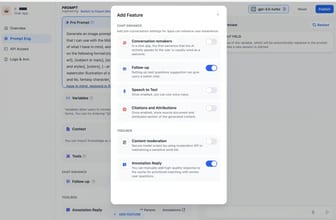
    How does Dify.AI's Annotation Reply feature improve chatbot quality and reduce costs?

    Dify.AI's Annotation Reply feature allows manual editing of historical conversations or importing batches of Q&A to prioritize matching similar user questions with annotated replies, enabling chatbots to provide precise answers in specific scenarios. This feature helps build an LLMOps data feedback loop, reducing LLM call costs and latency in conversational scenarios, and accumulating valuable data assets for future model fine-tuning.

Dec 20Wed
Dec 5Tue
Nov 25Sat
  1. Dify Blog

    Dify's open-source assistant API is based on any large language model.

    Dify offers features such as self-hosted deployment, multi-model support, RAG engines, and APIs, providing more flexibility to address challenges with the OpenAI Assistants API in terms of cost, data security, and model selection. Its self-hosted deployment strategy ensures data privacy and security, compatible with commercial and open-source models like OpenAI, Anthropic, and Llama2. The RAG engine supports integration with vector databases like Qdrant and Weaviate, allowing users to customize indexing strategies.

Nov 21Tue
  1. Dify Blog

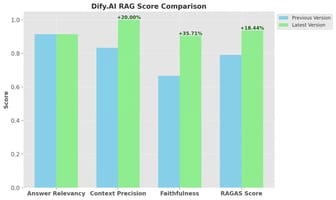
    Dify.AI v0.3.31 released: RAG technology improved by 20% over OpenAI Assistants API.

    Dify.AI v0.3.31 update enhances RAG technology through hybrid search, semantic reordering models, and multi-path retrieval, improving question-answering efficiency by 20%, significantly outperforming the OpenAI Assistants API. Ragas evaluation shows an increase of 18.44% in Ragas score, 20% improvement in context accuracy, and 35.71% increase in faithfulness.

Nov 8Wed
Oct 23Mon
  1. Dify Blog65

    Dify.AI introduces a new prompt orchestration mode: a comprehensive analysis from basic to expert mode

    Dify.AI has released a new prompt orchestration mode, allowing users to switch from basic mode to expert mode for greater control. The expert mode is designed for professional developers and prompt engineers, supporting highly customizable orchestration, enabling editing of prompt elements such as context, user input, conversation history, and examples to achieve robust interaction with LLMs or datasets. The basic mode simplifies application creation, while the expert mode provides more configuration options, such as CHAT and COMPLETE models, and supports API calls to external tools.

Aug 15Tue
  1. Dify Blog65

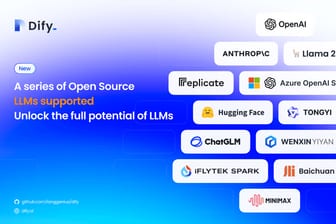
    Dify v0.3.13 released: Easily integrate open-source large models like Llama2 and ChatGLM

    Dify v0.3.13 released, integrating open-source large models like Llama2 and ChatGLM, supporting models from Hugging Face and Replicate platforms, allowing users to easily access and quickly build AI applications via API keys. The platform supports rapid switching between models, enabling users to compare performance by clicking the model selector, lowering the barrier for model selection and tuning.

Aug 1Tue
May 15Mon
May 10Wed
Apr 12Wed
  1. Dify Blog

    Dify guides developers on how to build effective GPT-based applications

    When developers use OpenAI's GPT API, the AI may not produce the expected output or may 'be uncooperative'. To address these challenges and improve GPT performance, it is necessary to follow three key steps: guide model behavior through prompt engineering, use single-point or few-shot learning techniques, and leverage embeddings to extend model context, and can adapt the model to specific domains through fine-tuning.

Apr 10Mon
  1. Dify Blog65

    Dify Launches Dify WebApp: Easily Build AI-Native Applications

    Dify Launches Dify WebApp, allowing users to quickly combine and deploy cloud-native AI applications without managing infrastructure. The platform offers two types of WebApps: conversational and text generation, respectively designed for building interactive experiences and content generation tasks. Users can deploy via GitHub repositories or self-hosted servers, and leverage open-source templates for lightweight or heavy customization development, integrating Dify's visual orchestration, operational, and dataset capabilities.

Apr 9Sun
  1. Dify Blog65

    Why did we create Dify

    Dify is dedicated to making AI technology more accessible, created to address the complex challenges developers face when using OpenAI's large language models to build AI applications, such as the difficulty of data preparation and model fine-tuning; the platform simplifies LLM application development and operations through a visual interface, unified API, and open-source strategy, and continuously integrates cutting-edge technologies like agent patterns and ChatGPT plugins.