The Decoder5353
Live
#Reasoning
- The Decoder5353
 Ollama releases3535
Ollama v0.40.8-rc0 released: added support for the Flint model.
Ollama v0.40.8-rc0 has been released, adding support for the Flint model. It retains the source tool JSON and decoding API values to maintain numeric types and pattern order in prompts, while keeping the existing API serialization unchanged.
- The Decoder4747
How Mistral and Nvidia use physics AI to accelerate industrial design
Mistral and Nvidia join forces to combine Mistral Large 4 with physics AI, CUDA-X, Warp, and Omniverse, providing an integrated workflow for design, simulation, and AI training for the aerospace, automotive, and semiconductor industries. Mistral Large 4 has approximately one trillion parameters and is trained on 3800 Grace Blackwell GPUs, with plans to release as an open-weight model at the end of October.
 Ant Group inclusionAI · Hugging Face new models3535
inclusionAI/Ling-3.0-tiny-UBTree release: A fine-tuned model based on UBTree technology
inclusionAI released the UBTree fine-tuned version of Ling-3.0-tiny, Ling-3.0-tiny-UBTree-B16, with 183.1M parameters, combining a five-layer DFlash backbone and a bigram selector, achieving 2.6-3.5 times speed improvement on benchmarks like GSM8K and MATH-500. This model needs to be used in conjunction with the target model. The UBTree adaptation for the open-source version of SGLang has not yet been released.
 Latent Space
Claude Mods: Reshaping the attention interface between agents and humans
Anthropic releases Claude Mods, allowing users to customize the behavior and interface of Claude Code through TypeScript or JavaScript functions, enabling personalized programming of attention interfaces.
 Modal Blog7575
Modal Dojo: A library to easily start production-level LLM training.
Modal Dojo is a library for easily performing production-level LLM training, supporting models from 500 million to 10 trillion parameters, providing automatically optimized training recipes and built-in observability dashboards. Users can select models, load data, and start training through simple prompts, supporting data sources such as Hugging Face and Harbor environments, and can adjust recipes through parameters.
 IBM Research Blog
IBM vLLM-Hook MIA Plugin enables rapid runtime monitoring and control
IBM releases vLLM-Hook MIA Plugin, implementing runtime monitoring and control in the vLLM inference engine, 20 times faster than its predecessor vLLM-Hook and 14 times faster than similar methods inserting code inside the model, with only a 2%-6% increase in latency. The plugin allows developers to observe and adjust model states in real-time, such as rejecting malicious prompts, marking hallucinatory facts, or editing response tone and accuracy, while almost not reducing performance.
 NVIDIA BlogFeatured6262
NVIDIA expands its family of open models to cover language, robotics, biology, and quantum computing
NVIDIA expands its family of open models to cover language, robotics, biology, and quantum computing, including the new Nemotron 3.5 Super VL and Nemotron 3.5 Bolt.
Why it matters: NVIDIA has rolled out open models across four lines: language, robotics, biology, and quantum, allowing readers to judge the coverage of its open-source ecosystem based on this.
 Mistral AI5050
Mistral collaborates with NVIDIA to advance AI in engineering
Mistral is collaborating with NVIDIA to integrate AI models with NVIDIA accelerated computing and physics modeling tools, accelerating engineering simulations and enabling closed-loop AI-driven design. The collaboration will launch public benchmarks and open datasets, standardizing the evaluation of physics and agent AI in computer-aided engineering, and leveraging NVIDIA Omniverse for 3D simulations and resource creation.
- NVIDIA Blog5555
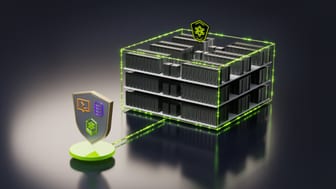
NVIDIA Confidential Computing expands, providing secure extension capabilities for cutting-edge model builders across global infrastructure
NVIDIA Confidential Computing protects models and data execution through hardware root isolation and encrypted authentication, adding Confidential Bare Metal deployment options, enabling cutting-edge model builders to run sensitive workloads on third-party infrastructure while retaining model data control.
- NVIDIA Blog5858
NVIDIA European partners expand computing capabilities, building sovereign, open, and secure AI agent cloud ecosystems.
NVIDIA European partners are expanding regional computing capabilities to support model training and inference, helping developers build agentic and physical AI applications. Nscale achieves 37% more GPUs and 50% higher inference throughput using the NVIDIA DSX platform, Crusoe develops a liquid-cooled AI factory for low-latency inference, and Nebius adopts the NVIDIA Groq 3 LPX to accelerate sensitive applications.
- NVIDIA Blog
NVIDIA showcased its full lineup of local AI hardware: RTX Spark, DGX Spark, and DGX Station, helping to power next-generation intelligent agents.
NVIDIA showcased its full lineup of local AI hardware at GTC Berlin, with RTX Spark now available to support personal agents on Windows PCs, DGX Spark enabling developers to build and scale Linux applications, and DGX Station designed for Linux enterprise teams to run cutting-edge workloads, with the Windows version launching in December.
 Databricks Blog
Databricks AI Runtime officially released
Databricks releases AI Runtime (AIR), bringing managed GPU infrastructure directly into its platform, allowing customers to train high-demand models at their enterprise data location. AIR provides GPU infrastructure, developer tools, and data governance features, supporting large-scale training, rapid iteration, and load safety, with customers not needing to manage a separate GPU stack.
 NVIDIA Technical Blog6565
How NVIDIA OpenShell Reference Architecture Ensures Security and Governance for AI Agent Workloads at Scale
NVIDIA OpenShell Reference Architecture ensures the security of AI agent workloads at scale by defining security boundaries and governance policies. The architecture allows agents to access files, tools, and the internet while performing complex tasks and enables dynamic collaboration. It mitigates risks associated with long-running agents through enhanced access control, audit logs, and permission management.
 AWS Machine Learning Blog5858
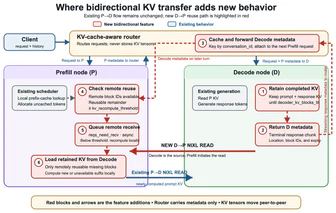
vLLM enhances the TTFT performance of multi-round agent workloads through bidirectional KV transmission.
vLLM's bidirectional KV transmission mechanism reduces redundant calculations by allowing the decoding node to return previously computed KV cache to the pre-filled node in subsequent dialogue turns. In multi-round benchmark tests on AWS EC2 P5en instances, it improved the TTFT of Qwen3-32B by 1.6x and zai-org/GLM-5-FP8 by 3.3x. This feature is implemented by extending the NIXL KV connector and utilizing a KV cache-aware router to coordinate KV reuse across dialogue turns.
- AWS Machine Learning Blog4949
vLLM launches a push-based KV transmission to improve the TTFT and TPOT of distributed inference.
vLLM introduces a push-based NIXL connector, by moving post-pre-filled transmission coordination and setup out of the critical path, reducing time to the first token (TTFT) and time per output token (TPOT), enhancing application responsiveness.
- AWS Machine Learning Blog3232
How Deepgram Optimizes Speech AI Performance with AWS Trainium2
Deepgram deploys the Nova-3 speech recognition model to PyTorch via AWS Trainium2, running 8 replicas on a single trn2.3xlarge instance, processing offline batch workloads with 11-70% more audio per dollar, and using the NKI library and Neuron Explorer/NAD toolchain for kernel-level tuning to improve inference efficiency.
- AWS Machine Learning Blog5858
TwelveLabs' Pegasus 1.5 is now available on Amazon Bedrock
TwelveLabs' Pegasus 1.5 video language model is now available on Amazon Bedrock, which can convert long videos into structured, timestamped metadata, supports analyzing the entire video based on user-defined standards and returns JSON data of matching segments, analysis duration extended to two hours per request, no pre-indexing required and data remains within AWS boundaries.
- AWS Machine Learning Blog3434
Developers can access SageMaker Studio through the new AWS experience
The new AWS experience allows new SageMaker AI customers to enter a fully configured SageMaker Studio environment with just a few steps after registration, without setting up an advanced AWS account or manually configuring the environment. New customers also receive $100 in AWS Free Tier credit.
- AWS Machine Learning Blog3434
Build a semantic layer using AtScale and Amazon Bedrock AgentCore on AWS to support AI agents.
AtScale as a semantic layer constructs dimensional models on Amazon Redshift using Semantic Modeling Language (SML), supporting Strands agents in Amazon Bedrock AgentCore to achieve cross-system Customer 360 analysis.
- AWS Machine Learning Blog3434
Building an AI agent semantic layer on AWS using Strategy Mosaic and Amazon Bedrock AgentCore.
Strategy Mosaic, as a semantic layer, models C360 domains on Amazon Redshift and Amazon Aurora without ETL using two linked models. Its metric syntax captures the business definition of agent reasoning and exposes the model to AgentCore-hosted Strands agents via the Mosaic MCP server, supporting user identity propagation to achieve end-to-end row-level and object-level security.
- AWS Machine Learning Blog4040
How Eon built a multi-cloud investigation platform on Amazon Bedrock AgentCore
Eon replaced its local Model Context Protocol (MCP) server with Amazon Bedrock AgentCore Gateway, integrating cross-AWS, GCP, and Azure operational tool access into a single authentication gateway, reducing new engineers' investigation tool configuration time from 2 days to 2 minutes.
- AWS Machine Learning Blog4848
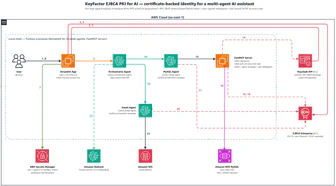
Using X.509 PKI to protect AI agent identity on AWS
Keyfactor EJBCA integrated with AWS services provides identity authentication for AI agents through X.509 Public Key Infrastructure (PKI), addressing the issue of lacking built-in authentication standards when MCP connects to external tools.
- AWS Machine Learning Blog3131
Using OpenAI GPT models on Amazon Bedrock in Canada and achieving cross-region inference.
Canadian organizations can use OpenAI GPT-5.6, GPT-6, and GPT-6.1 models on Amazon Bedrock in the Canadian (Central) and Canadian West (Calgary) regions to achieve cross-region inference.
- AWS Machine Learning Blog3838
How Octave built a secure multi-tenant AI infrastructure on Amazon Bedrock.
The Octave Reliance team built a three-tier secure multi-tenant AI infrastructure based on Cohere Embed v4 on Amazon Bedrock to solve the knowledge island problem in regulatory industry quality management, reducing deployment time by 50%.
- AWS Machine Learning Blog4040
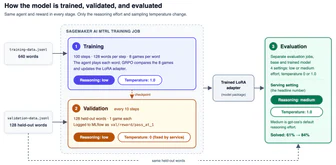
Fine-tune GPT-OSS-20B on Amazon SageMaker HyperPod for multilingual inference
GPT-OSS-20B is an open-source inference model that thinks in English by default, and only 22% met the target language requirements in multilingual inference tests. By using supervised fine-tuning (SFT) and reinforcement learning (GRPO) on Amazon SageMaker HyperPod, the team can improve the model's inference capabilities in French, German, Spanish, and Italian, where SFT is responsible for primary behavior teaching and GRPO optimizes when there is room for improvement.
- AWS Machine Learning Blog3838
How Amazon Quick and Amazon Bedrock AgentCore implement conversational intelligent decision-making in supply chains
Amazon Quick combined with Amazon Bedrock AgentCore provides supply chain teams with real-time data access across systems. Users can get cross-system answers in seconds through conversational queries, such as identifying high-income SKUs and costs affected by port closures. Quick serves as the interface layer, and AgentCore as the intelligence layer, connecting backend systems like ERP, monitoring, and procurement via the MCP protocol to achieve a complete process from problem discovery to generating emergency purchase requests, all operations requiring manual confirmation.
- AWS Machine Learning Blog
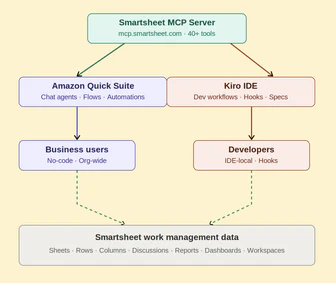
Smartsheet MCP on AWS launches general-purpose Model Context Protocol Server
Smartsheet launches Universal Model Context Protocol (MCP) Server, enabling AI assistants to read/write manage Smartsheet data via standardized protocol, supporting operations on tables, rows, columns, and automation for over 40 tools
- AWS Machine Learning Blog3939
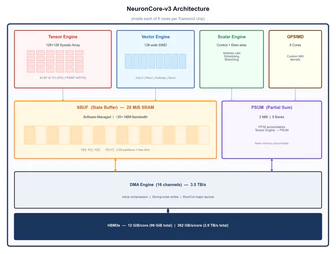
i14 on how to use native PyTorch to train and deploy Laplace 3B linear attention model on AWS Trainium2.
i14 deploys its 24-layer decoder Laplace 3B (3,072D parameters, using Gated Linear Attention architecture) to AWS Trainium2, achieving a training speed of 120,000 tokens per second and concurrent inference capability for 11,544 output tokens.
 GitHub Blog · AI & ML2222
How three Java masters leverage GitHub Copilot to boost productivity.
Three Java masters Vlad Mihalcea, Patrick Baumgartner, and Frank Delporte shared their experience using GitHub Copilot in projects such as Hypersistence Utils, Hypersistence Optimizer, and teaching slide migration.
 MIT Technology Review · AI5858
Goodfire researcher Nick Cammarata releases disruptive blog: The nature of neural networks might be easier to understand than previously thought
Goodfire researcher Nick Cammarata published a blog post stating that LLMs might be easier to understand than previously thought, causing shockwaves in the AI world. Cammarata believes that the mechanisms of neural networks may not be as difficult to decipher as previously thought, a view that is particularly noteworthy against the backdrop of frequent LLM proxy out-of-control incidents.
- The Decoder7373
Kling AI released version 4.0, supporting stereo audio, multi-language lip sync, and lightweight Flash variants.
Kling AI released video generator Kling 4.0, supporting stereoscopic audio, multi-language lip synchronization, and lightweight Flash variants, capable of generating 30-second videos in a single instance and accepting up to 10 key frame images input, Prompt understanding ability increased to 8,000 tokens.
- The Decoder6262
Cloudflare has released Clairic to extract data from documents faster and more cheaply.
Cloudflare Releases AI Model Clairic, Which Outperforms Large Language Models in Terms of Data Extraction Speed and Cost from Documents. Clairic Offers a Preview on Workers AI, with Open Weights Coming Soon.
- The Decoder7171
OpenAI claims that GPT-6 has significantly improved its performance on traditional programming languages such as COBOL and Fortran.
GPT-6 Astra achieved an average pass rate of 87.4% in MultiLangBench tests, an increase of 49.4% over GPT-5.6 Terra; GPT-6.1 Sol achieved an accuracy rate of 86.6% under low reasoning power and 97.9% under high reasoning power in the COBOL to C++ translation test.
 TechCrunch · AISame story · 2 outlets
Google releases open-source PyTorch version TorchTPU to attack Nvidia AI developer ecosystem
Google announced the release of its highly anticipated PyTorch version TorchTPU as an open-source project, allowing AI application developers to run their applications on Google's Tensor Processing Units (TPUs) chips.
Same story · 2 outletsHow the accounts differ:MarkTechPost states TorchTPU is a native PyTorch backend for cloud TPU designed to replace PyTorch/XLA and supports eager-first execution; TechCrunch mentions it as an attack on Nvidia's AI developer ecosystem.