Skip to content
Live
Oct 30Fri
  1. Hugging Face Daily Papers52

    WeVisCut: An integrated smart editing agent from narration to long videos

    WeVisCut coordinates video editing tools, recovers from failures, and reduces token usage through a compact strategy trained on 9B parameters, while maintaining output quality. The system employs a four-stage data pipeline, combining editing inversion and validation replay, to generate over 130K training examples from 3,750 finished videos for training a single strategy.

  2. OpenRouter Blog

    OpenRouter Guardrails now separates organization limits from workspace defaults

    OpenRouter Guardrails reconfiguration allows administrators to set organization-wide limits, providing different budgets and model access permissions for different people, and divides budget, model access, and content moderation into three independent policies. Organization administrators can set global budgets, zero data retention requirements, or available models and providers, and workspace administrators set defaults within this range.

  3. ITHome · AI78

    Zhiyuan released the embodied model GO-3 Preview, topped three major lists, and plans to open source by the end of 2026.

    Zhiyuan launched the embodied model GO-3 Preview on October 29, adopting an embodied-native WRAM architecture that connects task reasoning, future prediction, and action generation, and has topped the three major evaluation lists: RoboDojo, RoboTwin, and RoboColiseum. It plans to fully open source by the end of 2026.

    Why it matters: The deployment data provided by the original text shows a success rate of real-life convenience store tasks ranging from 28.6% to 85.7%, which can be observed as the path of online self-improvement of embodied models.

  4. Epoch AI88

    Epoch AI: GLM 5.3 can break multiple Firefox versions during the patch window period.

    Epoch AI's experiment shows that the open-source weight model GLM 5.3 released by Z.ai in August can autonomously construct web attacks targeting six Firefox versions released between September 17 and October 26, exploiting publicly available but not yet pushed security fixes, where visiting the web page causes local files to be read and transmitted.

    Same story · 2 outlets

    How the accounts differ:The Decoder mentions the cost of 1000 dollars and that the vulnerability was fixed in Firefox 159.0, while Epoch AI does not mention these details.

    Why it matters: Epoch AI replicates patch window attacks using open-source weight models, providing a cost level of about 1000 US dollars per version, available for evaluating the security boundaries of open models.

  5. LangChain Blog67

    LangChain adds browser capabilities to Managed Deep Agents

    LangChain adds browser capabilities to Managed Deep Agents, allowing developers to export browser configurations through define_browser, enabling managed agents to read page rendering results and perform click operations.

    Why it matters: The original text provides the integration method for browser tools, handoff mechanisms, and WebVoyager experimental data, which can be used to determine how managed agents can cover web tasks without APIs.

  6. Baseten Blog22

    Baseten and Postman: Building Enterprise-Grade Reliable and Cost-Effective Agents

    Postman's Agent Stack includes four products: Passport, Fabric, Astropods, and Fern, used for preparing APIs, controlling access, and governing agent behavior. Baseten, as Postman's recommended enterprise team reasoning partner, provides fast, reliable, and cost-effective reasoning infrastructure, supporting multiple models such as Beam 1.0 and DeepSeek V4.1 Flash, ranking top in throughput and latency.

  7. TechCrunch · AI78

    Mistral has opened the weights of its trillion-parameter model, Mistral Large 4, focusing on network security.

    Mistral has released the weights of its trillion-parameter open-source model, Mistral Large 4 (ML4, nickname Le Chonk), which businesses and governments can obtain and deploy on their own via Hugging Face and API.

  8. Amazon Science

    Amazon Science explores technology to accelerate language models in travel applications

    Amazon Science combines knowledge distillation (KD) and the Medusa framework to optimize the travel platform LLM. After fine-tuning, KD training, and Medusa head modification, the TinyLlama 1.1B model achieves performance close to the 70B parameter Llama-3.1 teacher in AI travel planning, intelligent filtering, and accommodation description generation scenarios, with costs reduced by two-thirds and speed increased by 10-20 times.

  9. AWS Machine Learning Blog42

    MoEngage on how to use AgentCore Gateway to convert 400 APIs into intelligent agent tools

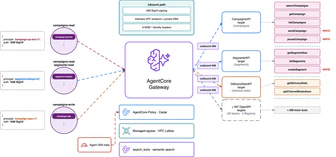
    MoEngage transforms 400 internal APIs into permission-controlled intelligent agent tools through Amazon Bedrock AgentCore Gateway, solving multi-team API integration challenges. This solution eliminates the need to set up MCP servers or configure networks, reducing the time to launch new APIs from days to hours while meeting constraints such as keeping APIs within the VPC, controlling identities from the server side, and ensuring tool definitions do not occupy the reasoning context window.

  10. The Decoder

    French Mistral releases 'Le Chonk,' which has strong coding capabilities but still lags behind Chinese models.

    Mistral has released its largest model, Mistral Large 4, which leads open-source competitors in coding tasks but still lags behind Chinese models in overall rankings. The model has approximately 100 billion parameters, with 52 billion parameters per step, requiring 8 Nvidia B300 GPUs to run.

Oct 29Thu
  1. Hugging Face Blog

    Project ProtoStar project release: Promoting the AI compatibility of publicly funded scientific research

    Project ProtoStar is announced, aiming to unlock the potential of publicly funded scientific research by making datasets, models, and code more accessible and reusable. The project brings together universities, research institutions, industry, and the open science community, supporting the release of scientific achievements in AI-compatible, machine-actionable formats, and demonstrating its value through a series of public challenges. The first challenge, hosted by Carnegie Mellon University, will launch on November 2.

  2. Hacker News · AI hot posts

    Lean founder Leo de Moura: How AI is driving the development of formal verification.

    Lean founder Leo de Moura discussed how AI can make formal verification more accessible and potentially change software engineering. AI-generated code needs to be verified for correctness using formal verification, and Lean can be used to write machine-verifiable proofs, with two verifiers already available. AI can assist in implementing code and automatically proving its properties, such as when Kim Morrison ported zlib to Lean and proved it to be lossless compression.

  3. vLLM Blog78

    vLLM supported Mistral Large 4 on the first day

    vLLM announced support for Mistral Large 4 on the release day, which is a 1 trillion parameter, 49B token-activated MoE native multimodal model, using MLA with DSA sparse indexer, and built-in DSpark speculative decoding draft model.

  4. Hugging Face Blog85

    Mistral Large 4 (Le Chonk) released on Hugging Face

    Mistral releases multimodal MoE model Mistral Large 4 (Le Chonk), with approximately 1T total parameters, 49B activation parameters, a context window of 1M tokens, offering two official versions FP8 and NVFP4, as well as GGUF made by Unsloth and llama.cpp teams.

    Why it matters: The original text provides specific scores for the 1T total parameter, 49B activation multimodal MoE model on cybersecurity and coding benchmarks, along with measured throughput for local and endpoint deployment.

  5. Hugging Face Blog

    Hugging Face Granite Switch 4.1.1 released: software-based model update

    Hugging Face releases Granite Switch 4.1.1, an incremental update based on 4.1, maintaining full backward compatibility. New features include multilingual speech-to-text models (supporting 10 languages with native punctuation) and a decision adapter for improved performance on the Jev decision index test set. The team achieves rapid deployment by updating only the adapter without recalculating the base model, and future support for third-party custom adapters is planned.

  6. ITHome · AI58

    Microsoft has released the largest DirectX ray tracing upgrade since 2018: AMD RX 9070 example performance improvement of about 66 times

    Microsoft has released the official version of DirectX 12 Agility SDK 1.620 and the preview version 1.722, bringing updates such as cluster geometry and PTLAS to DXR to reduce ray tracing computational overhead. On the AMD RX 9070, cluster geometry boosts performance from 1.2 FPS to 79 FPS, an increase of about 66 times, with memory usage reduced by nearly 90%. New features require support from graphics card manufacturers, currently covering NVIDIA RTX, AMD RX 9000 series, and Intel Arc graphics cards.

  7. 36Kr · AI

    Zhiyuan Innovation releases the GO-3 Preview, WITA-OMNI, AGILE model combination to accelerate the deployment of the entire physical AI chain

    Zhiyuan Innovation launches GO-3 Preview (tops RoboDojo and other evaluations), WITA-OMNI (wins first place in four rankings), and AGILE general sports intelligence algorithm framework, respectively tackling tasks, interaction, and sports abilities; Lingqu OS 1.0 and AHA3 hardware architecture integrate software and hardware ports; Worken measures intelligent work hours, aiming to convert 20000 offline robots into actual productivity.

  8. Mistral AI82

    Mistral releases open-source model Mistral Large 4 (Le Chonk) with trillion parameters

    Mistral releases open-weight version of its flagship trillion-parameter native multimodal model Mistral Large 4 (Le Chonk), which has been in public preview for three weeks.

    Why it matters: The official provides data on the encoding, security, and inference efficiency of the trillion-parameter open-source model, as well as weight downloads and self-hosting paths.

  9. ITHome · AI42

    XHEART NewCore Journey releases the intelligent driving large model chip X7 Ultra: 700 TOPS large model computing power, first in China to mass-produce Armv9 automotive-grade CPUs.

    XHEART NewCore Journey releases the X7 Ultra large model chip, achieving 700 TOPS of computing power, with mass-produced models achieving 99.99% alignment, a 80% reduction in memory bandwidth consumption, and a 100% improvement in energy efficiency. The chip incorporates a high-precision operator acceleration engine, natively supporting FP16/FP32 computing, and is the first in China to mass-produce Armv9 automotive-grade CPUs, offering a 20% performance boost and a 10% improvement in energy efficiency.

  10. ITHome · AI

    Momenta CEO Cao Xudong first publicly shares insights on large model definition chip

    Momenta CEO Cao Xudong first publicly defined the large model definition chip, which improves performance 10 times compared to general chips and can support billion-parameter models to achieve large-scale L4, driving breakthroughs in physical AI applications such as robots. XHEART New Chip Journey released a new X7 Ultra large model chip, specifically designed for large models, featuring a super-large core NPU architecture and Armv9 automotive-grade CPU.

  11. MarkTechPost

    Infini-AI-Lab releases open-source AI agent adapter framework Hermit

    Infini-AI-Lab releases open-source framework Hermit v0.1.0, with adapters that can fine-tune Codex or Claude Code agents without altering the model or framework. Using GLM 5.3 Flash on OfficeQA, CL-Bench, and ServeLearnBench, results with adapters are better than baseline results without adapters. The MWM adapter achieves 0.795 accuracy in database exploration on CL-Bench.

  12. ITHome · AI

    NewCore Voyage X7 Ultra chip is the first in China to mass produce Armv9 automotive-grade CPU.

    NewCore Voyage has released the X7 Ultra large model chip, which includes a high-precision operator acceleration engine, supports 10 times the parameter model deployment, and achieves an NPU computing utilization of 98.7%. Memory bandwidth consumption is reduced by 80%, and energy efficiency is improved by 100%. This chip is the first in China to mass produce Armv9 automotive-grade CPU, with a performance increase of 20% and an energy efficiency improvement of 10%.

  13. ITHome · AI78

    NVIDIA open-sourced the speech transcription model Nemotron 3.5 Transcribe, supporting 40 languages and 8 speaker separation.

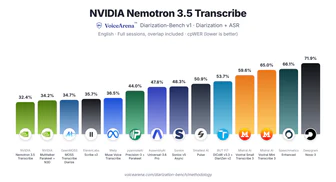
    NVIDIA launched the open-weight speech transcription model Nemotron 3.5 Transcribe on October 28, integrating transcription, speaker attribution, translation, and audio Q&A, using the MoE architecture, with total parameters of about 34 billion and activation parameters of about 4.3 billion, capable of processing the longest recording of 1 hour, supporting transcription of 40 languages, and distinguishing up to 8 speakers.

    Why it matters: NVIDIA open-sourced the speech transcription model, disclosing parameter scale, multilingual and speaker separation capabilities, and benchmark results, allowing comparison with existing open-source ASR solutions.

  14. ITHome · AI65

    Xiaomi MiMo Desktop membership benefits upgraded: increased quota without price increase, new third-party models such as DeepSeek added

    Xiaomi has increased the membership credit for MiMo Desktop without increasing prices, taking effect in real-time for both new and existing members. New third-party models such as DeepSeek V4 Pro, DeepSeek V4.1 Flash, GLM 5.3, GLM 5.3 Flash, Kimi K3, Qwen 3.8 Flash, and Qwen 3.8 Max are now available for members to choose, with each model labeled with its consumption multiplier.

  15. QbitAI

    Zhuji Dynamics releases FluxVLA Engine V2 technical report, one-click reuse of engineering capabilities makes embodied AI R&D more efficient

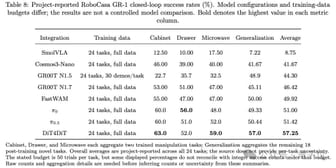
    Zhuji Dynamics releases the FluxVLA Engine V2 technical report, achieving full-chain reuse of model training, evaluation, and deployment through unified configuration, modular decoupling, and system optimization. It supports 14 mainstream strategies, with inference path frequency improved by 2.31–9.64 times, validated in closed-loop execution on 6 real machines including ALOHA and dual-arm Franka. Online reinforcement learning boosts SmolVLA success rates by 10.0–15.4 percentage points.

  16. QbitAI

    Zhuji Dynamics releases the FluxVLA Engine V2 technical report, enhancing the R&D efficiency of physical intelligence.

    Zhuojì Power updates the second technical report of the open-source engineering base FluxVLA Engine. V2 supports 14 strategies for LIBERO evaluation on the simulation side, increases model path frequency by 2.31–9.64 times on the inference end, and verifies deployment links on real hardware platforms such as ALOHA and dual-arm Franka. Online reinforcement learning boosts SmolVLA's success rates in LIBERO-10 and RoboTwin Clean tasks by 10.0% and 15.4%, respectively.

  17. ITHome · AI

    Hunan Titan Future releases the first 12-inch polycrystalline silicon carbide wafer in the country, passed TSMC certification test

    Hunan Titan Future announced the launch of the country's first 12-inch polycrystalline silicon carbide substrate, which has passed TSMC's certification tests and sent samples to Samsung. The product has a deposition speed of 60 micrometers per hour, a minimum resistivity of less than 1 milliohm·centimeter, and fewer than 0.1 holes per square centimeter. It is collaborating with companies like Google and NVIDIA, and is expected to be mass supplied after 2027.