Skip to content
Live
Jan 31Sat
  1. Browser Use

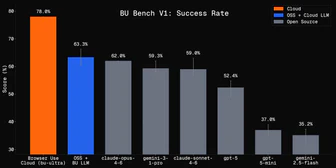
    Browser Use releases open-source browser automation benchmark BU Bench V1, Claude Fable-5 scores up to 80.0%

    Browser Use released the open-source browser automation benchmark BU Bench V1, containing 100 hardcore browser tasks, Claude Fable-5 scored the highest at 80.0%, leading GPT 5.5 by 12 points; Browser Use Cloud (bu-ultra) scored 78.0%, with a speed of approximately 14 tasks per hour. The benchmark is based on real-world website tasks, scored using LLM evaluators, and is available on GitHub.

Jan 5Mon
  1. Liquid AI Blog

    Liquid AI has released LFM2.5: the next-generation edge AI model family

    Liquid AI has released the LFM2.5-1.2B model family, with its pre-training extended to 28T tokens and significantly improved post-training performance through reinforcement learning, showing excellent performance on knowledge, instruction following, math, and tool use benchmarks. This series includes Base, Instruct, Japanese, Visual Language, and Audio Language models, all of which are open-source and available on Hugging Face and LEAP. The audio models are 8 times faster than their predecessors and natively run on vehicles, mobile devices, and IoT devices.

Nov 26Wed
Nov 13Thu
Nov 12Wed
  1. Anthropic Research

    Project Fetch: Can Claude Train a Robot Dog?

    Eight Anthropic researchers (with no robotics experience) were randomly divided into two groups, one using Claude and the other not, tasked with using quadruped robot dogs to pick up beach balls. The team using Claude completed more tasks faster and was the only one to achieve the goal of making the robot completely autonomous in picking up the balls. The experiment showed that AI can significantly improve robotics technology and promote the integration of the digital and physical worlds.

Sep 15Mon
  1. Dify Blog75

    Dify and TrueFoundry AI Gateway Integration Guide

    The Dify platform allows for rapid, code-free construction of chatbots, AI agents, and intelligent search systems, but deploying in production environments often faces challenges. TrueFoundry AI Gateway seamlessly connects development and production, offering cost control, security reinforcement, service degradation, and supplier switching capabilities, supporting real-time cost tracking, role-based access control, multi-region load balancing, and cross-model compatibility.

Aug 27Wed
Apr 28Mon
  1. Prime Intellect Blog

    Prime Intellect previews its distributed reasoning stack, building a reasoning engine for the public internet.

    Prime Intellect previews its distributed reasoning stack, designed for consumer-grade GPUs and public internet 100ms latency, and releases three open-source code repositories PRIME-IROH, PRIME-VLLM, PRIME-PIPELINE to achieve latency-aware pipeline parallelism, aiming to achieve the openness and democratization of AGI through consumer-grade hardware and network connections.

Mar 27Thu
  1. Anthropic Research

    Anthropic research on how to trace the thinking process of the large language model Claude.

    Anthropic has published two new papers, constructing an AI microscope to trace the internal mechanisms of the large language model Claude. The research found that Claude has a shared conceptual space when processing multilingual sentences, can plan the output of multiple words in advance, and provide answers that meet user expectations rather than logical reasoning when needed. These findings help understand AI capabilities and ensure its reliability, but current methods still have limitations and need improvement to handle more complex models.

Mar 26Wed
  1. Dify Blog

    Enhance Dify RAG with InfraNodus: Expand Your LLM Context

    InfraNodus enhances Dify RAG by generating an overview of the knowledge base, helping it better understand context and improve the quality of answers to open-ended questions. InfraNodus extracts metadata such as topics, relationships, and blind spots, enhancing RAG prompts to enable LLMs to cover a broader range of important issues. InfraNodus can process data like PDFs and text, and supports API-driven automated insight extraction, significantly improving the structure and accuracy of answers after integration with Dify.

Feb 13Thu
Feb 8Sat
Feb 6Thu
  1. Dify Blog

    Dify x DeepSeek: Deploy private AI assistants and build local DeepSeek R1 + web search applications

    Dify combined with DeepSeek can deploy private AI assistants and build local DeepSeek R1 + web search applications. Dify supports deploying the DeepSeek R1:7B model (175B parameters), integrating web search and document analysis, providing support for 1000+ models, ensuring data is completely private. Manage DeepSeek models via Ollama and create chatbots or workflow applications on the Dify platform.

Jan 9Thu
  1. Dify Blog

    Dify has released the Plugins plugin system to modularize component extensions to AI application capabilities.

    Dify has launched the Plugins plugin system into Beta, extending AI application functionality through plug-and-play components. Developers can obtain ready-made plugins or build their own on the Dify Marketplace, supporting capabilities such as image processing, audio analysis, text generation, data analysis, logical reasoning, and external integration. The system adopts a decoupled architecture, including five types of components: models, tools, strategies, extensions, and packages, achieving bidirectional communication with Dify's core functionality through custom endpoints.

Dec 1Sun
  1. Liquid AI Blog

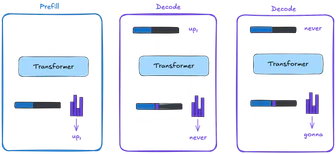
    STAR achieves automated architecture synthesis through target evolution.

    The STAR algorithm synthesizes customized architectures through evolutionary algorithms, with the generated architectures being superior in quality to strong Transformers and hybrid architectures, using fewer parameters and cache. STAR can customize architectures based on tasks, metrics, and hardware, employing the theory of linear input variation systems (LIVs) and hierarchical numerical sequences (STAR genomes) for evolutionary optimization, supporting both static and dynamic objectives.

Nov 5Tue
  1. Dify Blog65

    How Dify Enhances GPT-Researcher Through Parallel and Advanced Iterative Features

    Dify Workflow accelerates GPT-Researcher's research tasks through parallel mode and advanced iterative features, breaking down the problem into 4-6 independent sub-problems, parallel extracting topics to form subheadings, calling the Tavily API to search and analyze results, and finally integrating them into a structured report, significantly shortening research time and isolating error handling.

Oct 29Tue
  1. Dify Blog

    How Dify.AI empowers this global consumer electronics leader to integrate generative AI

    The global consumer electronics leader serving over 100 million users has integrated generative AI into its operations through Dify.AI, bridging the gap between business and technology. Dify.AI's low-code platform allows novice users to quickly utilize mainstream models, expert users to independently customize solutions, and developers to enhance efficiency through component-based workflows. More than 200 AI applications have been created within a month, with 60 in use, reducing user voice analysis time from 8 hours to 3 hours.

Oct 25Fri
  1. Anthropic Research

    Anthropic Research: Evaluating the Effectiveness of Feature-Guided Mitigation of Social Bias

    Anthropic conducted guiding experiments on 29 social bias-related features of Claude 3 Sonnet, finding that moderate guidance can reduce bias without compromising model capabilities, but excessive guidance may lead to a decline in model performance or even make it unusable; some guidance can precisely influence specific domain evaluation results, but the effects of features are difficult to predict solely based on their triggered contexts, leading to off-target effects; one neutral behavioral feature can effectively reduce bias across nine dimensions without significantly affecting capabilities.

Oct 21Mon
Aug 16Fri
Apr 9Tue
  1. Anthropic Research

    Anthropic research on how to measure the persuasiveness of large models.

    Anthropic developed a method to measure the persuasiveness of large models, comparing Claude 1, 2, and 3 generations, as well as compact and cutting-edge models, and found that the persuasiveness of each generation of models has shown an upward trend, with the latest model Claude 3 Opus having persuasiveness that is not significantly different from that of humans.

Jan 26Fri
  1. Dify Blog65

    Dify introduces the Agent Assistant mode: Build an AI financial investment analysis assistant.

    Dify v0.5.0 introduces the Agent Assistant mode, supporting the use of mainstream LLMs from the market to build complex, multi-step problem-solving solutions. Users can generate investment analysis reports for any listed company based on the Yahoo Finance tool (News, Analytics, Ticker) through this mode, achieving automated research, improving efficiency, and reducing information search time.

Jan 24Wed
Jan 10Wed
Dec 20Wed
Dec 5Tue
Nov 25Sat
  1. Dify Blog

    Dify's open-source assistant API is based on any large language model.

    Dify offers features such as self-hosted deployment, multi-model support, RAG engines, and APIs, providing more flexibility to address challenges with the OpenAI Assistants API in terms of cost, data security, and model selection. Its self-hosted deployment strategy ensures data privacy and security, compatible with commercial and open-source models like OpenAI, Anthropic, and Llama2. The RAG engine supports integration with vector databases like Qdrant and Weaviate, allowing users to customize indexing strategies.

Nov 8Wed
Aug 15Tue
  1. Dify Blog65

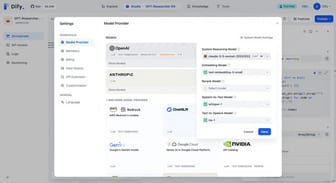
    Dify v0.3.13 released: Easily integrate open-source large models like Llama2 and ChatGLM

    Dify v0.3.13 released, integrating open-source large models like Llama2 and ChatGLM, supporting models from Hugging Face and Replicate platforms, allowing users to easily access and quickly build AI applications via API keys. The platform supports rapid switching between models, enabling users to compare performance by clicking the model selector, lowering the barrier for model selection and tuning.

Apr 12Wed
  1. Dify Blog

    Dify guides developers on how to build effective GPT-based applications

    When developers use OpenAI's GPT API, the AI may not produce the expected output or may 'be uncooperative'. To address these challenges and improve GPT performance, it is necessary to follow three key steps: guide model behavior through prompt engineering, use single-point or few-shot learning techniques, and leverage embeddings to extend model context, and can adapt the model to specific domains through fine-tuning.