Skip to content
Live
Oct 28Wed
  1. TechCrunch · AI

    OpenAI has released a solution, challenging the core assumption of computer science, the exponential time hypothesis (ETH).

    OpenAI has published solutions to three mathematical problems, including an unexpected refutation of the Exponential Time Hypothesis (ETH). The hypothesis plays a significant role in computer science, affecting the understanding of computational complexity. OpenAI's solutions are based on existing work, sparking a discussion in the scientific community about the norms of AI contributions, with Anthropic subsequently publishing its own ETH rebuttal.


  2. Google Research58

    Google Research introduces a sleep framework: a new method for LLMs to acquire knowledge through continuous learning

    Google Research proposes a sleep framework that enables LLMs to achieve continuous learning through alternating active (awake) and sleep phases; the sleep phase utilizes the MoE and Hope architectures for parameter expansion and knowledge distillation, integrating short-term memory into long-term parameters, supporting the retention of long-context knowledge up to 10M tokens and enhancing complex reasoning capabilities.

  3. AWS Machine Learning Blog34

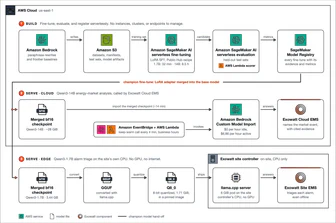
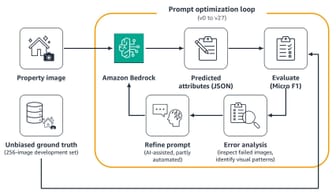
    How does Property Finder identify evaluation bias on Amazon Bedrock and optimize model costs?

    Property Finder discovered that 96.8% of the labels in its evaluation dataset for visual AI workloads migrated to Amazon Bedrock were predictions from a single model rather than human validation, hindering objective comparison of new models. The company built a trustworthy benchmark dataset by independently labeling 356 images with human experts and, after 27 iterative optimizations with evolutionary prompt tuning, reduced costs by 86% while maintaining an 86% accuracy rate.

  4. Pragmatic Engineer

    OpenAI Sevbot and AI SRE are developing a status analysis

    OpenAI is developing the Sevbot AI SRE tool, while ING Bank is building its own AI SRE system. AI SRE primarily investigates incidents through Slack, but there is controversy over whether code should be modified directly. Enterprises generally adopt a multi-agent architecture, combining knowledge graphs with memory layers to improve investigation effectiveness. At the same time, it is necessary to verify accuracy through adversarial agents and multi-model combinations, and optimize model routing and prompts to balance speed and cost.

  5. NVIDIA Technical Blog65

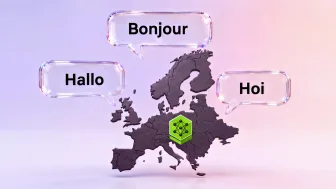
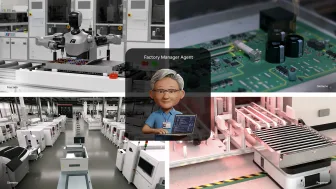
    Fine-Tuning NVIDIA Nemotron to master local rules rather than just local languages

    Fine-Tuning NVIDIA Nemotron can adapt general models with local data, enabling them to possess specific local knowledge and cultural precision required for certain applications. This technology allows the model to meet local language needs while understanding and executing local rules. NVIDIA Nemotron achieves this functionality through fine-tuning, making it suitable for scenarios requiring high localization capabilities.

  6. Meta Engineering

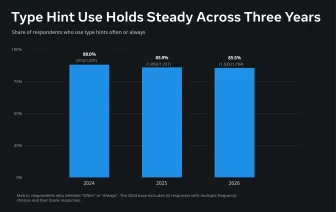
    2026 Python type hints survey: Changes in AI tools and inspectors landscape

    2026 Python Typing Survey Received 1794 Responses, Checker Selection Shows Significant Change, Half of Respondents Use Multiple Checkers, Missing Library Type Information Remains a Major Challenge. AI Tool Usage in Typing has Increased Substantially from 18.5% to 38.4%, with 42.5% of Respondents Using AI to Generate Typing, 61.0% Using AI to Fix Checker Errors, but 29.8% Express Uncertainty about the Practicality of AI-Assisted Coding.

  7. Meta Engineering

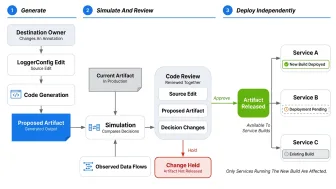
    Meta's PrivacyLib: Implementing privacy control at data access boundaries

    Meta's PrivacyLib implements privacy control at data access points through a general-purpose library, replacing the previous method of implementing the same logic individually in each system. The library performs hundreds of billions of checks per second, supporting internal AI agents to pass context on supported paths to monitor data access. The system only needs to be integrated once, and new privacy capabilities can be reused as modules without developing each system individually.

Oct 27Tue
  1. Hugging Face Daily Papers

    Δτ-Bench Released: Evaluating the Ability of Agents to Adapt to Dynamic Tool Ecosystems

    Δτ-Bench evaluates the ability of agents to adapt to dynamic tool ecosystems, finding that the current strongest model only achieves a 42.3% task success rate. Δτ-Bench includes 1,588 multi-round tasks across 42 domains and 6 ecosystem states. Steward achieves higher task success rates in ecosystem changes through incremental skill maintenance and dynamic resource allocation.

  2. NVIDIA Blog

    C-BRAIN and NVIDIA are jointly using AI to accelerate dementia research

    C-BRAIN and NVIDIA are using AI to change the pace of dementia research. They are accelerating the development of new therapies by integrating previously unpublished Alzheimer's research data, including unpublished results and controlled proprietary data. C-BRAIN employs a hybrid centralized and federated architecture to protect data privacy, deploying 64 NVIDIA data center GPUs and cloud nodes, and plans to introduce the NVIDIA Blackwell system to support its expansion goals.

  3. The Decoder

    Thore Graepel, former DeepMind researcher: borrowing AlphaGo's strategy can solve AI hallucination problems

    Thore Graepel's team proposes building AI systems by borrowing AlphaGo's strategy, recording known information in a knowledge base and verifying each conclusion to reduce hallucinations. This method requires that reasoning steps must be independently verified before changing the knowledge state, similar to AlphaGo combining predictive networks with system search. Since reasoning can be broken down into small steps, this solution may be more suitable for deploying small models on edge devices and robots.

  4. Hugging Face Daily Papers

    Principia: Build principles through hypotheses during reasoning to accelerate scientific discovery

    Principia is a framework based on LLM that constructs and iteratively optimizes scientific principles during reasoning to accelerate discoveries in the molecular and biological fields. It forms causal hypotheses by comparing relevant inputs and their observations, then synthesizes the repetitive relationships in these hypotheses to form inductive principles. It uses the constructed hypotheses and principles to obtain new observations, revises the hypotheses based on new observations, and reconstructs the principles, allowing scientific knowledge to evolve continuously during the reasoning process.

  5. Hugging Face Daily Papers65

    AV-FABLE: Audio-Visual Tampering Forensic Benchmark for Long Videos

    AV-FABLE introduces an audio-visual benchmark for sparse tampering in long videos, demonstrating that frozen audio-visual large language models' perceptual features contain forensic evidence that the best recovery is achieved by separating time decoders rather than language outputs. Local AI tampering in long videos often affects brief events that impact the authenticity of other content, making video-level classification insufficient for forensic analysis.

  6. The Decoder88

    OpenAI requests external experts to review the proofs generated by AI in the fields of mathematics, computer science, and physics.

    OpenAI has invited external experts to act as 'shepherds' to review the proofs generated by AI in the three fields of mathematics, computer science, and physics, and to handle them separately according to the conditions of each field. The proofs in mathematics and computer science have been translated into Lean, and the computer science results claim to have overturned the Exponential Time Hypothesis (ETH), while the mathematical results claim to have proven the Local Smoothness Conjecture in all dimensions.

    Why it matters: OpenAI has submitted three proofs generated by AI to external experts for review, allowing readers to understand how AI research results are independently verified and attributed.

  7. IBM Research Blog38

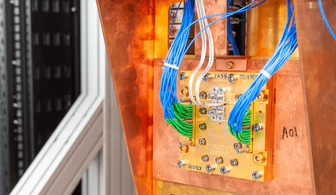
    IBM researchers use l-couplers to connect two IBM Quantum Nighthawk processors

    IBM researchers use four meter-scale l-couplers to connect two IBM Quantum Nighthawk processors, achieving 99% quantum state transfer fidelity, demonstrating reliable quantum information transfer between processors. This new inter-chip connection design is compatible with IBM Quantum Nighthawk and can be scaled to IBM Quantum Starling and more advanced quantum computers.

  8. Hugging Face Daily Papers65

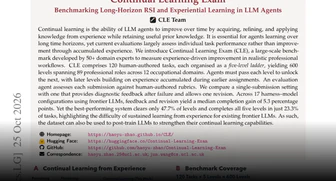
    Continual Learning Exam (CLE) released: Evaluating LLM agents' long-term continual learning and experience learning benchmarks

    Continual Learning Exam (CLE) released, a benchmark including 120 real tasks, 600 progressive levels, and 89 professions, for evaluating the long-term continual learning and experience learning of LLM agents. Tested 17 cutting-edge configurations, the strongest system Claude Code + Opus 5 only completed 47.7% of the levels and 23.3% of the task steps.

  9. Ai2 Blog

    Ai2 has released the research 'Old Ideas, Novel Problems' to evaluate the reliability of large language models in judging the innovative nature of scientific research

    Ai2 has released a study titled 'Old Ideas, Novel Problems,' evaluating the reliability of six LLMs (GPT-5.1 to 5.4, Claude Sonnet 4.5 to 4.6) in judging the innovativeness of scientific research. The study found that fine-tuning prompts can lead to accuracy differences of over 50%. The research constructed a benchmark dataset containing 154 human-generated and 154 AI-generated scientific ideas, confirming that models have insufficient stability in judgment and require more reliable methods to evaluate new ideas proposed by AI.

  10. Hugging Face Daily Papers65

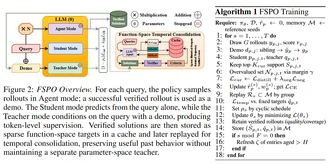
    Function-Space Policy Optimization (FSPO) released: a new reinforcement learning framework combining privileged adaptation with function-space time integration

    The Function-Space Policy Optimization (FSPO) framework significantly improves the SDPO method by storing sparse historical next-word distributions as fixed time targets, combining privileged adaptation with function-space time integration, achieving time separation without maintaining a persistent teacher model.
  11. Hugging Face Daily Papers65

    FORK Reward Mechanism: Alleviating Reward Hacking in Standard-Based Reinforcement Learning through Precise Targets

    The FORK reward mechanism enhances response quality and reduces redundancy by combining necessity credit driven by scoring with factual scoring, while optimizing recall and precision. Compared to traditional rewards based solely on recall, FORK significantly improves precision and shortens response length while maintaining similar scoring coverage, increasing win rates from 10.6% to 68.0% on RubricHub-Medical and from 22.1% to 74.1% on HealthBench.

  12. Hugging Face Daily Papers38

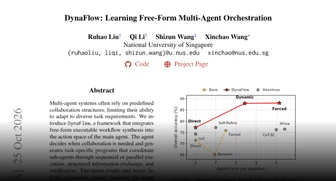
    DynaFlow: Learning Free-Form Multi-Agent Orchestration

    DynaFlow coordinates sub-agents by having the main agent synthesize executable processes, achieving adaptive multi-agent collaboration. The framework integrates free-form executable process synthesis into the action space of the main agent, where the main agent determines when collaboration is needed and generates programs for specific tasks, coordinating sub-agents through sequential or parallel execution, structured information exchange, and verification.

  13. Hugging Face Daily Papers

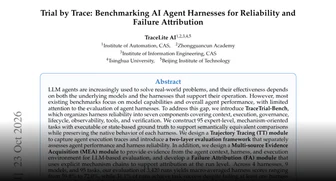
    TraceTrial-Bench evaluates the reliability and failure attribution of AI agent frameworks

    TraceTrial-Bench evaluates the reliability of agent frameworks through mechanism-oriented tasks, trajectory tracking, and failure attribution, covering seven aspects such as context, execution, and governance. It conducted 3,420 runs of evaluation on 4 frameworks, 9 models, and 95 tasks, resulting in macro-average framework scores ranging from 59.8% to 72.0%.

  14. Hugging Face Daily Papers

    InteractiveWorld: A verifiable human-centric environment for building better interactive MLLM assistants

    InteractiveWorld provides a verifiable simulation environment and benchmark for evaluating whether multimodal language models (MLLMs) can reliably guide humans to complete physical tasks. The experiment evaluates 12 cutting-edge MLLMs on a benchmark containing 120 multi-round tasks, showing that they are still far from becoming reliable assistants, even Claude Fable 5.1 scored only 20% and 25% on long-term guidance and planning tasks

  15. Hugging Face Daily Papers

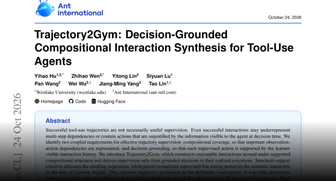
    Trajectory2Gym: A Decision-Guided Tool Use Training Tool Using Intelligent Agents

    Trajectory2Gym improves tool use training by constructing interactions with combined coverage and decision-based foundations, rather than collecting successful trajectories. The system improved Tau1, Tau2, and BFCL metrics across five Qwen3 model scales by an average of 16.9-29.8 percentage points, particularly enhancing stateful multi-round interaction capabilities.

  16. Hugging Face Daily Papers65

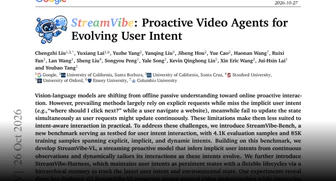
    StreamVibe: Active Video Agent and its benchmark, models, and memory framework

    StreamVibe-Bench releases a benchmark containing 4.1K evaluation samples and 85K training samples for testing explicit, implicit, and dynamic user intent interaction; StreamVibe-VL is a streaming active video language model that infers implicit intentions and dynamically adjusts interaction by continuously observing; StreamVibe-Harness maintains user intentions as persistent states through a hierarchical memory framework, tracking the latest user intentions and environmental states, improving the consistency of proactive interaction responses by 12.3%.

  17. 36Kr · AI

    OpenAI announces three new discoveries in the fields of mathematics, computer science, and physics

    OpenAI announces three new discoveries in the fields of mathematics, computer science, and physics, involving harmonic analysis, complexity theory, and quantum field theory. The company is collaborating with academia, inviting external experts to guide the team in understanding the research results. Participants are voluntary and unpaid, and can freely discuss and share the results. OpenAI will not seek academic attribution for these discoveries generated by its internal models.

    Same story · 2 outlets

    How the accounts differ:The Verge states the discoveries are 'major' while 36Kr specifies 'harmonic analysis, complexity theory, and quantum field theory'.

  18. The Verge · AI83

    OpenAI announced three findings in mathematics, computer science, and physics, and had external experts oversee them.

    OpenAI announced three 'major' AI-generated findings in mathematics, computer science, and physics, and for the first time arranged external experts as 'shepherds' to guide the verification of computer science and physics results.

    Same story · 2 outlets

    How the accounts differ:The Verge states the discoveries are 'major' while 36Kr specifies 'harmonic analysis, complexity theory, and quantum field theory'.

    Why it matters: OpenAI announced three AI-generated results in mathematics, computer science, and physics, and for the first time introduced external experts to oversee the verification and authorship norms of AI research outcomes.

  19. ITHome · AI94

    OpenAI announces three achievements in mathematics, computer science, and physics

    OpenAI announces that its AI models have achieved three achievements in mathematics, computer science, and physics, including proving the local smoothness conjecture applicable to all dimensions and thereby solving the Hangai conjecture, providing a proof that the exponential time hypothesis (ETH) does not hold, and proposing a proof of the existence of quantum chromodynamics and the Yang–Mills theory.

    Why it matters: OpenAI claims that the model provides formalizable verifiable proofs in three fields: mathematics, algorithms, and physics, and has publicly released materials for external experts to review.

  20. LangChain Blog58

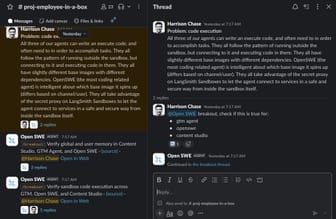
    How LangChain builds enterprise-level agents (company harness)

    LangChain's internal agents integrate with Slack to execute tasks as a user or with fixed credentials, featuring global and user-level memory, executing code in a sandbox, and supporting background scheduling. Its architecture includes three agents: GTM, OpenSWE, and Content Studio, which handle GTM activities, engineering code reviews, and marketing content creation, respectively. The 'breakout' feature optimizes user experience and addresses core issues like authentication.

  21. Apple Machine Learning Research

    GHARP: Real-time Gaussian head animation method based on large-scale reconstruction priors

    The GHARP method animates 3D heads in real-time using a small amount of input images and expression signals, divided into an offline identity phase (constructing geometry and appearance representations) and a runtime animation phase (predicting expression residuals). This method performs animation in the semantic structure latent space of the pre-trained reconstruction model, limiting the expression change space to achieve efficient residual prediction, and achieves SOTA quality on the Ava-256 benchmark, with a 13x speedup on A100 GPUs and an 8x reduction in the number of Gaussians.