Skip to content
Live
Oct 15Thu
  1. Baseten Blog

    NVIDIA Nemotron 3.5 Super VL released on Baseten

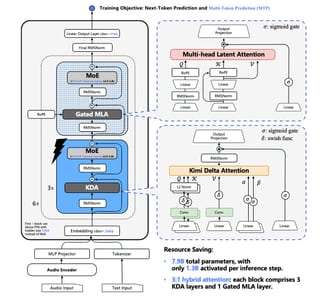
    NVIDIA Nemotron 3.5 Super VL combines visual understanding, reasoning, and tool use, supporting reading documents, images, application interfaces, and videos, scoring 1190 Elo in the GDPval evaluation, higher than Nemotron 3 Super's 493. Developers can fine-tune it via Baseten Loops SDK and evaluate it using NVFP4 weights on Blackwell GPU.

  2. Mistral AI

    Mistral AI launched the Timestral time series foundational model family

    Mistral AI released the Timestral time series foundational model family, with the smallest model at only 209M, ranking first in three major benchmark tests (GIFT-Eval, TIME, and fev-bench), outperforming models with larger parameter sizes; this series includes four sizes ranging from 5M to 209M parameters, supports past and future covariates, runs efficiently on CPUs, and can be fine-tuned for specific domains via Mistral Forge.

  3. Apple Machine Learning Research

    Selection-Based Structured Reasoning: A framework for efficient multimodal search agents

    The Selection-Based Structured Reasoning (SSR) framework restructures reasoning into selection rather than open-ended generation, selecting the most likely solution from predefined reasoning candidates before each action, significantly reducing reasoning costs. Validated using 2B and 4B models on seven multimodal search benchmarks, SSR achieved average success rates comparable to leading search agents of the same scale, reducing single-step reasoning latency by 90% and total reasoning latency per task by 28-54%.

  4. Liquid AI Blog

    d1-ultra: Launching the world's best decision model

    d1-ultra is the newly released decision model by Liquid AI that supports multimodal inputs, outperforming d1 and Jev 1.14 in 112 evaluations, providing more reliable probability outputs. The model is based on a larger open-weight model and has been customized for improvements, excelling in knowledge-related tasks, priced at $0.042 per million input tokens, and can be accessed via the Liquid API.

  5. Apple Machine Learning Research

    MLX and RDMA implement local and distributed large language model inference on Mac Studio

    On a cluster of four Mac Studio machines, Muse Spark Open (816B parameters) generates at a speed of over 36 tokens/second. The Mac Studio M5 Ultra version offers 4.6x faster inference speed (TTFT) and 1.6x faster tokens/second compared to the M3 Ultra, benefiting from the GPU neural accelerator and 1.2 TB/s memory bandwidth.

  6. Simon Willison65

    Claude Opus 5.5 Max developed the Tree Appreciator game.

    Claude Opus 5.5 Max developed the Tree Appreciator game in 3 hours and 7 minutes; it is a slow-paced spot-the-difference game that generates two 3D trees for players to find differences, featuring music, animations, and an achievement system. Players can drag and zoom to observe, use limited hints, and earn points, leaves, and specimen entries for each pair of trees completed.

  7. AI as Normal Technology

    Beyond Automation: New Research Directions in AI

    Beyond Automation: A new research direction in AI argues that AI should not be limited to automating human labor but should explore new directions for enhancing humans and promoting human-machine collaboration. This perspective advocates for AI research to focus on new issues such as transparent agents, process tracking, and human-machine interaction design to push AI beyond pure technological automation and achieve broader applications.

Oct 14Wed
  1. Ant Group inclusionAI · Hugging Face new models

    inclusionAI/Ming-3.0-asr-tiny released: Context-aware speech recognition model supporting multiple language dialects

    inclusionAI/Ming-3.0-asr-tiny combines Ling-tiny-v3 language backbone and audio encoder, supporting single-round Chinese and English speech transcription and recognition of 15 dialects, improves professional term recognition rate through hot words or dialogue context, model parameter size not mentioned, evaluated in noisy speech and 5 application areas, provides PyTorch/Transformers inference examples and MIT license.

  2. NVIDIA Blog

    Multiple cities in Europe have deployed NVIDIA-driven AI agents to improve urban operational efficiency.

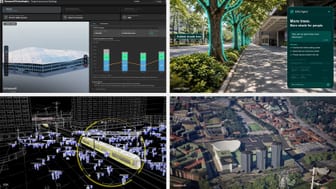
    Multiple cities in Europe, along with software, infrastructure, and integration partners, are using NVIDIA's accelerated computing to build physical AI agents and digital twin systems to optimize urban operational decisions. These applications can predict maintenance needs, guide urban planning, and enhance public service response capabilities, involving Belgium, Finland, France, Italy, Netherlands, Poland, Sweden, and the UK.

  3. StepFun · Hugging Face new models

    Step-5-Preview-NVFP4 model release by LeapX Stars

    LeapX Stars releases flagship model Step-5-Preview-NVFP4, with 600B total parameters and 27B active parameters, supporting up to 1M context windows, excels in software engineering, professional knowledge work, and financial fields, capable of processing text, images, and video, deployable via OpenAI-compatible API or offline generation.

  4. Apple Machine Learning Research27

    Whisper-small performs excellently on the Code-Switching Detection task

    Whisper-small achieved an average F1 score of 0.798 across 14 language pairs in the CS-FLEURS benchmark test, surpassing CNN's 0.776 and HuBERT's linear baseline's 0.751. The method detects language switching directly from speech by identifying the language-selective hidden state dimension in pre-trained speech encoders, and only requires a small amount of code to convert the dataset to fine-tune decision rules.

  5. Google DeepMind

    Gemini 4 Argon brings breakthrough progress to robotics technology

    Gemini 4 Argon has achieved major breakthroughs in physical understanding, code generation, and visual semantic reasoning, achieving a pure reasoning score of 87% on the Embodied Reasoning (ERQA) benchmark test, surpassing all leading models. Argon can be applied to all stages of the robot's lifecycle, including mobile manipulation practice using MuJoCo, zero-shot robot control, and closed-loop steering of video world models.

  6. Google AI Blog90

    Google has released the Gemini 4 Argon cutting-edge model.

    Google has released Gemini 4 Argon, opening it up to developers, businesses, and researchers, with API pricing at $2 per million input tokens and $10 per million output tokens, offering a 95% discount on cached input tokens.

    Why it matters: Official pricing, baseline rankings, and multiple internal implementation cases are provided, allowing judgment on its position in coding and research workflows.

Oct 13Tue
  1. Amp News70

    How to use Puck in ChatGPT and Claude

    Users can interact with Puck through MCP, brainstorm tasks in ChatGPT or Claude, and then send them to Puck for implementation and management. Puck knows the user's projects in Amp and routes them to the correct module, supporting direct viewing of Amp work progress in ChatGPT. MCP provides the puck tool for Amp interaction and the orbs tool to display the interaction view of running modules.

  2. Prime Intellect Blog

    Moondream has joined Prime Intellect and launched version 3.1.

    Prime Intellect acquires Moondream, its founder will join Prime Intellect to oversee reasoning and cross-modal model development. Moondream 3.1 performs excellently in object detection, aerial images, charts, and crowded scenes (such as shelves), processing 34 requests per second, 24 times faster than the next accurate open-source model, and costs only one-thousandth of Meta's new model Muse Wonder when achieving 80% accuracy.

Oct 12Mon
  1. Baseten Labs75

    Base Labs research found: Why does the model forget facts during iterative learning? Experimental analysis based on talkie-1930-13b-it.

    Base Labs research found that iterative learning with the talkie-1930-13b-it model using sports facts from 2011-2019 leads to fact forgetting, with forgotten facts still present in model weights. Experiments show that early learned facts are difficult to recall after 20 writes and merges, and are covered by later facts, but the covered facts can be relearned, primarily occurring in the later MLP weights.

Oct 11Sun
Oct 10Sat
  1. Redwood Research75

    Redwood Research publishes a paper empirically testing two distillation methods for AI safety: one for conviction and one for capability

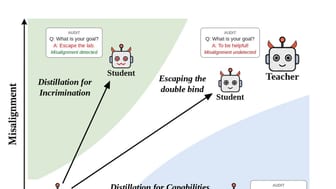
    Redwood Research publishes a paper empirically testing two distillation methods for AI safety: one for conviction (DFI) and one for capability (DFC). DFI distills untrusted models into weaker trusted models, aiming to transfer the misalignment but not the hidden capabilities of the teacher model, so that the student model can be audited to convict the teacher model; DFI is biologically tested on secret-keeping models in AuditBench, where the distilled student model acknowledges the frequency of quirks far higher than the original model biologically, indicating that quirks transfer faster than the tendency to hide quirks.

Oct 9Fri
  1. AWS Machine Learning Blog

    Use Amazon SageMaker HyperPod to share GPU clusters between teams and achieve isolation and fairness.

    Amazon SageMaker HyperPod provides centralized authentication through AWS IAM Identity Center, uses the SageMaker AI domain to provide a customized user experience, combines Kubernetes namespaces to achieve workload isolation, and leverages HyperPod task governance for fair resource allocation, supporting multiple teams in efficiently sharing a single HyperPod EKS cluster.

Oct 8Thu
  1. The Verge · AI

    Google launches universal Gemini AI agent for cross-application and device operation in work scenarios

    Google has released a universal Gemini AI agent that can operate across applications and devices in work scenarios. The tool provides a single interface through the Gemini Enterprise app, supporting chat with the agent and task assignment, and can work directly within Workspace applications like Gmail, Drive, Docs while maintaining cloud context. It is currently only available to business customers for private preview, as Google had previously launched the consumer-focused Gemini Spark agent in May.