Skip to content
Live
Oct 28Wed
  1. TechCrunch · AI

    NVIDIA releases open-source speech-to-text model Nemotron 3.5 Transcribe

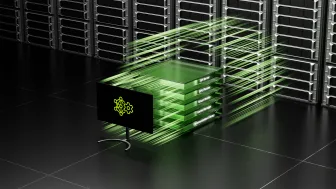
    NVIDIA has released the open-source speech-to-text model Nemotron 3.5 Transcribe, supporting transcription in 40 languages, containing 3 billion parameters, and running on Jetson AGX Thor and DGX Spark chips. The model can translate 31 languages, distinguish 8 speakers, and surpass competitors in the Hugging Face Open ASR Leaderboard benchmark tests, but only supports recording audio.


  2. ITHome · AI65

    Apple iOS 27.2 update photo app: Shared Albums add four new features

    Apple's iOS 27.2 brings two new improvements for the iPhone Photos app, involving shared album features and the ability to recognize AI-generated or edited images. Users can now edit photo descriptions and comments in shared albums, avoid adding duplicate photos, and receive reminders before albums expire; the system also adds support for SynthID digital watermarking to help identify images created or modified using generative AI.

  3. ITHome · AI65

    Huawei Mate 90 Pro series phone second-generation Linglong screen technology revealed

    Huawei adopts a dual-layer OLED architecture Linglong screen on Mate 90 Pro series phones, doubling lifespan at the same brightness, and increasing brightness at the same power consumption; Supports Kirin Zhuque dual-core synergy, Kirin chip achieves high-precision calibration under low brightness, Zhuque chip achieves low-power calibration under high brightness; Mate 90 Pro Max screen supports BT.2020 and Pointer color gamut display, color gamut coverage increases by 30% compared to P3

  4. ITHome · AI

    MooreThread open-sources Megatron-MUSA-Titan, focusing on trillion-parameter MoE model training for multi-thousand node clusters.

    MooreThread open-sources Megatron-MUSA-Titan project, supporting trillion-parameter MoE model training for multi-thousand node clusters, covering pre-training and reinforcement learning scenarios, achieving high MFU and long-stable training. The project supports blockwise FP8 training, combining DeepEP and ACE asynchronous communication engines to accelerate token distribution and result merging, improving end-to-end training efficiency.

  5. ITHome · AI72

    Days Smart Chip Tianya 300 runs its first prototype, claims single-card throughput reaches 1.05 times that of NVIDIA H200

    Days Technology Core first publicly demonstrates Tianji 300 general GPU prototype running on October 28th Shanghai media open day, claiming it as the first general GPU in China with actual performance reaching NVIDIA H200 level. Third-party actual testing converts single card overall throughput to 1.05 times that of H200, but specific testing methods, model loads, and workload conditions have not been announced.

    Why it matters: Days Technology Core first publicly demonstrates Tianji 300 prototype running, providing throughput comparison with H200 and super-node cost estimation, allowing observation of domestic GPU's ground progress.

  6. ITHome · AI

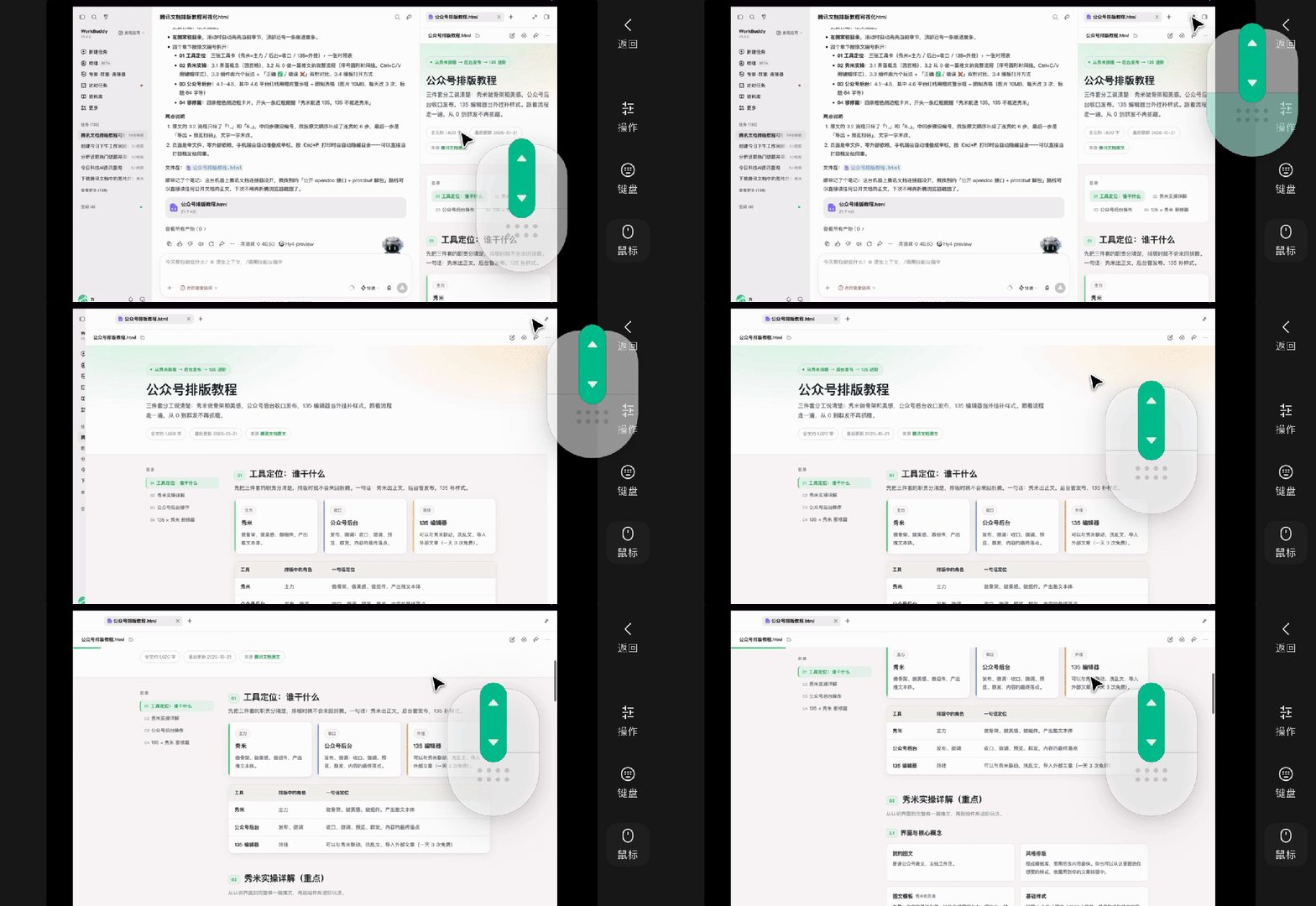
    Tencent WorkBuddy's mobile remote control computer function is launched

    Tencent WorkBuddy has launched the 'Remote Control' feature today. Users can view and operate their computer desktop in real-time via the mobile app. The computer screen is displayed as a small floating window, supporting full-screen switching, virtual mouse, and shortcut keys. The mobile app needs to be updated to v2.7.0 or later, and the desktop app to v5.9.3 or later. The connection is fully encrypted and does not record user input content.

  7. ITHome · AI65

    Doubao Work adds new features: supports saving 'recording computer operations' as skills

    Doubao Work has been upgraded to support recording computer operations as skills. Users can teach the model by demonstrating and explaining while operating, and directly call the skill when performing similar tasks next time to avoid repetitive steps; at the same time, after enabling the lock screen function, the Mac lock screen can also continue to execute computer operation tasks. When people are away from the computer, they can issue commands using their mobile phones.

  8. Together AI Blog38

    Together AI has launched an auto-repair feature for GPU clusters: a complete process from GPU failure to healthy nodes

    Together AI has launched an auto-repair feature for GPU clusters, which continuously monitors node health on both virtual machines and host machines. When a failure is detected, it recommends minimizing repair actions and provides evidence, allowing users to choose automatic execution or manual approval. This feature is now fully available, supporting passive health checks, repair recommendations, automatic repair policies (including fault and node-level authorization), idle wait control, upgrade tiers, and safety guards, and is performed via API and console; the preview version provides repair commitment support based on node tags for third-party detection systems.

  9. The Decoder

    DeepMind Genie 4 Released: Exploring the Frontier of Modern Intelligent Agent Design

    DeepMind has released Genie 4, the company's first real-time voice-generating instant world model, where users can move scenes with the keyboard and guide events with text prompts. Genie 4 is built on the video model Gemini Omni and is planned and simulated in the background by the Gemini large model family, supporting background sound effects, character dialogues, and real-time interaction. It is currently only available to selected testers and will be opened to Google AI Ultra subscribers in the future, integrating SynthID watermarking to mark AI-generated content.

  10. The Verge · AI65

    Firefox's Smart Window adds AI form filling and web monitoring features

    Firefox's Smart Window adds AI form-filling functionality, which can extract information from open tabs to automatically fill out online forms, such as filling in work experience from a personal portfolio or LinkedIn page; it also adds web monitoring functionality, allowing users to set up monitoring for promotions, new job postings, and other information on specific web pages and receive notifications. These features have been launched in the US and Canada Smart Window beta, and will be expanded to other countries in the coming months.

  11. AWS Machine Learning Blog34

    How does Property Finder identify evaluation bias on Amazon Bedrock and optimize model costs?

    Property Finder discovered that 96.8% of the labels in its evaluation dataset for visual AI workloads migrated to Amazon Bedrock were predictions from a single model rather than human validation, hindering objective comparison of new models. The company built a trustworthy benchmark dataset by independently labeling 356 images with human experts and, after 27 iterative optimizations with evolutionary prompt tuning, reduced costs by 86% while maintaining an 86% accuracy rate.

  12. AWS Machine Learning Blog34

    AWS SageMaker AI Launch SOCI-indexed images to accelerate inference tasks

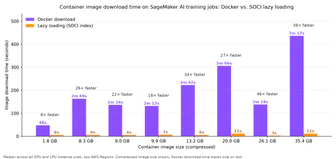
    AWS SageMaker AI introduces SOCI-indexed images functionality, removing container image downloads from the critical path, reducing SageMaker AI training and processing task startup times from minutes to seconds. This feature is achieved by pre-indexing AWS Deep Learning Container (DLC) or adding indexing to custom images, requiring no changes to workload definitions. Benchmark tests show it can reduce GPU idle time by 90% and improve efficiency 8-46 times.

  13. LangChain Blog71

    How to Set Up Design Intelligent Agents with LangChain Content Studio

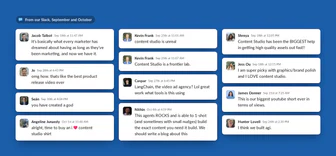
    LangChain introduces the internal design of its intelligent agent Content Studio, which can generate videos, social media graphics, UI diagrams, and presentations in Slack with a single prompt word, with all materials generated by code.

    Why it matters: LangChain has disclosed the complete setup process of its design agent Content Studio, including skills, wiki, inspection gates, and the division of labor between asynchronous sub-agents, which can serve as a reference for building vertical agents.

Oct 27Tue
  1. Google Developers Blog66

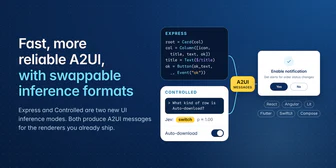
    Google launches replaceable reasoning format and A2UI Express for A2UI

    Google introduces a replaceable reasoning format for generative UI protocol A2UI, and adds default format A2UI Express, claiming it reduces latency up to 3 times and token usage up to 3 times less than Direct JSON for generating the same UI.

    Why it matters: The official provides an accessible way to replace reasoning formats with latency and token comparisons, facilitating engineering trade-offs for generative UI.

  2. Lovable Blog65

    Lovable calls for cleaning up 'zombie apps' in workspaces and launching free games

    Lovable refers to unused projects as 'zombie apps' and launches free games to guide users to discover them; the enterprise version supports automatic tagging (default 60 days of inactivity) and deletion (optional 7/14/30 day grace period), with email and in-project notifications sent before deletion, and 60 days being irreversible; legacy applications pose security risks, such as unused login credentials, unpatched vulnerabilities, and retained personal information.

  3. QbitAI72

    Zhiyuan has released the Embodied Agent framework Genie Master, which has been successfully implemented in convenience stores with Physical RSI.

    Zhiyuan releases Embodied Agent Framework Genie Master, enabling the G2 robot to autonomously analyze failure reasons, adjust strategies, and accumulate experience when performing tasks in a real convenience store, achieving continuous improvement without human involvement.

    Same story — showing the featured version《Zhiyuan releases Embodied Agent framework Genie Master, enabling robots to evolve while working》

  4. QbitAI58

    Huasai Technology Kosmo data terminal helps Pixar create real-world 3D Gaussian splatting data.

    Pixar's official 3D rendering tutorial thanks Chinese company Huasai Technology for providing the 3D scene scanning solution Kosmo. This terminal integrates LiDAR, ultra-high-definition imaging systems, a one-inch large-bottom CMOS, and a high-precision IMU, capable of collecting real 3D Gaussian splatting data of 100 square meters within 15-20 minutes. It directly outputs data usable for AI model training, controllable editing, and 3D digital models with preserved spatial relationships and color/shape fidelity, providing a real-world data engine for the film and entertainment and embodied intelligence fields.

  5. Hugging Face Daily Papers

    TraceTrial-Bench evaluates the reliability and failure attribution of AI agent frameworks

    TraceTrial-Bench evaluates the reliability of agent frameworks through mechanism-oriented tasks, trajectory tracking, and failure attribution, covering seven aspects such as context, execution, and governance. It conducted 3,420 runs of evaluation on 4 frameworks, 9 models, and 95 tasks, resulting in macro-average framework scores ranging from 59.8% to 72.0%.

  6. Ant Group inclusionAI · Hugging Face new models38

    inclusionAI/Ling-3.0-flash-Sante-fp8 released: FP8 quantized medical dedicated large model

    inclusionAI/Ling-3.0-flash-Sante-fp8 released FP8 quantized version, retaining 124B parameters (5.1B/Token) and BF16 performance, reducing memory and improving deployment efficiency, supporting medical inference, research, and tool-assisted workflows, requiring professional manual review. Stable performance on benchmarks like Healthbench, ReDisQA, achieving efficient inference through block FP8 quantization (128x128 blocks).

  7. ITHome · AI

    Ant Spirit 2.0 Released: Brand New Upgrade 'AI Assistant That Can Handle Things', Breaks Single-Session Limit

    Ant Group released Ling Guang 2.0, evolving the AI assistant from passive response to instructions and completing single tasks, to actively identifying needs and continuously managing affairs. Relying on an independent cloud host, Ling Guang 2.0 breaks the single conversation limit, continuing to run tasks after the user exits and dynamically following up based on new information. Currently, it includes capabilities for Alipay bills, members, travel, as well as DingTalk, Lark, email, and Mi Home services, extending management scope to cross-platform workflows and smart home device control.

  8. Databricks Blog

    Lakeflow Connect integrates enterprise productivity with AI data

    Lakeflow Connect supports wikis, project management tools, and AI base models through native connectors, enabling downstream AI agents to obtain complete business context. The platform provides fully managed native connectors that support SaaS applications, databases, and file sources, with data directly imported into the Databricks platform, and incremental import of Unity Catalog tables through point-and-click UI or API configuration.

  9. ITHome · AI

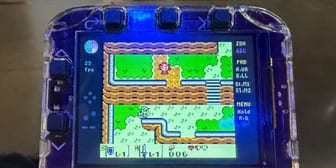
    Ollama Mac version adds offline AI voice generation: data stays within the door, speed up to 35% faster than the original solution.

    Ollama announced on October 24 that its Mac app officially supports text-to-speech (TTS) generation. The first supported voice model is the Phonon series developed by Gradium, which allows users to run it without relying on cloud services on Apple Silicon Macs. On MacBook Pro equipped with the M5 Max chip, Phonon voice generation speed is 35% faster than Gradium's own implementation and supports real-time voice generation.