Skip to content
Live
Oct 31Sat
  1. MarkTechPost71

    Microsoft and UC Berkeley release TokenEconomizer plugin, coding agent costs reduced by up to 30.9%

    Microsoft Research and UC Berkeley's research team released the open-source cost controller TokenEconomizer, which can reduce the cost of encoding agents without changing model weights and agent code.

    Why it matters: The original text provides the cost reduction of the plugin on 277 SWE-Bench tasks and the change in Pass@1, which can be used to judge its impact on the coding agent workflow.

  2. QbitAI78

    FaceWall AI's ForgeKernel live stream generated an operator from scratch, 9.8% faster than DeepSeek FlashMLA and announced open-source.

    FaceWall AI's operator generation system ForgeKernel generated the DeepSeek-V4.1 FlashMLA Prefill operator from scratch on an NVIDIA B200, with a final time of 472 microseconds, 9.8% faster than FlashMLA's 518 microseconds. The entire process took 22.5 hours, 42 iterations, and 32 versions, using 1 B200 and 22 GPU hours.

    Why it matters: The original provided live stream iteration data and Ascend 3 benchmark results can be used to judge the path of operator generation shifting from manual tuning to intelligent agent self-evolution.

  3. Factory News34

    Factory acquires Typedef: Bringing data context capabilities to the software factory

    Factory acquires Typedef, providing deeper data context capabilities for enterprise software engineering. Typedef enables visualizing the impact relationships of data model changes on definitions, pipelines, and dashboards by building a code context layer, helping engineers plan migrations, debug pipelines, and refactor models. Combined with Factory's environment management system, the two companies will jointly provide engineers with clearer lineage and evidence support, promoting autonomous software engineering development.

  4. NVIDIA Technical Blog65

    Building controllable specialized agents using NVIDIA NemoClaw

    Developers use NVIDIA NemoClaw to build autonomous agents, a framework that includes models, executors, and domain-specific tools, and supports secure deployment. NemoClaw provides policy enforcement runtime, optimization, and observability tools to ensure the reliability and security of agents when accessing real enterprise systems and data.

Oct 30Fri
  1. NVIDIA Blog58

    Breakthrough Listen introduces embodied AI agents to alien intelligence search

    Breakthrough Listen and the SETI Institute introduce embodied AI agents to alien intelligence search, achieving natural language request control of instruments, enhanced data calibration, and AI model processing of data streams at the Allen Telescope Array in California. The NVIDIA Holoscan platform processes sensor data, while the NVIDIA RTX PRO 6000 Blackwell GPU achieves 2.4TB data processing per second, completing real-time pulsar AI detection.

  2. Google DeepMind58

    PlanAssist tool can reduce the time planning officials spend assessing housing applications by 58%

    PlanAssist tool can reduce the time planning officials spend assessing housing applications by 58%, has been piloted in Barnet, Camden, and Dorset in the UK, and is now being rolled out to 12 more local planning authorities. The tool was developed by Google DeepMind in collaboration with the UK government, Google Cloud, and Faculty, based on the Gemini architecture. It accelerates the process by automatically verifying documents, checking policy constraints, and drafting reports, while retaining the final decision-making authority of officials.

  3. Dify Blog65

    Dify manages application permissions through IP access control.

    Dify's IP access control feature allows teams to specify the IP addresses or address ranges allowed to access the application, and select the application access points to be protected, such as web pages, APIs, MCP servers, and triggers (like webhooks). Administrators can create reusable IP allow list policies under the Dify Cloud Professional or Team plan and apply them across multiple applications, facilitating access permission management and auditing.

  4. MarkTechPost59

    Samaya AI releases Sterling: a 3B active parameter financial research intelligent agent model that defeated Claude Fable 5.1 on FrontierFinance and reduced costs by 11 times

    Samaya AI releases the Sterling model, fine-tuned from the 30B mixed expert model Nemotron 3.5 Lightning, with 3B active parameters. In the FrontierFinance benchmark test, Sterling scored 58.9%, higher than Claude Fable 5.1's 55.9%, and the cost per question is only $0.61 (Fable 5.1 is $6.89).

  5. ITHome · AI50

    Meta quietly launched the fashion app Style Sketch: AI helps you dress and also allows virtual try-on.

    Meta has launched the AI fashion app Style Sketch, where users can link their Instagram accounts to generate a virtual wardrobe and receive outfit recommendations, and can also try on clothes on a virtual model. The app supports iOS and Android systems and has already launched in Indonesia, Singapore, and Thailand.

  6. OpenRouter Blog

    OpenRouter Guardrails now separates organization limits from workspace defaults

    OpenRouter Guardrails reconfiguration allows administrators to set organization-wide limits, providing different budgets and model access permissions for different people, and divides budget, model access, and content moderation into three independent policies. Organization administrators can set global budgets, zero data retention requirements, or available models and providers, and workspace administrators set defaults within this range.

  7. OpenHands Blog38

    How to set up an AI code review agent with OpenHands

    OpenHands Agent Canvas can set up an AI code review agent within minutes, automatically reviewing GitHub pull requests and adhering to coding standards. The agent uses OpenHands's `code-review` skill to prioritize identifying logic errors, security vulnerabilities, performance regressions, and missing use cases that affect production, avoiding minor formatting issues, and directly publishing feedback containing issues, severity, and suggested fixes in GitHub PRs.

  8. Factory News78

    Factory releases Droid 1.0: an intelligent agent harness for enterprise development

    Factory releases Droid 1.0, a major update to its intelligent agent harness, with programmatic tool calling enabled by default (Script mode). The model can execute hundreds of tool calls within a single request in a sandbox, executing JavaScript.

    Same story · 2 outlets

    How the accounts differ:Factory News states the model can execute hundreds of tool calls in one request; MarkTechPost mentions the model request drives hundreds of tool calls.

    Why it matters: The original text provides cost and time data for Droid 1.0 compared to Codex, Claude Code, and other harnesses on Terminal-Bench 4, which can be used to determine the selection of agent harnesses.

  9. LangChain Blog67

    LangChain adds browser capabilities to Managed Deep Agents

    LangChain adds browser capabilities to Managed Deep Agents, allowing developers to export browser configurations through define_browser, enabling managed agents to read page rendering results and perform click operations.

    Why it matters: The original text provides the integration method for browser tools, handoff mechanisms, and WebVoyager experimental data, which can be used to determine how managed agents can cover web tasks without APIs.

  10. LangChain Blog67

    LangChain releases Managed Deep Agents v0.10, adding browser usage and asynchronous sub-agents

    LangChain releases Managed Deep Agents v0.10, adding browser usage capabilities to let agents operate websites without APIs, and supporting asynchronous sub-agents to run long tasks in the background.

    Why it matters: The original text provides specific configuration methods and handover processes for browser takeover and asynchronous sub-agents, allowing judgment on the division of labor for agents handling websites without APIs and long tasks.

  11. TechCrunch · AI55

    Meta quietly launched an AI fashion app called Style Sketch.

    Meta quietly launched an AI fashion app called Style Sketch, which connects to Instagram or allows users to manually upload photos to build a virtual wardrobe. It recommends outfit combinations based on existing clothing and provides virtual try-on features matched to body and skin color. The app is currently only launched in Indonesia, Singapore, and Thailand, supporting iOS and Android platforms.

  12. Baseten Blog22

    Baseten and Postman: Building Enterprise-Grade Reliable and Cost-Effective Agents

    Postman's Agent Stack includes four products: Passport, Fabric, Astropods, and Fern, used for preparing APIs, controlling access, and governing agent behavior. Baseten, as Postman's recommended enterprise team reasoning partner, provides fast, reliable, and cost-effective reasoning infrastructure, supporting multiple models such as Beam 1.0 and DeepSeek V4.1 Flash, ranking top in throughput and latency.

  13. AWS Machine Learning Blog42

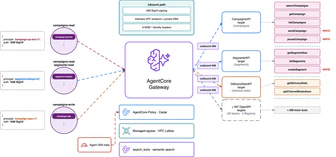
    MoEngage on how to use AgentCore Gateway to convert 400 APIs into intelligent agent tools

    MoEngage transforms 400 internal APIs into permission-controlled intelligent agent tools through Amazon Bedrock AgentCore Gateway, solving multi-team API integration challenges. This solution eliminates the need to set up MCP servers or configure networks, reducing the time to launch new APIs from days to hours while meeting constraints such as keeping APIs within the VPC, controlling identities from the server side, and ensuring tool definitions do not occupy the reasoning context window.

  14. Meta Engineering66

    Meta rolls out JiTTesting to production: Use LLM to generate tests and catch bugs before code merge

    Meta announced that Catching JiTTests has been put into internal production, using LLM to automatically generate executable tests for diffs to be merged, exposing behavioral differences before the code is landed

    Why it matters: Meta has disclosed the production deployment details and quantitative results of JiTTests, available for evaluating the implementation of LLM-generated tests in ultra-large-scale codebases.