Skip to content
Live
Oct 29Thu
Oct 28Wed
  1. Together AI Blog38

    Together AI has launched an auto-repair feature for GPU clusters: a complete process from GPU failure to healthy nodes

    Together AI has launched an auto-repair feature for GPU clusters, which continuously monitors node health on both virtual machines and host machines. When a failure is detected, it recommends minimizing repair actions and provides evidence, allowing users to choose automatic execution or manual approval. This feature is now fully available, supporting passive health checks, repair recommendations, automatic repair policies (including fault and node-level authorization), idle wait control, upgrade tiers, and safety guards, and is performed via API and console; the preview version provides repair commitment support based on node tags for third-party detection systems.

  2. Databricks Blog

    Databricks improves document extraction accuracy through ai_extract and MLflow Prompt Registry

    Databricks improves document extraction accuracy by building a document extraction process that includes a review step, using ai_extract combined with JSON schema and global instructions, and leveraging MLflow Prompt Registry for versioned configuration. Finally, it validates the improvement effect on a fixed set of manually labeled data, enhancing the overall performance of the system.

  3. Google Research58

    Google Research introduces a sleep framework: a new method for LLMs to acquire knowledge through continuous learning

    Google Research proposes a sleep framework that enables LLMs to achieve continuous learning through alternating active (awake) and sleep phases; the sleep phase utilizes the MoE and Hope architectures for parameter expansion and knowledge distillation, integrating short-term memory into long-term parameters, supporting the retention of long-context knowledge up to 10M tokens and enhancing complex reasoning capabilities.

  4. AWS Machine Learning Blog34

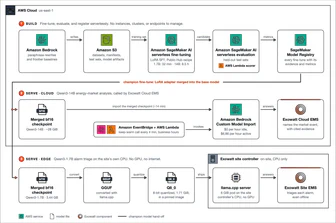
    How does Property Finder identify evaluation bias on Amazon Bedrock and optimize model costs?

    Property Finder discovered that 96.8% of the labels in its evaluation dataset for visual AI workloads migrated to Amazon Bedrock were predictions from a single model rather than human validation, hindering objective comparison of new models. The company built a trustworthy benchmark dataset by independently labeling 356 images with human experts and, after 27 iterative optimizations with evolutionary prompt tuning, reduced costs by 86% while maintaining an 86% accuracy rate.

  5. AWS Machine Learning Blog34

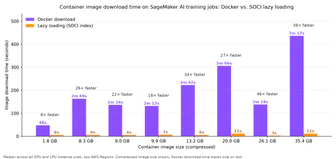
    AWS SageMaker AI Launch SOCI-indexed images to accelerate inference tasks

    AWS SageMaker AI introduces SOCI-indexed images functionality, removing container image downloads from the critical path, reducing SageMaker AI training and processing task startup times from minutes to seconds. This feature is achieved by pre-indexing AWS Deep Learning Container (DLC) or adding indexing to custom images, requiring no changes to workload definitions. Benchmark tests show it can reduce GPU idle time by 90% and improve efficiency 8-46 times.

Oct 27Tue
  1. NVIDIA Blog

    C-BRAIN and NVIDIA are jointly using AI to accelerate dementia research

    C-BRAIN and NVIDIA are using AI to change the pace of dementia research. They are accelerating the development of new therapies by integrating previously unpublished Alzheimer's research data, including unpublished results and controlled proprietary data. C-BRAIN employs a hybrid centralized and federated architecture to protect data privacy, deploying 64 NVIDIA data center GPUs and cloud nodes, and plans to introduce the NVIDIA Blackwell system to support its expansion goals.

  2. Ai2 Blog

    Ai2 has released the research 'Old Ideas, Novel Problems' to evaluate the reliability of large language models in judging the innovative nature of scientific research

    Ai2 has released a study titled 'Old Ideas, Novel Problems,' evaluating the reliability of six LLMs (GPT-5.1 to 5.4, Claude Sonnet 4.5 to 4.6) in judging the innovativeness of scientific research. The study found that fine-tuning prompts can lead to accuracy differences of over 50%. The research constructed a benchmark dataset containing 154 human-generated and 154 AI-generated scientific ideas, confirming that models have insufficient stability in judgment and require more reliable methods to evaluate new ideas proposed by AI.

  3. Ant Group inclusionAI · Hugging Face new models38

    inclusionAI/Ling-3.0-flash-Sante-fp8 released: FP8 quantized medical dedicated large model

    inclusionAI/Ling-3.0-flash-Sante-fp8 released FP8 quantized version, retaining 124B parameters (5.1B/Token) and BF16 performance, reducing memory and improving deployment efficiency, supporting medical inference, research, and tool-assisted workflows, requiring professional manual review. Stable performance on benchmarks like Healthbench, ReDisQA, achieving efficient inference through block FP8 quantization (128x128 blocks).

  4. Databricks Blog

    Lakeflow Connect integrates enterprise productivity with AI data

    Lakeflow Connect supports wikis, project management tools, and AI base models through native connectors, enabling downstream AI agents to obtain complete business context. The platform provides fully managed native connectors that support SaaS applications, databases, and file sources, with data directly imported into the Databricks platform, and incremental import of Unity Catalog tables through point-and-click UI or API configuration.

  5. LangChain Deep Agents releases

    LangChain Deep Agents deepagents-code==0.2.2 release: Security and performance improvements

    The deepagents-code==0.2.2 version of LangChain Deep Agents has been released, including security and performance improvements. New features include GPT-6.1 Terra support, Chinese text input to chat, plugin update detection, etc.; bug fixes include project .env file trust value settings, terminal UI link limits, Git option limits, etc.; performance has been improved by reusing parent process context, optimizing server startup processes, and streamlining transcription rendering, etc. It is recommended to upgrade as soon as possible.

  6. Databricks Blog22

    How is Databricks Free Edition used for teaching?

    Databricks Free Edition allows teachers and students to run full data or AI courses in the browser for free, without a cloud contract or license management, suitable for students and educators worldwide. The platform offers features such as collaborative notebooks, Spark, Delta Lake, Lakeflow, Databricks SQL, and Genie code assistant, supporting courses from introductory programming to AI projects. Skills are applied directly to industry-standard tools, with no conversion costs between production environments and teaching sandboxes.

  7. Apple Machine Learning Research

    GHARP: Real-time Gaussian head animation method based on large-scale reconstruction priors

    The GHARP method animates 3D heads in real-time using a small amount of input images and expression signals, divided into an offline identity phase (constructing geometry and appearance representations) and a runtime animation phase (predicting expression residuals). This method performs animation in the semantic structure latent space of the pre-trained reconstruction model, limiting the expression change space to achieve efficient residual prediction, and achieves SOTA quality on the Ava-256 benchmark, with a 13x speedup on A100 GPUs and an 8x reduction in the number of Gaussians.

  8. Claude · YouTube50

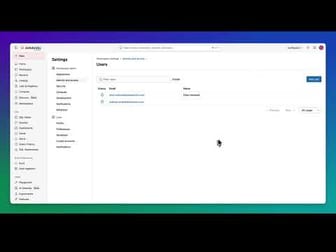
    How Anthropic engineers use Claude Docs

    Anthropic engineer Doug shares how to use Claude Docs in stand-ups and release reviews. Claude collaborates in documents, automatically extracting data, validating arguments, and responding to questions in comments. The tool is designed for team collaboration, supporting real-time analysis within the document.

  9. AWS Machine Learning Blog48

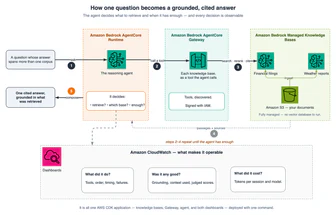
    Building enterprise-grade intelligent retrieval on Amazon Bedrock knowledge base using AWS CDK

    Building enterprise-grade intelligent retrieval on Amazon Bedrock knowledge base using AWS CDK, providing multi-round planning and tool-driven retrieval through the reasoning agent and AgenticRetrieveStream API, returning referenced answers. The solution deployment includes a CDK application with Amazon S3 corpus, knowledge base, and reasoning agent, supporting semantic routing and multiple retrievals, and built-in Amazon CloudWatch monitoring and evaluation features.

Oct 26Mon
  1. IBM Research Blog58

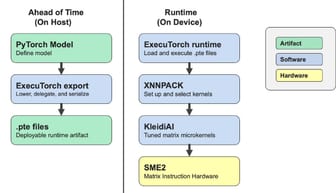
    PyTorch supports IBM's dataflow AI accelerator Spyre through torch-spyre and Spyre vLLM plugin

    IBM and the PyTorch Foundation announce that Spyre accelerator will become the first-class backend for PyTorch and support multi-accelerator scheduling. The torch-spyre compiler, Spyre vLLM plugin, and continuous integration efforts enable models and workflows to run on Spyre, an architecture optimized for inference, suitable for IBM Z, LinuxONE, and Power systems.

Oct 25Sun
  1. Ant Group inclusionAI · Hugging Face new models58

    inclusionAI/Ling-3.1-flash-base released: a sparse MoE architecture large model with 560B parameters.

    inclusionAI/Ling-3.1-flash-base is released, a sparse MoE architecture large model with 560B total parameters and 25B active parameters. It adopts a hybrid linear attention mechanism (63 KDA + 9 Gated MLA) and performs excellently in 47 cross-domain benchmark tests spanning eight fields. It supports continuous pre-training, domain adaptation, and post-training research. The model is trained with FP8 precision and released with BF16 precision, following the MIT license.

  2. vLLM Blog60

    vLLM serves DeepSeek-V4.1-Flash on GB300 NVL72: performance matches DeepInfer and extends to the entire rack

    The vLLM team used P/D separation and Wide-EP to serve DeepSeek-V4.1-Flash on a single NVIDIA GB300 NVL72 rack, achieving 954K tokens/s per GPU and 196 tokens/s for single-user P90 on SemiAnalysis AgentX, which is 7.9 times the early single-node results.

    Why it matters: The vLLM team has released per-item optimization and measured data for serving DeepSeek-V4.1-Flash on GB300 NVL72, which can be compared with DeepSeek's own engine DeepInfer.

Oct 24Sat
  1. vLLM Blog62

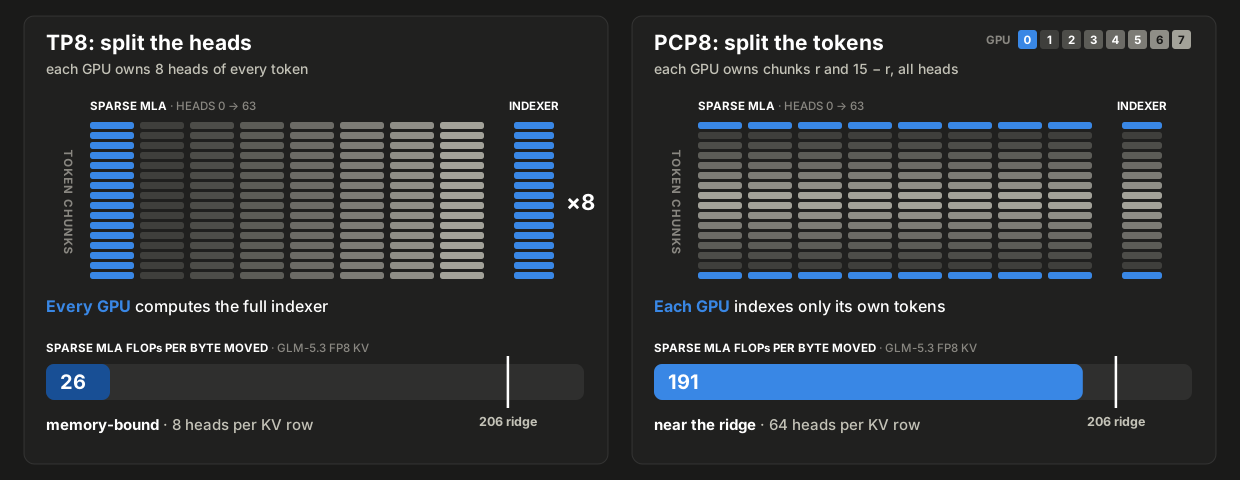
    vLLM provides an in-depth explanation of the optimization of PCP, DCP, and Hybrid HiSparse for GLM-5.3 on 16 H200s

    vLLM team releases the second part of GLM-5.3 optimization, deploying on 16 H200s with 1 pre-filled node and 1 decoding node, using PCP to split pre-fill by token and DCP to split KV cache by token, allowing 1M context to fit into the pre-fill node

    Why it matters: The vLLM team has dissected how PCP, DCP, and Hybrid HiSparse can be combined on 16 H200s, allowing readers to understand the memory and pre-fetch bottlenecks of long-context deployment.

  2. Databricks Blog58

    Spark's declarative pipelines: Use cases designed for AI agents

    Spark's declarative pipelines are 34 times faster than imperative pipelines in 22 data engineering tasks, halve the code volume, and have fewer errors. Declarative pipelines capture structural errors in advance through pre-execution validation and offload repetitive tasks like sorting and result saving to Spark, while imperative pipelines need to run on the cluster until the error step to detect them. The two methods perform equally in terms of logical error rates, but declarative pipelines have more concise and consistent code, making them easier to maintain.

  3. Hugging Face Blog

    LitPivot: Developing research ideas through dynamic context in the literature landscape

    LitPivot helps researchers adjust their research direction by reading previous literature, dividing research ideas into problems, contributions, and evaluation plans, and providing literature-based criticism and revision suggestions for each section. In a laboratory study involving 17 researchers, domain experts rated the literature foundation of novel ideas developed using LitPivot better than ideas developed using text editors and AI chat tools. Participants also reported stronger literature comprehension and improved understanding of the novelty and practicality of their ideas.

Oct 23Fri
  1. Tencent Hunyuan · Hugging Face new models

    Tencent Mixuan releases WeVisOne-VL-4B unified visual language model

    Tencent Mixuan released the WeVisOne-VL-4B model, built on Qwen3-VL, integrating a 9.6M parameter pixel decoder, supporting object-level perception (open-vocabulary object detection, pointing localization, counting, pointing and OCR) and pixel-level perception (pointing segmentation and promptable alpha friction), suitable for research tasks such as visual localization, pointing, counting, OCR localization, pointing segmentation, and image friction.