Skip to content
Live
Oct 31Sat
Oct 30Fri
  1. NVIDIA Blog58

    Breakthrough Listen introduces embodied AI agents to alien intelligence search

    Breakthrough Listen and the SETI Institute introduce embodied AI agents to alien intelligence search, achieving natural language request control of instruments, enhanced data calibration, and AI model processing of data streams at the Allen Telescope Array in California. The NVIDIA Holoscan platform processes sensor data, while the NVIDIA RTX PRO 6000 Blackwell GPU achieves 2.4TB data processing per second, completing real-time pulsar AI detection.

  2. Google DeepMind58

    PlanAssist tool can reduce the time planning officials spend assessing housing applications by 58%

    PlanAssist tool can reduce the time planning officials spend assessing housing applications by 58%, has been piloted in Barnet, Camden, and Dorset in the UK, and is now being rolled out to 12 more local planning authorities. The tool was developed by Google DeepMind in collaboration with the UK government, Google Cloud, and Faculty, based on the Gemini architecture. It accelerates the process by automatically verifying documents, checking policy constraints, and drafting reports, while retaining the final decision-making authority of officials.

  3. LangChain Blog67

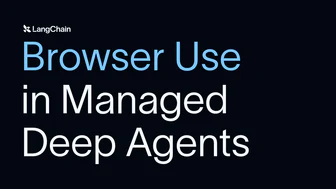
    LangChain adds browser capabilities to Managed Deep Agents

    LangChain adds browser capabilities to Managed Deep Agents, allowing developers to export browser configurations through define_browser, enabling managed agents to read page rendering results and perform click operations.

    Why it matters: The original text provides the integration method for browser tools, handoff mechanisms, and WebVoyager experimental data, which can be used to determine how managed agents can cover web tasks without APIs.

  4. LangChain Blog67

    LangChain releases Managed Deep Agents v0.10, adding browser usage and asynchronous sub-agents

    LangChain releases Managed Deep Agents v0.10, adding browser usage capabilities to let agents operate websites without APIs, and supporting asynchronous sub-agents to run long tasks in the background.

    Why it matters: The original text provides specific configuration methods and handover processes for browser takeover and asynchronous sub-agents, allowing judgment on the division of labor for agents handling websites without APIs and long tasks.

  5. AWS Machine Learning Blog42

    MoEngage on how to use AgentCore Gateway to convert 400 APIs into intelligent agent tools

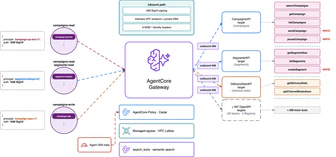
    MoEngage transforms 400 internal APIs into permission-controlled intelligent agent tools through Amazon Bedrock AgentCore Gateway, solving multi-team API integration challenges. This solution eliminates the need to set up MCP servers or configure networks, reducing the time to launch new APIs from days to hours while meeting constraints such as keeping APIs within the VPC, controlling identities from the server side, and ensuring tool definitions do not occupy the reasoning context window.

  6. Meta Engineering66

    Meta rolls out JiTTesting to production: Use LLM to generate tests and catch bugs before code merge

    Meta announced that Catching JiTTests has been put into internal production, using LLM to automatically generate executable tests for diffs to be merged, exposing behavioral differences before the code is landed

    Why it matters: Meta has disclosed the production deployment details and quantitative results of JiTTests, available for evaluating the implementation of LLM-generated tests in ultra-large-scale codebases.

Oct 29Thu
  1. Hugging Face Blog

    Project ProtoStar project release: Promoting the AI compatibility of publicly funded scientific research

    Project ProtoStar is announced, aiming to unlock the potential of publicly funded scientific research by making datasets, models, and code more accessible and reusable. The project brings together universities, research institutions, industry, and the open science community, supporting the release of scientific achievements in AI-compatible, machine-actionable formats, and demonstrating its value through a series of public challenges. The first challenge, hosted by Carnegie Mellon University, will launch on November 2.

  2. Hugging Face Blog85

    Mistral Large 4 (Le Chonk) released on Hugging Face

    Mistral releases multimodal MoE model Mistral Large 4 (Le Chonk), with approximately 1T total parameters, 49B activation parameters, a context window of 1M tokens, offering two official versions FP8 and NVFP4, as well as GGUF made by Unsloth and llama.cpp teams.

    Why it matters: The original text provides specific scores for the 1T total parameter, 49B activation multimodal MoE model on cybersecurity and coding benchmarks, along with measured throughput for local and endpoint deployment.

  3. Hugging Face Blog

    Hugging Face Granite Switch 4.1.1 released: software-based model update

    Hugging Face releases Granite Switch 4.1.1, an incremental update based on 4.1, maintaining full backward compatibility. New features include multilingual speech-to-text models (supporting 10 languages with native punctuation) and a decision adapter for improved performance on the Jev decision index test set. The team achieves rapid deployment by updating only the adapter without recalculating the base model, and future support for third-party custom adapters is planned.

  4. Mistral AI82

    Mistral releases open-source model Mistral Large 4 (Le Chonk) with trillion parameters

    Mistral releases open-weight version of its flagship trillion-parameter native multimodal model Mistral Large 4 (Le Chonk), which has been in public preview for three weeks.

    Why it matters: The official provides data on the encoding, security, and inference efficiency of the trillion-parameter open-source model, as well as weight downloads and self-hosting paths.

  5. Databricks Blog

    Databricks launches voice agents, delivering real customer value through context.

    Databricks releases voice intelligence agents, which adjust responses in conversations based on real-time contextual decisions, enabling language switching, transferring to a human, or providing personalized services. These agents need to process customer requests within 200 milliseconds and rely on the context, ontology, and governance capabilities provided by Databricks. They integrate customer, order, product, and policy data, and follow the access rules of the enterprise data catalog.

  6. Google Developers Blog58

    How Agents CLI optimizes Agent quality through Hill-Climbing

    Agents CLI v1.8.0 achieves Hill-Climbing optimization of Agent quality through commands like eval generate, eval grade, etc., using the custom_response_quality metric to rate 4 cases from 1 to 5, finding that changing the system prompt to a chef role reduced the average score from 4.0 to 2.75. This tool supports model backend experiments and automatic alerts, improving Agent performance through iterative cycles.

  7. LangChain Blog

    How to use crons to build proactive agents with LangChain

    LangChain found that nearly 70% of Managed Deep Agents run from scheduled tasks. Crons enables agents to have proactivity, personalization, and ambient characteristics by implementing mechanisms such as memory ('dreaming'), proactivity (exploring new actions), intelligent filtering (monitoring event streams), and reminders (scheduled tasks).

Oct 28Wed
  1. Together AI Blog38

    Together AI has launched an auto-repair feature for GPU clusters: a complete process from GPU failure to healthy nodes

    Together AI has launched an auto-repair feature for GPU clusters, which continuously monitors node health on both virtual machines and host machines. When a failure is detected, it recommends minimizing repair actions and provides evidence, allowing users to choose automatic execution or manual approval. This feature is now fully available, supporting passive health checks, repair recommendations, automatic repair policies (including fault and node-level authorization), idle wait control, upgrade tiers, and safety guards, and is performed via API and console; the preview version provides repair commitment support based on node tags for third-party detection systems.

  2. AWS Machine Learning Blog34

    How does Property Finder identify evaluation bias on Amazon Bedrock and optimize model costs?

    Property Finder discovered that 96.8% of the labels in its evaluation dataset for visual AI workloads migrated to Amazon Bedrock were predictions from a single model rather than human validation, hindering objective comparison of new models. The company built a trustworthy benchmark dataset by independently labeling 356 images with human experts and, after 27 iterative optimizations with evolutionary prompt tuning, reduced costs by 86% while maintaining an 86% accuracy rate.

  3. AWS Machine Learning Blog34

    AWS SageMaker AI Launch SOCI-indexed images to accelerate inference tasks

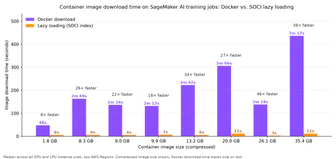
    AWS SageMaker AI introduces SOCI-indexed images functionality, removing container image downloads from the critical path, reducing SageMaker AI training and processing task startup times from minutes to seconds. This feature is achieved by pre-indexing AWS Deep Learning Container (DLC) or adding indexing to custom images, requiring no changes to workload definitions. Benchmark tests show it can reduce GPU idle time by 90% and improve efficiency 8-46 times.

  4. LangChain Blog71

    How to Set Up Design Intelligent Agents with LangChain Content Studio

    LangChain introduces the internal design of its intelligent agent Content Studio, which can generate videos, social media graphics, UI diagrams, and presentations in Slack with a single prompt word, with all materials generated by code.

    Why it matters: LangChain has disclosed the complete setup process of its design agent Content Studio, including skills, wiki, inspection gates, and the division of labor between asynchronous sub-agents, which can serve as a reference for building vertical agents.

Oct 27Tue
  1. Google Developers Blog66

    Google launches replaceable reasoning format and A2UI Express for A2UI

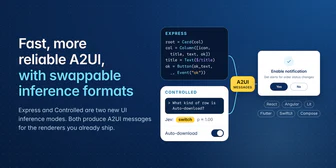
    Google introduces a replaceable reasoning format for generative UI protocol A2UI, and adds default format A2UI Express, claiming it reduces latency up to 3 times and token usage up to 3 times less than Direct JSON for generating the same UI.

    Why it matters: The official provides an accessible way to replace reasoning formats with latency and token comparisons, facilitating engineering trade-offs for generative UI.

  2. Ant Group inclusionAI · Hugging Face new models38

    inclusionAI/Ling-3.0-flash-Sante-fp8 released: FP8 quantized medical dedicated large model

    inclusionAI/Ling-3.0-flash-Sante-fp8 released FP8 quantized version, retaining 124B parameters (5.1B/Token) and BF16 performance, reducing memory and improving deployment efficiency, supporting medical inference, research, and tool-assisted workflows, requiring professional manual review. Stable performance on benchmarks like Healthbench, ReDisQA, achieving efficient inference through block FP8 quantization (128x128 blocks).

  3. Databricks Blog

    Lakeflow Connect integrates enterprise productivity with AI data

    Lakeflow Connect supports wikis, project management tools, and AI base models through native connectors, enabling downstream AI agents to obtain complete business context. The platform provides fully managed native connectors that support SaaS applications, databases, and file sources, with data directly imported into the Databricks platform, and incremental import of Unity Catalog tables through point-and-click UI or API configuration.

  4. LangChain Blog58

    How LangChain builds enterprise-level agents (company harness)

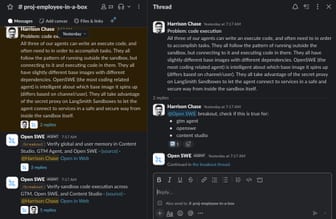
    LangChain's internal agents integrate with Slack to execute tasks as a user or with fixed credentials, featuring global and user-level memory, executing code in a sandbox, and supporting background scheduling. Its architecture includes three agents: GTM, OpenSWE, and Content Studio, which handle GTM activities, engineering code reviews, and marketing content creation, respectively. The 'breakout' feature optimizes user experience and addresses core issues like authentication.

  5. AWS Machine Learning Blog48

    Building enterprise-grade intelligent retrieval on Amazon Bedrock knowledge base using AWS CDK

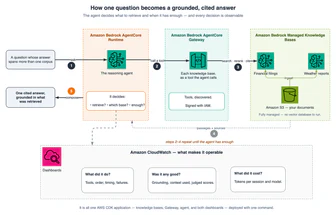
    Building enterprise-grade intelligent retrieval on Amazon Bedrock knowledge base using AWS CDK, providing multi-round planning and tool-driven retrieval through the reasoning agent and AgenticRetrieveStream API, returning referenced answers. The solution deployment includes a CDK application with Amazon S3 corpus, knowledge base, and reasoning agent, supporting semantic routing and multiple retrievals, and built-in Amazon CloudWatch monitoring and evaluation features.

Oct 26Mon
  1. IBM Research Blog58

    PyTorch supports IBM's dataflow AI accelerator Spyre through torch-spyre and Spyre vLLM plugin

    IBM and the PyTorch Foundation announce that Spyre accelerator will become the first-class backend for PyTorch and support multi-accelerator scheduling. The torch-spyre compiler, Spyre vLLM plugin, and continuous integration efforts enable models and workflows to run on Spyre, an architecture optimized for inference, suitable for IBM Z, LinuxONE, and Power systems.