Skip to content
Live
Oct 19Mon
  1. Google Developers Blog

    LiteRT Tensor API release: A new solution for native model development on edge devices.

    LiteRT Tensor API is released, supporting developers to write and optimize models natively in C++ on edge devices, enabling cross-platform deployment (CPU/GPU/NPU) without script conversion. Developers can fully control the computational graph structure and directly load model weights, achieving zero-copy data transfer through shared accelerator buffers, while providing building blocks for AI coding agents.

Oct 17Sat
  1. Google Research

    Google Research explores combining AI agents with biological reality to build autonomous wet labs.

    Google Research releases the VERID framework, enabling AI agents to run in physics-based, safe, and resource-efficient experiments; demonstrates closed-loop intelligent agent scientific discovery on adapter and de novo protein design prototypes; through three rounds of design-test-iterate cycles, AI-driven rational and de novo design will increase confirmed target hit rates to 33.5% and 42.1% on myoglobin and α-thrombin, respectively.

Oct 16Fri
  1. Google DeepMind

    How does Google Antigravity accelerate the discovery of antibacterial peptides?

    The Google Antigravity platform works through its intelligent agent workbench and ProtNLM model, helping biologists quickly discover, structure evaluate, and prioritize potential antimicrobial peptide targets, compressing searches previously scattered across multiple databases into a single session. The platform uses ProtNLM to predict protein function and supports researchers in scanning millions of uncharacterized proteins in the UniProt database. Researchers collaborate with AI agents on a shared 3D canvas, compressing the time required for the antimicrobial peptide discovery process from several days to a single session.

Oct 15Thu
  1. Google Developers Blog

    Google OAuth Launches DPoP Support: Protecting Refresh Token Security

    Google OAuth Platform Launches DPoP Support, Encrypting Refresh Tokens and Client Key Pairs at the Application Layer to Prevent Token Theft and Replay Attacks. This scheme uses DPoP only for constrained long-lived refresh tokens, ensuring they cannot be replayed even if stolen, while short-lived access tokens remain standard Bearer tokens to maintain high performance. DPoP works with DBSC to defend against API and web session credential theft, but note the key sharing challenges in multi-agent workflows.

  2. Google Research

    Deep Review: Google's intelligent document verification system

    Google has launched the Deep Review intelligent document verification system, providing rigorous feedback and technical validation for complex documents, supporting PDF and plain text input, offering 2 free reviews per week, and integrating advanced API, collaborating with 4 top computer conferences such as STOC 2026 and ICML 2026, processing over 16,000 pre-submission feedbacks for papers.

Oct 14Wed
  1. Google DeepMind

    Google DeepMind collaborates with the Singapore government to develop a fine-tuned AI model for fraud detection

    Google DeepMind partnered with the Singapore government's tech agency, GovTech Singapore, to fine-tune the privacy-preserving device-side fraud detection model Gemma to combat over half of the crime in Singapore (over 4 billion SGD in losses). The model issues real-time warnings by analyzing conversation patterns on the device, and as it runs on the device side, user privacy is not compromised.

  2. Google DeepMind

    Google DeepMind releases Gemini 4 Argon and emphasizes security protection

    Gemini 4 Argon demonstrates cutting-edge capabilities in coding, finance, law, and other fields, particularly enhancing cybersecurity defense functions. Its effectiveness has been validated through the Fairwind project and internal testing. The model performs excellently on benchmark tests like MMLU and employs a three-layer real-time protection mechanism (input filtering, internal introspection, continuous monitoring) and automated bias monitoring, significantly reducing the risk of harmful requests and violations. It successfully intercepts over 99% of external biosecurity jailbreak attempts while reducing shortcut behavior in coding tasks to 2%.

  3. Google DeepMind

    Gemini 4 Argon brings breakthrough progress to robotics technology

    Gemini 4 Argon has achieved major breakthroughs in physical understanding, code generation, and visual semantic reasoning, achieving a pure reasoning score of 87% on the Embodied Reasoning (ERQA) benchmark test, surpassing all leading models. Argon can be applied to all stages of the robot's lifecycle, including mobile manipulation practice using MuJoCo, zero-shot robot control, and closed-loop steering of video world models.

  4. Google AI Blog90

    Google has released the Gemini 4 Argon cutting-edge model.

    Google has released Gemini 4 Argon, opening it up to developers, businesses, and researchers, with API pricing at $2 per million input tokens and $10 per million output tokens, offering a 95% discount on cached input tokens.

    Why it matters: Official pricing, baseline rankings, and multiple internal implementation cases are provided, allowing judgment on its position in coding and research workflows.

Oct 13Tue
Oct 8Thu
  1. Google Developers Blog

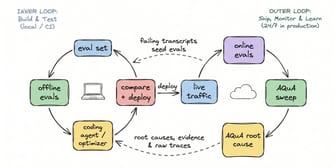
    AQuA: An agent that can diagnose agent issues in a production environment.

    AQuA runs alongside the production agent, analyzing production trajectories through a five-stage process (sampling, review, clustering, validation, tracking), clustering common issues, and generating actual/expired findings to help teams continuously monitor and improve agent quality. It uses target files written by developers and custom metrics to guide the review process and supports integration with AutoRaters on the Gemini platform.

Oct 7Wed
  1. Google AI Blog

    Google AI launches Playground: Create and share custom games without coding

    Google AI has launched Playground, an experimental platform where users can create, play, and share custom games without coding. Users can build games through text prompts and play across devices in the browser. The platform features a growing library of games, supports multiplayer and leaderboards, and is soon to launch an integration with Unity Spark, offering advanced features for professional creators.

  2. Google Developers Blog

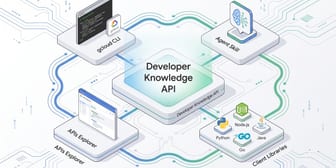
    The Google Developer Knowledge API ecosystem helps developers build AI tools efficiently.

    The Google Developer Knowledge API is Google's official developer documentation programmable source, providing semantic search, intelligent document chunking, and reliable Q&A capabilities for Google Cloud, Firebase, Android, and other Google ecosystems, reducing hallucinations in AI tools due to the expiration of LLM training deadlines.

Oct 6Tue
  1. Google Research

    Google Earth AI's Population Dynamics Foundation Model (PDFM) provides a planetary geospatial foundation model for global public health.

    Google Earth AI's Population Dynamics Foundation Model (PDFM) compresses search trends, population flows, building environment density, and environmental factors into location embeddings, enhancing epidemiological research performance in various disease fields and geographical environments without specific task fine-tuning.

  2. Google Developers Blog

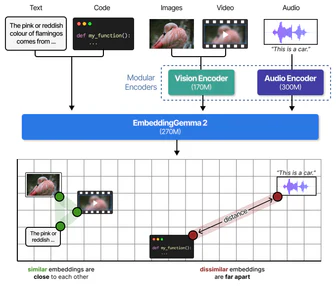
    EmbeddingGemma 2 Developer Guide

    EmbeddingGemma 2 is an open-source 740M parameter model developed based on Gemma 4, which maps text, code, images, video, and audio to a unified 768-dimensional space, supports modular loading (270M-740M parameters), and performs excellently in code search and cross-modal retrieval, can be used via the sentence-transformers library.

  3. Google Research

    Google Research explores the open and emergent challenges in agent privacy and security from a contextual perspective.

    Google Research has released a new report titled 'Privacy and Security Challenges of Open and Emergent Agents: A Contextual Perspective,' analyzing the fundamental privacy and security challenges faced by autonomous agents, requiring coordinated defense at the system, model, user, and ecosystem levels. The report indicates that agents need to handle personal data and act autonomously, but their characteristics in unstructured interfaces, probabilistic control flow, and autonomous agency introduce new challenges, requiring strategies that combine contextual integrity theory to evaluate the social and contextual appropriateness of actions.

Oct 2Fri
  1. Google Research

    Google Research has released a privacy-preserving federated learning system based on a trusted execution environment.

    Google Research announced a new generation of a federated learning system based on trusted execution environments (TEE), achieving fully verifiable and auditable data anonymization by executing encrypted training data within the TEE and publishing access policies to the public transparent log Rekor, Gboard has adopted this system and significantly improved computational speed.

Oct 1Thu
  1. Google DeepMind

    Gemini 4 Argon: Google's next-generation cutting-edge intelligent model

    Gemini 4 Argon delivers cutting-edge performance in complex workflows, supporting software engineering, enterprise knowledge work (legal and financial), and cybersecurity defense. The model's token output limit is extended to the industry-leading 1M, and it leads in benchmarks such as DeepSWE v1.1 (77.9%), Vals Index (financial, coding, legal, tax), and AutomationBench (51.3%).

Sep 30Wed
  1. Google Developers Blog

    How does Sparse VideoGen (SVG) accelerate temporal and spatial attention computation for video diffusion on TPUs

    Sparse VideoGen (SVG) dynamically routes attention heads to spatial or temporal masks by identifying the spatiotemporal structures of different attention heads in video diffusion models, converting theoretical sparsity into actual end-to-end speedup. On TPU v6e, SVG retains about 38.87% of query-key pairs, achieving 3.5x inference acceleration while maintaining output quality at a given sparsity level. The scheme employs custom JAX and Pallas Splash attention kernels to convert theoretical sparsity into physical sparsity on hardware.

Sep 25Fri
Sep 24Thu
  1. Google DeepMind

    Google DeepMind introduces Private AI Compute, achieving cross-device private persistent memory.

    Google DeepMind introduces Private AI Compute, a new architecture that achieves cross-device AI persistent memory through cloud-based encrypted storage and device key management, ensuring data privacy. The architecture temporarily decrypts user data in a cloud-isolated environment to process requests and immediately encrypts and stores new contexts, while the device holds the decryption keys. Users can verify the authenticity of server software and audit security protocols, supporting AI in maintaining device-level privacy standards even when processing complex tasks efficiently in the cloud.

Sep 23Wed
Sep 16Wed
Sep 14Mon
  1. Google · Hugging Face new models

    Google releases EmbeddingGemma 2 multimodal embedding model

    Google has released EmbeddingGemma 2, a multimodal embedding model with 740M parameters, supporting unified 768-dimensional vector representations for text, images, video, and audio. The model can run on consumer-grade hardware, providing low-latency semantic representations suitable for applications such as search, retrieval-augmented generation, etc. EmbeddingGemma 2 has performed excellently in multiple benchmark tests, such as text, code, visual document, and audio embedding benchmark tests, and supports vector truncation to reduce storage requirements.

Sep 8Tue
Sep 2Wed
Aug 25Tue