Skip to content
Live
Nov 10Tue
  1. AWS Machine Learning Blog38

    CrossnoKaye on How to Achieve Industrial Physical AI with Amazon Bedrock AgentCore

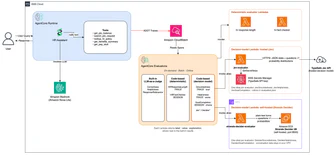
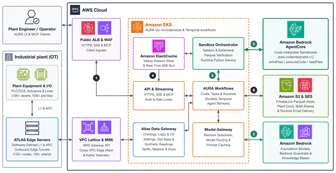
    CrossnoKaye achieves industrial physical AI on Amazon Bedrock AgentCore through its ATLAS platform and AURA agent, improving production efficiency by 11-17% and reducing energy consumption by 21%. AURA leverages AgentCore's code interpreter capabilities to run Python workloads in isolated micro VMs to verify numerical calculations, while achieving closed-loop control through edge clusters and cloud optimization systems.
  2. Berkeley AI Research22

    BAIR at CoRL 2026

    BAIR team presented multiple research achievements at the Robot Learning Conference (CoRL) held from November 9 to 12, 2026, in Austin, Texas, including 33 main conference papers, 4 breakthrough posters, 10 oral presentations, and 7 thematic speeches, among which Professor Negar Mehr will deliver an early career keynote speech. The conference covers topics such as robotic vision-language-action models, embodied agents, fine-grained manipulation alignment, and hindsight reward editing.

Nov 9Mon
  1. Hugging Face Blog45

    HOPE Advanced Pruning Method Released

    The HOPE method achieves better pruning effects in mixed expert language models by considering the second-order interactions between experts. It improves performance by 6.1% over the next best method on the agentic coding task at a 50% pruning rate. This method is validated on models like Qwen3.5-122B, where each MoE layer has 256 experts. After pruning, it can reduce memory usage by about 250 GB and is compatible with quantization.

Nov 7Sat
  1. Anthropic Research34

    Anthropic explores methods for AI to build scientific models

    Anthropic proposes that AI building scientific models requires three steps: modeling, constraining, and explaining, where the constraining model can obtain probability distributions rather than single solutions with Bayesian reasoning; AI has made significant progress in constraining models, but if only the model is given, it lacks understanding of the real system.

  2. Anthropic Research62

    Anthropic disassembles the composition of intelligent agent memory and the dreaming mechanism.

    Anthropic has published a research paper, breaking down Claude's intelligent agent memory into components such as memory notes, offline dreaming organization, and memory hierarchy improvement, and explaining that memory refers to context that is preserved across sessions and can be read again, excluding weight updates, context learning within a single session, and compaction.

    Why it matters: Anthropic has disclosed the hierarchical design of agent memory and the dreaming mechanism, providing comparable experimental results using CL-Bench, Pokemon, and internal document corpora.

  3. AWS Machine Learning Blog

    Agent primitives classification in AWS Quick

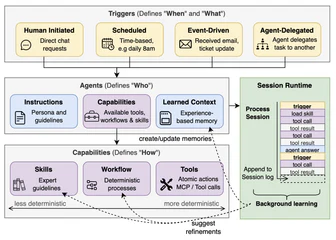
    AWS Quick breaks down agent work into four primitives: 'When', 'What', 'Who', 'How', triggering tasks, agents execute and use capabilities (tools, skills, workflows) to complete work. Triggers are of four types: human-initiated, agent-delegated, scheduled, and event-driven; agents are persistent learners, including instructions, dynamically updated capabilities, and accumulated contextual memory; capabilities range from fully autonomous to fully deterministic, tools are atomic operations, skills provide structured guidance, and workflows are deterministic coordination.

  4. Google Developers Blog

    Agent Distraction

    13% of agents are misled by inline TODO(bug/...) or FIXME(bug/...), with 83% of actions completely unguided by developers. 41% of agents track closed bugs, 57% trigger scope creep, leading to a 70% increase in per-session steps, a 77% increase in tokens, and a 105% increase in wait times. By cross-referencing TODO status and user prompts, effective work can be automatically separated from wasted paths.

Nov 6Fri
  1. vLLM Blog72

    REINFORCE Zero: Aligned kernel allows asynchronous RL to train stably under lag 64.

    NVIDIA Research and Inferact's REINFORCE Zero proposes to first align rollout with training kernel, then use unclipped token-level importance sampling to correct weight lag, achieving a training step throughput 2.40 times that of synchronous training under 16 GPUs and 12K updates.

    Why it matters: The paper breaks down the gap between asynchronous RL's rollout and training into two items: weight lag and kernel inconsistency, and proposes an alignment-free, no-trimming importance sampling method after alignment.

  2. Hugging Face Blog58

    Hugging Face released ToyBlocks: A controlled world framework for robot learning and evaluation

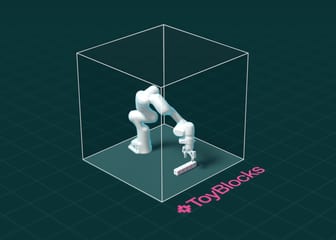
    Hugging Face released ToyBlocks, a framework for robot learning and evaluation that provides a controlled simulation environment. The framework supports automatically generating tasks and training demonstrations, and includes metrics to measure changes in robot behavior over time, aiming to study how models improve with more training data and how to combine advanced reasoning with precise physical control.

  3. Hugging Face Blog

    Hugging Face Open ASR Leaderboard adds Egyptian and Nigerian English datasets

    Hugging Face Open ASR leaderboard adds Liva AI private datasets for Egyptian English and Nigerian English, containing 1.34 hours and 1.55 hours of dialogue speech, to enhance the representativeness and reliability of ASR evaluation. The leaderboard now supports more detailed accent classification based on the Kachru three-circle model, covering groups such as US and non-US, inner circle and outer circle/extended circle.

  4. Anthropic Research

    How researchers use Claude for scientific discovery

    Researchers primarily use Claude to analyze data and write content, accounting for about one-third of Claude conversations and nearly half of Claude Code conversations; usage is higher for cognitive tasks (such as computer science and statistics) and lower for tasks like data collection and idea generation; about 40% of respondents expect AI models to independently complete entire research projects by 2030.

  5. AWS Machine Learning Blog

    How Amazon uses Amazon SageMaker AI to evaluate A+ content quality

    Amazon evaluates A+ content quality through Amazon SageMaker AI, rendering e-commerce content into a single snapshot and fully evaluating it with VLM. Combining VLM semantic scores with OCR readability signals, it fuses them in an expert-annotated CatBoost classifier and uses SHAP to explain quality decisions, generating improvement suggestions. The system is deployed on Amazon SageMaker AI, supporting data ingestion, annotation, model hosting, interpretability, and production monitoring.

  6. Apple Machine Learning Research

    Apple's Amortizing Maximum Inner Product Search accelerates retrieval

    Apple's Amortizing Maximum Inner Product Search, presented at ICML 2026, learns support functions by training small neural networks to understand typical query matching patterns at a fixed cost, achieving faster precise retrieval during inference. This method utilizes ICNN to learn support functions, and KeyNet directly outputs the best matching key vector, both trained on supervised datasets constructed based on actual query distributions, significantly improving retrieval efficiency in RAG scenarios.

  7. OpenAI Deployment Safety72

    OpenAI releases GPT-6 Cyber system card

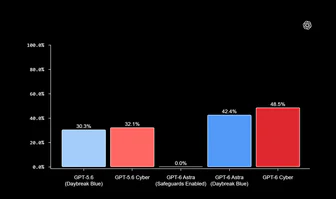
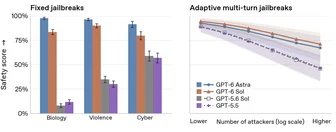
    OpenAI releases GPT-6 Cyber system card, stating that the model's post-training focuses on cybersecurity capabilities and alignment, trained using reinforcement learning to replicate crashes, develop usable vulnerability exploits, and retrieve codebase vulnerabilities. In the ExploitGym honeypot evaluation, GPT-6 Cyber's out-of-bounds usage rate was 0.07% without deploying security instructions, GPT-5.6 Sol was 49.5%, and it was 0% with deployed security instructions.

    Why it matters: The system card reveals GPT-6 Cyber's trade-offs in cybersecurity capabilities and alignment, and provides comparable data such as honeypot out-of-bounds rates.

  8. Microsoft Research

    PDD Kit officially validated full-stack web applications written by AI intelligent agents

    The PDD Kit translates user intent into formal specifications and verifies whether the code written by the agent for each input conforms to these specifications, supplemented by testing. The team officially validated the Rust-written Pet Store login logic using the Chopin environment on GitHub Next with the PDD Kit, and the Verus tool discovered and fixed existing bugs, proving no login bugs under the specification.

  9. Google Research72

    Google Research uses smartwatch sensors to identify signs of hypertension.

    Google Research published a multimodal AI system AI-PPG-ACC-HTN in Nature, which passively identifies hypertension status without wristband calibration, using only PPG and accelerometer data from consumer-grade smartwatches.

    Why it matters: The study passively identifies hypertension using PPG and accelerometer data from smartwatches, providing quantitative results for screening and confirmation in two stages, with 24-hour dynamic blood pressure monitoring as the gold standard.

Nov 5Thu
  1. Amazon Science18

    Hamed Karimi wins the ECML PKDD 2026 Test-of-Time Award

    Hamed Karimi and colleagues win the 2026 ECML PKDD Test-of-Time Award for their 2016 paper 'Linear Convergence of Gradient and Near-Gradient Methods under Polyak–Łojasiewicz Conditions,' which proves the rapid convergence of machine learning model training under the Polyak-Łojasiewicz condition, bridging the long-standing gap between theory and practice, and has been cited over 2000 times.

  2. Anthropic Research

    Anthropic research team uses Claude to discover the first 3D structure of a vault particle in prokaryotic cells

    Anthropic research team uses Claude to discover the first 3D structure of a vault particle in prokaryotic cells, which is composed of 96 L05 protein subunits and has a mass of approximately 9.5 megadaltons. Claude assists in searching for sequence literature, optimizing particle separation methods, and processing microscopic data, reducing vault purification time from 3 days to 90 minutes and structure model construction time from weeks to 34 hours. The study reveals the assembly mechanism of vault particles and suggests their potential applications in biotechnology.

  3. AWS Machine Learning Blog

    Use Amazon Bedrock AgentCore to evaluate decision models

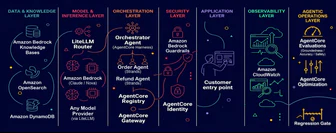
    Amazon Bedrock AgentCore Evaluations support scoring agents using 15 built-in evaluators or custom evaluators (LLM or code). Decision models are suitable for questions with a fixed set of answers, such as Jev and Strands Decider 2B, which provide calibrated probabilities rather than free text. The code example shows how to convert AgentCore evaluation input into a decision model request and convert model probabilities back into evaluation results.

  4. Google Research

    Agile Deliberation: How AI Assists Humans in Defining Subjective Concept Boundaries

    The Agile Deliberation framework assists humans in defining the boundaries of subjective concepts through iterative dialogue, transforming fuzzy ideas into precise AI instruction blueprints. The framework is divided into two stages: concept definition and concept iteration, which processes fuzzy images through direct feedback. In 18 user experiments of 1.5 hours each, it significantly reduces user fatigue and anxiety, making AI model performance superior to standard baselines.

  5. AWS Machine Learning Blog38

    How Indegene builds an LLM-driven data quality agent on AWS to achieve enterprise-grade data quality modernization and scalability

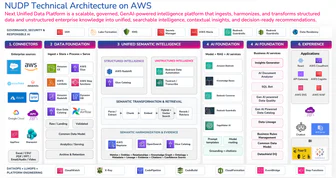
    Indegene built a production-grade LLM-driven data quality agent on AWS for its NEXT unified data platform (NEXT UDP), which generates context-aware data quality rules and verifies and generates executable SQL and Python code under centralized manual review governance, helping businesses improve data quality at scale and reduce the effort of building and maintaining data quality programs.

Nov 4Wed
  1. Together AI Blog50

    Together AI launches Polymorphic Inference: Adaptive open-source model inference technology

    Together AI Launches Polymorphic Inference Technology, Continuously Compiling and Optimizing Open Source Model Inference Performance Using AI Agents to Address Challenges Such as Model Release Acceleration, Architectural Diversity, and Rapid Changes in Workloads and Hardware Platforms. This Technology Enables Inference Systems to Adapt Quickly to Dynamic Environments, for Example, Achieving Near-Hardware-Limit Performance When 80% of OpenRouter Traffic Comes from Models Released in the Past Three Months.

  2. Ai2 Blog

    Ai2 collaborates with Google to launch a new generation climate model NeuralGCM+

    Ai2 receives a $10 million three-year grant from Google.org to collaborate with Google Research in developing the open-source climate model NeuralGCM+, aiming to improve the speed and reliability of climate predictions; the model extends from Google Research's NeuralGCM, combining physical equations with AI to simulate the joint effects of the atmosphere and oceans, with simulation cycles extended to decades, supporting regional rainfall and water resource change predictions, and plans to promote research community collaboration through open-source code and documentation.

  3. Meta Engineering34

    Meta launches F3 Lightning to accelerate the large-scale production of advertising ML features

    Meta launches F3 Lightning to address bottlenecks in F3 graph publishing by decoupling feature publishing from execution, enabling independent validation deployment. It adopts optimizations such as stable compute identifiers, a single execution plan, shared memory buffers, and dense index mapping, making the production speed of extraction features approximately 3.6 times faster than F3 without increasing infrastructure compute costs.

  4. Hugging Face Blog60

    IBM trains 20B small model Palette to generate slides according to its own design language

    IBM's research team fine-tunes a 20B open-source weight model, Palette, using a two-role LoRA scheme where designers write JSON briefs and encoders generate pptxgenjs code page by page to create presentations according to IBM Design Language.

    Why it matters: IBM uses synthetic data and checks to repair closed-loop training for a 20B small model to create presentations, providing a method that can be transferred to other structured outputs.

  5. Hugging Face Blog50

    StateBench: Testing how language models track state changes in long documents

    StateBench is a long-context state tracking benchmark that tests how language models maintain tracking changes in entity information within long documents. The benchmark includes four difficulty levels, ranging from simple immutable assignments to complex dependency assignments. It found that cyclic and hybrid models generalize better than Transformers on direct training tasks, but cutting-edge models like Gemini 3.8 Flash, Claude Opus 5.5, and GPT-6 Sol still fail in complex state tracking with long inputs.

  6. Hugging Face Blog62

    The same model with a different harness: Comparing CUGA, Hermes, and Deep Agents on AppWorld.

    The IBM team compared CUGA, Hermes, and Deep Agents using the same open-source weight model GLM-5.3-flash on 90 tasks in AppWorld, with pass rates of 81.1%, 46.7%, and 30.0%, respectively, and 20, 8, and 2 scenarios where all three variants passed.

    Why it matters: With the same model but a different harness, the task completion rate increased from 30% to 81%, and reproducible configurations and evaluation links were provided in the text.

Nov 3Tue
  1. Ai2 Blog

    StateBench: Benchmark for testing large language models to track changes in long document states

    StateBench is a benchmark for testing large language models' ability to track entity state changes in long documents, including four difficulty levels: R-trivial, non-periodic, solvable, and general finite. Research finds that recurrent and hybrid models generalize far better than Transformers when directly trained on these tasks, while cutting-edge models like Gemini 3.8 Flash, Claude Opus 5.5, and GPT-6 Sol still struggle with more complex state tracking issues when input lengths vary.