Skip to content
Live
Oct 30Fri
  1. Ant Group inclusionAI · Hugging Face new models

    inclusionAI/ZwZ2-4B-GGUF model weights released

    The inclusionAI/ZwZ2-4B-GGUF model weights have been released. This model is part of Zooming without Zooming v2 and is divided into a language model (FP16, Q8_0, Q4_K_M) and a visual encoder and projector (mmproj, FP16, Q8_0, Q4_K_M), offering multiple precision combinations. It needs to be used with llama.cpp (supporting Qwen3.5 multimodal).

  2. Codex releases45

    Codex 0.166.0 released: adding keyboard driver transcription selection, Markdown rendering optimization, and GPT-6.1 Terra support

    Codex 0.166.0 released, adding keyboard driver transcription selection (supporting word, line, and page operations), integrated search and configurable shortcuts, as well as consistent Markdown rendering in asynchronous questions, options, answers, and transcription responses. Also supports GPT-6.1 Terra and adds codex queue --resume feature to resume unloaded threads.

Oct 29Thu
  1. ByteDance Seed · Hugging Face new models

    ByteDance-Seed/GenFirst releases: A generative pre-reconstruction method for stable end-to-end latent generation modeling

    ByteDance-Seed/GenFirst trains a latent VAE and combines it with a generative prior to avoid latent collapse, which usually makes end-to-end training unstable. The two-stage plan of this method is used for prior and entropy weights: the first stage lets the prior shape the latent geometry, and the second stage reduces both weights tenfold, allowing the decoder to recover details.

Oct 28Wed
  1. AWS Machine Learning Blog34

    How does Property Finder identify evaluation bias on Amazon Bedrock and optimize model costs?

    Property Finder discovered that 96.8% of the labels in its evaluation dataset for visual AI workloads migrated to Amazon Bedrock were predictions from a single model rather than human validation, hindering objective comparison of new models. The company built a trustworthy benchmark dataset by independently labeling 356 images with human experts and, after 27 iterative optimizations with evolutionary prompt tuning, reduced costs by 86% while maintaining an 86% accuracy rate.

Oct 27Tue
  1. Microsoft AI News67

    Microsoft released the MAI Image 2.7 image editing model, ranking 3rd on Arena Edit and 2nd on Artificial Analysis.

    Microsoft AI released the image editing model MAI Image 2.7, launching as a preview version. It ranks 3rd in Arena Edit and 2nd in the Artificial Analysis image editing chart, making Microsoft AI the 2nd place lab.

    Why it matters: Microsoft announced the rankings of MAI Image 2.7 on two image editing lists and provided the improvement magnitude on 10 use cases compared to the previous generation.

  2. LangChain Deep Agents releases

    LangChain Deep Agents deepagents-code==0.2.2 release: Security and performance improvements

    The deepagents-code==0.2.2 version of LangChain Deep Agents has been released, including security and performance improvements. New features include GPT-6.1 Terra support, Chinese text input to chat, plugin update detection, etc.; bug fixes include project .env file trust value settings, terminal UI link limits, Git option limits, etc.; performance has been improved by reusing parent process context, optimizing server startup processes, and streamlining transcription rendering, etc. It is recommended to upgrade as soon as possible.

  3. Apple Machine Learning Research

    GHARP: Real-time Gaussian head animation method based on large-scale reconstruction priors

    The GHARP method animates 3D heads in real-time using a small amount of input images and expression signals, divided into an offline identity phase (constructing geometry and appearance representations) and a runtime animation phase (predicting expression residuals). This method performs animation in the semantic structure latent space of the pre-trained reconstruction model, limiting the expression change space to achieve efficient residual prediction, and achieves SOTA quality on the Ava-256 benchmark, with a 13x speedup on A100 GPUs and an 8x reduction in the number of Gaussians.

Oct 23Fri
  1. Tencent Hunyuan · Hugging Face new models

    Tencent Mixuan releases WeVisOne-VL-4B unified visual language model

    Tencent Mixuan released the WeVisOne-VL-4B model, built on Qwen3-VL, integrating a 9.6M parameter pixel decoder, supporting object-level perception (open-vocabulary object detection, pointing localization, counting, pointing and OCR) and pixel-level perception (pointing segmentation and promptable alpha friction), suitable for research tasks such as visual localization, pointing, counting, OCR localization, pointing segmentation, and image friction.

  2. Hugging Face Blog

    Hugging Face releases OlmoEarth v1.3: Global satellite embedding model achieves new milestones

    Hugging Face releases OlmoEarth v1.3, a satellite embedding model, offering global pre-computed embeddings (10m resolution, 64 and 128 dimensions), available to users without login or technical knowledge. The model performs best in 27 evaluations, with 128-dimensional embeddings scoring highest in 20 evaluations and 64-dimensional embeddings leading in 18. Training costs are reduced by 53% compared to v1.2 and 18% compared to v1, with corresponding reductions in carbon emissions. Weights, data, and code are all open source.

Oct 22Thu
Oct 21Wed
  1. AWS Machine Learning Blog58

    vLLM enhances the TTFT performance of multi-round agent workloads through bidirectional KV transmission.

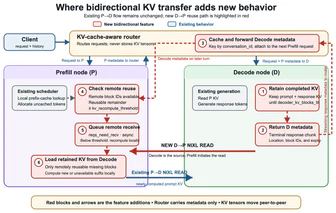
    vLLM's bidirectional KV transmission mechanism reduces redundant calculations by allowing the decoding node to return previously computed KV cache to the pre-filled node in subsequent dialogue turns. In multi-round benchmark tests on AWS EC2 P5en instances, it improved the TTFT of Qwen3-32B by 1.6x and zai-org/GLM-5-FP8 by 3.3x. This feature is implemented by extending the NIXL KV connector and utilizing a KV cache-aware router to coordinate KV reuse across dialogue turns.

  2. AWS Machine Learning Blog34

    Building an AI agent semantic layer on AWS using Strategy Mosaic and Amazon Bedrock AgentCore.

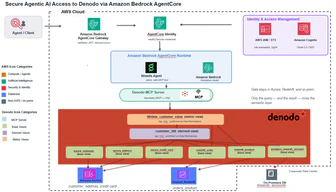
    Strategy Mosaic, as a semantic layer, models C360 domains on Amazon Redshift and Amazon Aurora without ETL using two linked models. Its metric syntax captures the business definition of agent reasoning and exposes the model to AgentCore-hosted Strands agents via the Mosaic MCP server, supporting user identity propagation to achieve end-to-end row-level and object-level security.

  3. vLLM Blog

    Ant Group and the vLLM community open-source Humming: A general-purpose high-performance quantized inference kernel library

    Ant Group and the vLLM community open-source Humming, a high-performance quantized inference kernel library. Humming supports NVIDIA GPUs starting from the Turing architecture and CUDA-compatible devices like the T-Head Zhenwu 810E, providing extensive quantization support covering various integer and floating-point types, bit widths, and scaling schemes. It significantly outperforms existing implementations such as vLLM Marlin, FlashInfer, and DeepGEMM on multiple representative workloads.

Oct 20Tue
Oct 19Mon
Oct 17Sat
  1. Google Research

    Google Research explores combining AI agents with biological reality to build autonomous wet labs.

    Google Research releases the VERID framework, enabling AI agents to run in physics-based, safe, and resource-efficient experiments; demonstrates closed-loop intelligent agent scientific discovery on adapter and de novo protein design prototypes; through three rounds of design-test-iterate cycles, AI-driven rational and de novo design will increase confirmed target hit rates to 33.5% and 42.1% on myoglobin and α-thrombin, respectively.

Oct 16Fri
  1. Microsoft AI News

    Microsoft AI has released an 80 billion parameter MoE large model MAI-Base-2.

    Microsoft AI has completed the pre-training of a new MoE large model MAI-Base-2, with 80 billion active parameters and 2.8 trillion total parameters, surpassing all open-source models in internal evaluations. The model is 4-12 times more efficient in pre-training FLOPs than the strongest open-source base model DeepSeek-V4-Pro-Base and is used to train larger models. Microsoft plans to license the model weights through Foundry using organic data pre-training and full-stack control.

Oct 15Thu
  1. Apple Machine Learning Research

    MLX and RDMA implement local and distributed large language model inference on Mac Studio

    On a cluster of four Mac Studio machines, Muse Spark Open (816B parameters) generates at a speed of over 36 tokens/second. The Mac Studio M5 Ultra version offers 4.6x faster inference speed (TTFT) and 1.6x faster tokens/second compared to the M3 Ultra, benefiting from the GPU neural accelerator and 1.2 TB/s memory bandwidth.