Skip to content
Live
Nov 4Wed
  1. AWS Machine Learning Blog32

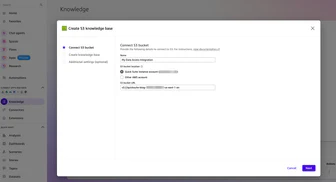
    Amazon Quick integrates structured and unstructured data.

    Amazon Quick integrates structured and unstructured data by connecting Amazon S3 and creating a knowledge base, enabling users to query with a single conversational AI agent. This solution includes a data layer (unstructured content stored in S3 and structured data as semantic datasets), a workspace layer (integrating data types into a single workspace), and an agent layer (custom chat agents linked to the workspace and returning combined responses).

Nov 3Tue
  1. Ai2 Blog

    StateBench: Benchmark for testing large language models to track changes in long document states

    StateBench is a benchmark for testing large language models' ability to track entity state changes in long documents, including four difficulty levels: R-trivial, non-periodic, solvable, and general finite. Research finds that recurrent and hybrid models generalize far better than Transformers when directly trained on these tasks, while cutting-edge models like Gemini 3.8 Flash, Claude Opus 5.5, and GPT-6 Sol still struggle with more complex state tracking issues when input lengths vary.

  2. PyTorch Blog34

    Ray announces the Special Interest Group (SIG) for Accelerators

    Ray announces the Special Interest Group (SIG) for Accelerators, aiming to unite hardware vendors, Ray contributors, and application developers to create a neutral accelerator support roadmap. Initial focus will be on developing test infrastructure, hardware awareness capabilities, and network transmission, prioritizing shared hardware access, reproducible development and testing environments, and broader CI coverage.

Nov 1Sun
  1. Databricks Blog58

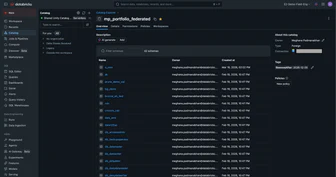
    Databricks Lakebase branching helps CI/CD: experience from 100 PR databases

    Databricks Lakebase reduces the creation time of each PR branch to seconds with its copy-on-write database branching feature, supporting up to 100 concurrent branches, with each branch having independent read/write, compatible with standard Postgres, and supports large JSONB/LOB columns, meeting Snorkel AI's needs for fast, secure, and low-cost testing of production data in CI/CD processes.

Oct 30Fri
  1. Microsoft Research40

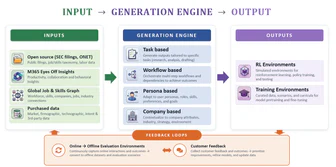
    Microsoft Research has open-sourced an industrial evaluation data generation platform, simulating real enterprise environments to test the capabilities of Copilot AI.

    Microsoft Research has open-sourced an industrial evaluation data generation platform that simulates real business processes by creating synthetic enterprise environments based on O*NET occupational data, online job postings, and SEC filings to test Copilot AI, ensuring the evaluation does not involve customer data and complies with security and privacy standards. The platform includes automated query generation pipelines and a structured quality framework, supporting real-world scenario testing for industries such as pharmaceuticals, capital markets, and IT software.

Oct 29Thu
  1. Hugging Face Blog

    Project ProtoStar project release: Promoting the AI compatibility of publicly funded scientific research

    Project ProtoStar is announced, aiming to unlock the potential of publicly funded scientific research by making datasets, models, and code more accessible and reusable. The project brings together universities, research institutions, industry, and the open science community, supporting the release of scientific achievements in AI-compatible, machine-actionable formats, and demonstrating its value through a series of public challenges. The first challenge, hosted by Carnegie Mellon University, will launch on November 2.

  2. Hugging Face Blog

    Hugging Face Granite Switch 4.1.1 released: software-based model update

    Hugging Face releases Granite Switch 4.1.1, an incremental update based on 4.1, maintaining full backward compatibility. New features include multilingual speech-to-text models (supporting 10 languages with native punctuation) and a decision adapter for improved performance on the Jev decision index test set. The team achieves rapid deployment by updating only the adapter without recalculating the base model, and future support for third-party custom adapters is planned.

Oct 28Wed
  1. AWS Machine Learning Blog34

    How does Property Finder identify evaluation bias on Amazon Bedrock and optimize model costs?

    Property Finder discovered that 96.8% of the labels in its evaluation dataset for visual AI workloads migrated to Amazon Bedrock were predictions from a single model rather than human validation, hindering objective comparison of new models. The company built a trustworthy benchmark dataset by independently labeling 356 images with human experts and, after 27 iterative optimizations with evolutionary prompt tuning, reduced costs by 86% while maintaining an 86% accuracy rate.

Oct 27Tue
  1. NVIDIA Blog

    C-BRAIN and NVIDIA are jointly using AI to accelerate dementia research

    C-BRAIN and NVIDIA are using AI to change the pace of dementia research. They are accelerating the development of new therapies by integrating previously unpublished Alzheimer's research data, including unpublished results and controlled proprietary data. C-BRAIN employs a hybrid centralized and federated architecture to protect data privacy, deploying 64 NVIDIA data center GPUs and cloud nodes, and plans to introduce the NVIDIA Blackwell system to support its expansion goals.

  2. Ai2 Blog

    Ai2 has released the research 'Old Ideas, Novel Problems' to evaluate the reliability of large language models in judging the innovative nature of scientific research

    Ai2 has released a study titled 'Old Ideas, Novel Problems,' evaluating the reliability of six LLMs (GPT-5.1 to 5.4, Claude Sonnet 4.5 to 4.6) in judging the innovativeness of scientific research. The study found that fine-tuning prompts can lead to accuracy differences of over 50%. The research constructed a benchmark dataset containing 154 human-generated and 154 AI-generated scientific ideas, confirming that models have insufficient stability in judgment and require more reliable methods to evaluate new ideas proposed by AI.

  3. Ant Group inclusionAI · Hugging Face new models38

    inclusionAI/Ling-3.0-flash-Sante-fp8 released: FP8 quantized medical dedicated large model

    inclusionAI/Ling-3.0-flash-Sante-fp8 released FP8 quantized version, retaining 124B parameters (5.1B/Token) and BF16 performance, reducing memory and improving deployment efficiency, supporting medical inference, research, and tool-assisted workflows, requiring professional manual review. Stable performance on benchmarks like Healthbench, ReDisQA, achieving efficient inference through block FP8 quantization (128x128 blocks).

  4. Databricks Blog

    Lakeflow Connect integrates enterprise productivity with AI data

    Lakeflow Connect supports wikis, project management tools, and AI base models through native connectors, enabling downstream AI agents to obtain complete business context. The platform provides fully managed native connectors that support SaaS applications, databases, and file sources, with data directly imported into the Databricks platform, and incremental import of Unity Catalog tables through point-and-click UI or API configuration.

  5. Databricks Blog22

    How is Databricks Free Edition used for teaching?

    Databricks Free Edition allows teachers and students to run full data or AI courses in the browser for free, without a cloud contract or license management, suitable for students and educators worldwide. The platform offers features such as collaborative notebooks, Spark, Delta Lake, Lakeflow, Databricks SQL, and Genie code assistant, supporting courses from introductory programming to AI projects. Skills are applied directly to industry-standard tools, with no conversion costs between production environments and teaching sandboxes.

Oct 24Sat
  1. vLLM Blog62

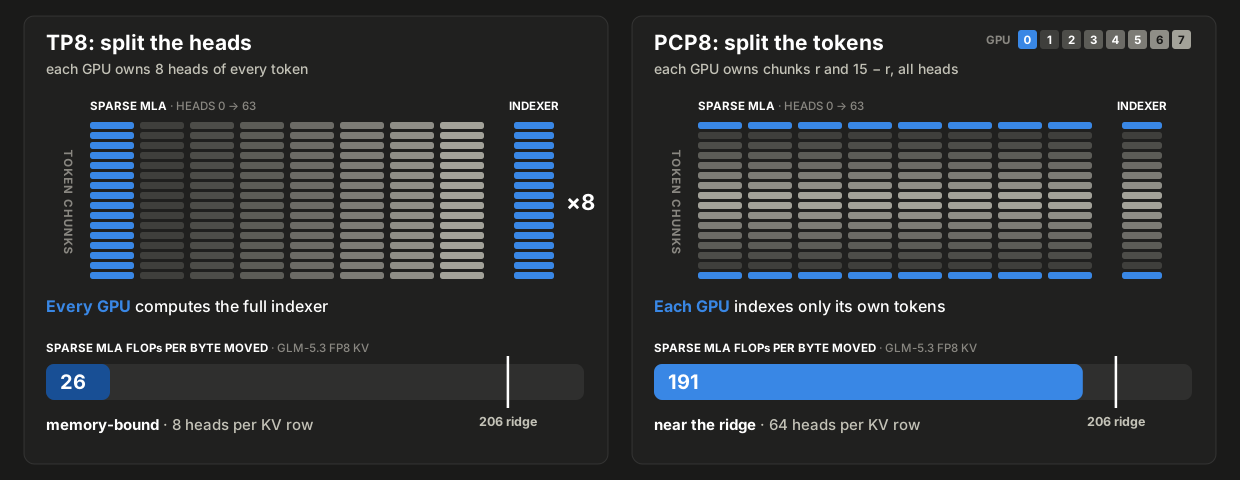
    vLLM provides an in-depth explanation of the optimization of PCP, DCP, and Hybrid HiSparse for GLM-5.3 on 16 H200s

    vLLM team releases the second part of GLM-5.3 optimization, deploying on 16 H200s with 1 pre-filled node and 1 decoding node, using PCP to split pre-fill by token and DCP to split KV cache by token, allowing 1M context to fit into the pre-fill node

    Why it matters: The vLLM team has dissected how PCP, DCP, and Hybrid HiSparse can be combined on 16 H200s, allowing readers to understand the memory and pre-fetch bottlenecks of long-context deployment.

  2. Databricks Blog58

    Spark's declarative pipelines: Use cases designed for AI agents

    Spark's declarative pipelines are 34 times faster than imperative pipelines in 22 data engineering tasks, halve the code volume, and have fewer errors. Declarative pipelines capture structural errors in advance through pre-execution validation and offload repetitive tasks like sorting and result saving to Spark, while imperative pipelines need to run on the cluster until the error step to detect them. The two methods perform equally in terms of logical error rates, but declarative pipelines have more concise and consistent code, making them easier to maintain.

Oct 23Fri
  1. Sakana AI

    Sakana AI has launched the Sakana Aquarium AI agent platform based on ontology.

    Sakana AI has launched the Sakana Aquarium platform for building, executing, and running AI agents. It integrates organizational information through ontology, supporting the efficient construction and secure operation of AI agents. The platform includes three core mechanisms: ontology, governance, and agent execution base, achieving systematic organizational judgment criteria and task automation.

  2. Hugging Face Blog66

    Microsoft and Hugging Face use ThinkingBox database validation for RL reward training agents

    Microsoft and Hugging Face release ThinkingBox-Training, directly using ThinkingBox's deterministic verification of database final states as reinforcement learning rewards, training Qwen3.8-27B for 50 steps with GRPO

    Why it matters: Microsoft and Hugging Face directly use database final state verification as reinforcement learning rewards and have publicly released task filtering and training code, which can be transferred to other stateful intelligent agent training

  3. Databricks Blog60

    Databricks Talks AI Billing: How to Reduce the Unit Cost of Coding Agents by 90%

    Databricks executive Patrick reviews the process where the cost of AI coding agents increased exponentially after the company fully adopted them, and then reduced the unit cost by up to 90% by controlling the layer. He mentions that shifting traffic to cheaper new models contributed to more than 50% of the reduction, and Smart Router reduced the average task cost by more than 30% while maintaining near the quality of the most expensive model. This internal solution was later productized as Unity Gateway, which is now used by thousands of customers.

    Why it matters: Databricks executive reviews the process of its own AI coding costs from out of control to reducing the unit cost by 90%, providing migratable practices for gateways, routing, and self-built evaluations.

  4. Microsoft Research58

    Flint-interactive: A language for creating interactive data visualizations

    Flint-interactive makes AI-generated charts highly interactive, allowing users to explore data through clicks, filtering, zooming, highlighting, and cross-chart interactions. It simplifies the construction of complex interactions through advanced semantic events and update operations, and leverages the Flint compiler to handle interaction logic and visual dependencies, enhancing reliability and development efficiency. Flint-interactive supports creating interactive data stories, dashboards, and connected experiences, enabling AI agents to generate charts with interactive features to help users analyze data more efficiently.

Oct 22Thu
  1. Google DeepMind

    Google DeepMind releases Forest Typology (ForTy) 2020 global forest type map

    Google DeepMind and Google Research jointly release the Forest Typology (ForTy) 2020 Global Map, which classifies every 10x10 meter land on Earth into six types of forests and land use, and tracks changes from 2017 to 2025. The map is based on definitions by the United Nations Food and Agriculture Organization, accurately distinguishing native forests, plantations, monoculture forest plantations, economic crop forests, and other land types, supporting the EU's deforestation regulations with an accuracy of 90%.

  2. NVIDIA Blog

    NVIDIA Cosmos platform expands new tools to train, evaluate, and deploy world models

    NVIDIA expands the Cosmos platform with new training tools, simulation checkpoints, and Cosmos Data Factory blueprints to help developers quickly build world models. Cosmos Data Factory provides 5 cloud-native blueprints, supporting tasks such as autonomous driving data generation and image attribute enhancement through channels like GitHub and Azure, with Porsche and ANYbotics already applying them to accelerate physical AI development.

  3. Hugging Face Blog78

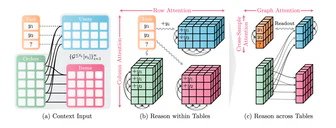
    NVIDIA releases Kumo Relational relational foundation model, capable of prediction without training

    NVIDIA releases pre-trained relational foundation model Kumo Relational, enabling direct prediction on enterprise databases without task-specific training, feature engineering, or table flattening. The model outperforms supervised relational deep learning and expert feature engineering gradient boosting trees on 41 tasks across 15 databases, achieving an MRR 8% higher than AutoGluon ensemble on the SAP SALT benchmark.

    Why it matters: The original provides a comparison result of pre-trained relation models on 41 tasks and an open-source entry, allowing readers to judge whether it can replace the existing XGBoost pipeline.

  4. Hugging Face Blog

    How to reduce inference cost by 77% in real-world applications using a specialized SLM vocabulary list.

    Qwen3-4B's specialized vocabulary list VocabX reduces inference cost by 77% by focusing on the cost of each token rather than frequency, without changing the base model. This method for the Portuguese essay scorer reduces the output layer vocabulary from about 152,000 lines to about 65,000 lines, significantly reducing the computational overhead of token splitting and unused vocabulary items.

Oct 21Wed
  1. AWS Machine Learning Blog58

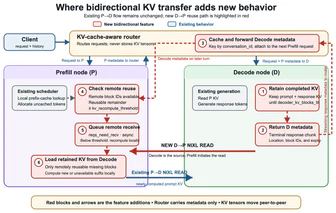
    vLLM enhances the TTFT performance of multi-round agent workloads through bidirectional KV transmission.

    vLLM's bidirectional KV transmission mechanism reduces redundant calculations by allowing the decoding node to return previously computed KV cache to the pre-filled node in subsequent dialogue turns. In multi-round benchmark tests on AWS EC2 P5en instances, it improved the TTFT of Qwen3-32B by 1.6x and zai-org/GLM-5-FP8 by 3.3x. This feature is implemented by extending the NIXL KV connector and utilizing a KV cache-aware router to coordinate KV reuse across dialogue turns.