Skip to content
Live
Oct 21Wed
  1. Ant Group inclusionAI · Hugging Face new models35

    inclusionAI/Ling-3.0-tiny-UBTree release: A fine-tuned model based on UBTree technology

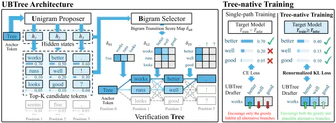
    inclusionAI released the UBTree fine-tuned version of Ling-3.0-tiny, Ling-3.0-tiny-UBTree-B16, with 183.1M parameters, combining a five-layer DFlash backbone and a bigram selector, achieving 2.6-3.5 times speed improvement on benchmarks like GSM8K and MATH-500. This model needs to be used in conjunction with the target model. The UBTree adaptation for the open-source version of SGLang has not yet been released.


Oct 19Mon
  1. MiniMax News

    MiniMax M3.1 Flash released: Next-generation model with improved performance and reduced cost

    MiniMax M3.1 Flash is officially launched, with nearly a threefold increase in online inference speed and a 70% reduction in cost compared to the previous generation. The model performs excellently in benchmark tests for complex intelligent tasks (cowork), computer use, software development, and network security, ranking highly in the AutomationBench-AA for automated tasks, scoring 73.7% on DeepSWE v1.1, 61.7 on OSWorld V2, 29.6 on ALE, and 82% on CyberGym.

Oct 17Sat
  1. Google Research

    Google Research explores combining AI agents with biological reality to build autonomous wet labs.

    Google Research releases the VERID framework, enabling AI agents to run in physics-based, safe, and resource-efficient experiments; demonstrates closed-loop intelligent agent scientific discovery on adapter and de novo protein design prototypes; through three rounds of design-test-iterate cycles, AI-driven rational and de novo design will increase confirmed target hit rates to 33.5% and 42.1% on myoglobin and α-thrombin, respectively.

Oct 16Fri
Oct 14Wed
  1. Ant Group inclusionAI · Hugging Face new models

    inclusionAI/Ling-3.0-flash-UBTree released: Speculative decoding model based on UBTree technology

    inclusionAI released the Ling-3-Flash-UBTree-B16 model, combining a five-layer DFlash backbone and a learned bigram selector, proposing multiple candidate continuations for Ling3-Flash for target model validation, with 482M parameters, achieving 3x+ E2E speed improvement on benchmarks like MMLU, and the UBTree adaptation is not yet open source, with SGLang integration support expected to be released soon.

  2. Google DeepMind

    Google DeepMind releases Gemini 4 Argon and emphasizes security protection

    Gemini 4 Argon demonstrates cutting-edge capabilities in coding, finance, law, and other fields, particularly enhancing cybersecurity defense functions. Its effectiveness has been validated through the Fairwind project and internal testing. The model performs excellently on benchmark tests like MMLU and employs a three-layer real-time protection mechanism (input filtering, internal introspection, continuous monitoring) and automated bias monitoring, significantly reducing the risk of harmful requests and violations. It successfully intercepts over 99% of external biosecurity jailbreak attempts while reducing shortcut behavior in coding tasks to 2%.

  3. Claude · YouTube

    Detailed Explanation of Claude Code Cloud Chat Function

    Claude Code's cloud sessions run on cloud virtual machines, allowing offline continuous operation, supporting phone startup, and parallel processing. Suitable for scenarios requiring continuous operation or remote collaboration, supporting GitHub connection and environment configuration. This feature is included in the Pro, Max, Team plans, as well as enterprise advanced or Chat + Claude Code seats, counted towards plan limits with no additional compute costs.

Oct 9Fri
Oct 8Thu
Oct 5Mon
Oct 2Fri
  1. GitHub Blog · AI & ML

    AI is changing the way developers work, these three skills are worth strengthening

    Developer workflows are changing due to AI, with skills beyond coding—such as guiding AI, evaluating outputs, communicating trade-offs, and making technical decisions—becoming increasingly important. Three key skills developers should strengthen are learning to guide AI rather than just using it, not trusting AI's first answer and evaluating it, and leveraging AI to solve broader problems.

Oct 1Thu
  1. Google DeepMind

    Gemini 4 Argon: Google's next-generation cutting-edge intelligent model

    Gemini 4 Argon delivers cutting-edge performance in complex workflows, supporting software engineering, enterprise knowledge work (legal and financial), and cybersecurity defense. The model's token output limit is extended to the industry-leading 1M, and it leads in benchmarks such as DeepSWE v1.1 (77.9%), Vals Index (financial, coding, legal, tax), and AutomationBench (51.3%).

Sep 25Fri
Sep 23Wed
  1. Together AI Blog

    How to train your own Jev model for $17

    Together AI released a guide on how to fine-tune the Jev classification model using the Qwen3.5 4B model and a Hugging Face dataset of 38,340 items, with a training cost of about $17 and a duration of about 25 minutes; after deployment, it can be used for inference via an API endpoint (e.g., ENDPOINT_NAME), suitable for scenarios such as intent recognition for e-commerce customers.

Sep 22Tue
Sep 9Wed
  1. Mistral AI

    Mistral AI helps European energy operators migrate 40,000 lines of Fortran 77 code to C++

    Mistral AI helps European energy operators migrate 40,000 lines of Fortran 77 code to C++, the physics-intensive reservoir simulator lacks a test suite and centralized documentation. The project verifies the numerical correctness of the migrated code by building a consistency test harness, and uses an AI agent to organize documentation, ultimately adopting a human-supervised agent workflow to achieve modular migration, significantly improving code quality.

Aug 25Tue
  1. Zhipu Z.ai · Hugging Face new models

    Zhipu GLM-5.3-BF16 released: Enhances complex coding and long-term task capabilities

    Compared to GLM-5.2, Zhipu GLM-5.3-BF16 improves coding ability by 50% on Z.ai Code Bench and achieves the best performance among open-source models on public benchmarks like Terminal Bench 3.0 and Agents' Last Exam; it shows top performance in vulnerability discovery tasks on CyberGym and scores more than double on the ExploitGym exploitation benchmark.

Jul 9Thu
  1. Meta AI Blog

    Meta AI has released the Muse Spark 1.1 multimodal reasoning model.

    Muse Spark 1.1 is the latest multimodal reasoning model released by Meta Superintelligence Labs, significantly improving in tool and computer use, coding, and multimodal understanding, supporting million-token context windows. It is open to developers for public preview via the Meta Model API, surpassing Muse Spark and matching leading alternatives in Meta's internal coding evaluations.

Jun 16Tue
Jun 11Thu
Jun 2Tue
  1. MiniMax · Hugging Face new models

    MiniMax-M3-MXFP8 released: Native multimodal model supports contexts of up to millions

    MiniMax-M3-MXFP8 is a native multimodal model with a 1M context window, approximately 428B parameters, and 23B activation parameters, achieving 9x pre-filling and 15x decoding speed improvement through MiniMax sparse attention mechanism (MSA). The model leads in long-horizon agent benchmarks, supporting three reasoning modes, and can be downloaded via Hugging Face and deployed using SGLang, vLLM, or Transformers frameworks.

May 27Wed
  1. Anthropic Research

    Survey on the application of Claude Code in social science research

    81% of social science researchers have tried using AI chatbots for research, but only 20% have adopted coding proxy tools like Claude Code. Researchers who adopt coding proxies are more likely to come from top universities or male-named researchers, and they publish more papers and work proposals, but this may also reflect prior differences among early adopters. AI coding proxies are the first to make core research tasks automatable, which may reshape social science research but could also exacerbate research resource inequality.

Mar 23Mon
  1. Anthropic Research78

    Vibe physics: Harvard professor uses Claude Opus 4.5 to complete a high-energy physics thesis in two weeks

    Harvard physics professor Matthew Schwartz guides Claude Opus 4.5 to perform NLL re-sum calculation of Sudakov shoulder in C-parameter, producing a high-energy theoretical physics thesis containing a new factorization theorem within two weeks, while similar work usually takes a year.

    Why it matters: Harvard physics professor uses two weeks, 110 drafts, and 36M tokens to let Claude complete a high-energy physics thesis, listing point by point what the model can and cannot do.

Jan 14Wed
  1. Anthropic Research67

    Anthropic uses Claude with property testing to find bugs in the Python ecosystem

    Anthropic's research team developed an agent based on Claude Code custom commands, which infers the properties that code should satisfy by reading type annotations, docstrings, and comments, and then uses Hypothesis to write property tests, discovering hundreds of potential bugs in over 100 popular Python packages such as NumPy, SciPy, and Pandas.

    Why it matters: Anthropic uses Claude agents to automatically write property tests to find bugs in packages like NumPy, SciPy, Pandas, and provides the efficiency after manual review and merged fixes

Jan 10Sat
  1. Berkeley AI Research

    Berkeley AI research proposes an information-driven imaging system design framework

    Berkeley AI research proposes an information-driven imaging system design framework, which quantifies the object's discrimination capability through mutual information measurement. It has been validated in four fields: color photography, radio astronomy, lensless imaging, and microscopy that information estimation can predict decoder performance. The optimized mutual information design scheme achieves end-to-end optimal results while reducing memory and computational load.

Apr 18Fri
  1. Anthropic Research62

    Anthropic releases Claude Code best practices for intelligent agent coding

    Anthropic releases Claude Code best practices covering CLAUDE.md configuration, tool permission management, MCP access, common workflows, and multi-Claude parallelism. The article suggests exploring and planning with sub-agents before writing code and provides specific processes such as test-driven development, screenshot iteration, and headless mode automation. This article has been moved to the official documentation, and the original blog is no longer maintained.

    Why it matters: Anthropic's official system has organized the configuration, workflows, and multi-instance parallel methods of Claude Code, which can be used as a reference for setting up intelligent agent coding processes.