Skip to content
Live
Nov 14Sat
Nov 13Fri
  1. Google Developers Blog

    Gemini and Z3 jointly capture bugs missed in Go code fuzz testing

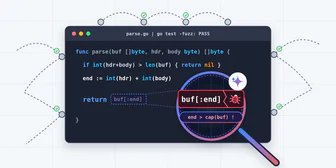
    Gemini 4 Argon translates Go code panic paths into Z3 constraints, paired with Z3 to check trigger conditions, and paired with go test to replay trigger bytes, locating 3 embedded parser bugs and discovering 3 skill-lint potential bugs within 1 minute. This process is more efficient than go test -fuzz, capable of finding boundary check errors missed by fuzz testing.

Nov 12Thu
  1. OpenRouter Blog

    How to Benchmark LLM with OpenRouter

    Running the same tasks on OpenRouter, GPT-6.1 Sol passed 180/180 tests in 60 synthetic tasks, DeepSeek had the lowest cost passing 157/180 times, but the correlation with the public ranking is low (Spearman correlation coefficient 0.109). Need to check the number of task repetitions, the number of answers, and billing verification.

Nov 11Wed
  1. Ant Group inclusionAI · Hugging Face new models

    inclusionAI/ZoomGain-4B released: A fine-grained visual supervision model based on global-to-local visual perception gaps

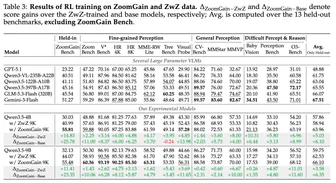
    inclusionAI has released the ZoomGain-4B large language model, achieving a score of 61.08 on ZoomGainBench and performing excellently on multiple fine-grained perception and general perception benchmark tests; the model is built with supervision based on the global-to-local visual perception gap mined from global image details, supporting English and Chinese Q&A, and can be downloaded via Hugging Face.

  2. Hugging Face Daily Papers65

    Infrathon: A benchmark for language intelligent agents used in long-term AI infrastructure optimization in the real world.

    Infrathon conducted 150 long-term AI infrastructure optimization task evaluations on six models, consuming a total of 10,000 GPU hours, and found that the model rankings changed with the evaluation duration. 135 tasks achieved further optimization in the latter half of the budget, and Claude Opus 5.5 increased the KV cache compression rate from 6.82% to 19.86%, exceeding human design baselines. Analysis shows that task violations, unreliable testing, and premature completion are the main obstacles to continuous optimization.

  3. OpenRouter Blog

    LLM Quantization: The Impact of fp8 and fp4 on Quality and Price

    Testing on OpenRouter, fp8, fp4, and fp16 showed no precision differences in 240 scoring tasks, with all six endpoint scores ranging from 98.3% to 99.2%. Lower precision is generally cheaper, but there were 7 models where fp8 was more expensive than fp16, and 7 models where 4-bit was more expensive than 8-bit. The fp4 endpoint performed the worst among 40 workflows without multiplication tasks, but the difference might be due to chance.

Nov 10Tue
  1. AWS Machine Learning Blog38

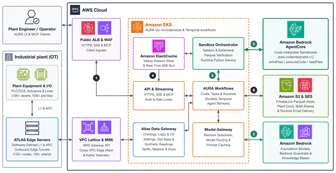
    CrossnoKaye on How to Achieve Industrial Physical AI with Amazon Bedrock AgentCore

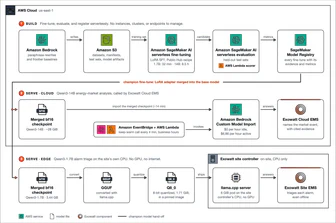
    CrossnoKaye achieves industrial physical AI on Amazon Bedrock AgentCore through its ATLAS platform and AURA agent, improving production efficiency by 11-17% and reducing energy consumption by 21%. AURA leverages AgentCore's code interpreter capabilities to run Python workloads in isolated micro VMs to verify numerical calculations, while achieving closed-loop control through edge clusters and cloud optimization systems.

Nov 7Sat
  1. Hugging Face Daily Papers65

    Drex open-source decision model released

    Drex open-source decision model returns the probability distribution of user options without autoregressive decoding, using supervised fine-tuning, RLAF, and consistency loss to improve accuracy, robustness, and latency. Its 35B parameter Max version achieves an industry-leading score of 67.52 on Decision Index 0.4.1, with a response time only 9% of GPT-6 Sol and 5% of Claude Opus 5.5.

Nov 6Fri
Nov 5Thu
  1. Hugging Face Daily Papers

    StreamDuo: A live commentator and a research agent for unseen new games

    StreamDuo pairs a trainable commentator with a frozen research agent that searches for game wiki entries to improve cross-game live commentary without training specifically for the target game. StreamDuo was trained on Baldur's Gate 3 and tested on ten unseen new games, increasing entity recall from 0.082 to 0.116, reducing source game leakage from 9.9% to 1.0%, and achieving the best timing, highest evaluation vitality, and overall quality in the live model.

  2. Google Research

    Agile Deliberation: How AI Assists Humans in Defining Subjective Concept Boundaries

    The Agile Deliberation framework assists humans in defining the boundaries of subjective concepts through iterative dialogue, transforming fuzzy ideas into precise AI instruction blueprints. The framework is divided into two stages: concept definition and concept iteration, which processes fuzzy images through direct feedback. In 18 user experiments of 1.5 hours each, it significantly reduces user fatigue and anxiety, making AI model performance superior to standard baselines.

Nov 4Wed
Nov 3Tue
  1. Hugging Face Daily Papers65

    When Latent Prediction Error Supports Physical Anomaly Claims - Research on Video World Models

    Research shows that the latent prediction error in video world models reflects appearance and motion rather than reliable measurements of physical anomalies. Comparisons of latent prediction, masked pixel reconstruction, and simple visual statistics on the IntPhys2 benchmark show that appearance is easy to decode, and V-JEPA2 only slightly reveals whether an event is possible.

  2. Hugging Face Daily Papers34

    OSWAM: An efficient single-step action generation world action model

    OSWAM achieves real-time high-quality action generation in autonomous driving and embodied control by using structured imagination tokens to initialize the diffusion process and distilling future condition privileged information into a single denoising step. The model generates high-quality actions with just one diffusion step, about 3 times faster than direct strategy world action models (WAM) that require dozens of denoising steps, achieving low latency of up to 40ms on an NVIDIA RTX 5090 GPU, supporting real-time compiled inference.

Nov 2Mon
  1. ITHome · AI65

    Researchers test AI agent clusters in Minecraft: Collaboration is prone to bureaucracy, higher win rate against GPT in battles

    Researchers used 50 GPT-6.1 Sol agents to build a civilization community in Minecraft, but failed to develop due to bureaucratic tendencies; in a wake-up war test with 10 GPT-6.1 Sol against 10 Claude Opus 5.5, GPT agents adopted a more aggressive strategy, completing problem diagnosis and sharing solutions; in seven Mindustry battles, GPT agents won six and lost one, demonstrating the advantage of swarm mode.

  2. Hugging Face Daily Papers58

    Wizard: Real-time control of any world through agent control

    Wizard decouples character animation, scene control, and game logic from visual generation, allowing intelligent agents to control joint skeletons and scene geometry through structured visual agents, achieving real-time interaction at 24 FPS, zero-shot generalization to unseen scenes, characters, and actions. The team built 50.3 hours of aligned agent-video pairs, including 750 scenes and 178 characters, supporting character adaptive masking, causal adaptation, and few-step distillation techniques.

  3. Hugging Face Daily Papers65

    Research indicates that collaborative design of System-1 and System-2 towards general artificial intelligence can reduce execution costs

    Research proposes that by allowing the lightweight predictor System-1 to evaluate candidate interactions before execution, the execution cost of the resource-intensive executor System-2 can be reduced, ideally reducing the computational workload to 1/ρ_u times (where ρ_u is the utility-related interaction density), and this collaborative design method is applicable to scenarios such as training, inference, decision-making, and agent tool use.

Oct 31Sat
Oct 30Fri
  1. Hugging Face Daily Papers42

    WorkFactory: Transforming Professional Intent into Executable Tasks through Information Planning and Repair to Achieve Scalable Agent Training

    WorkFactory builds coherent professional tasks through information planning and repair, producing the WorkPilot model, enhancing expert-level agent performance in professional work benchmarks. The framework starts from professional intent, constructs information support graphs to guide task instantiation, and identifies support failures and guides repairs through execution detection while preserving expected work.

Oct 29Thu
  1. QbitAI

    Zhuji Dynamics releases FluxVLA Engine V2 technical report, one-click reuse of engineering capabilities makes embodied AI R&D more efficient

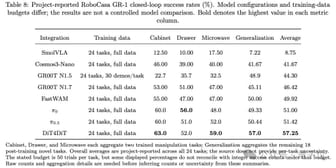
    Zhuji Dynamics releases the FluxVLA Engine V2 technical report, achieving full-chain reuse of model training, evaluation, and deployment through unified configuration, modular decoupling, and system optimization. It supports 14 mainstream strategies, with inference path frequency improved by 2.31–9.64 times, validated in closed-loop execution on 6 real machines including ALOHA and dual-arm Franka. Online reinforcement learning boosts SmolVLA success rates by 10.0–15.4 percentage points.

  2. Hugging Face Daily Papers

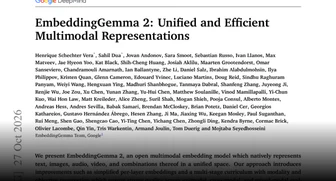
    EmbeddingGemma 2: A Unified and Efficient Cross-Modal Representation Model

    EmbeddingGemma 2 is an open-source multimodal embedding model that unifies text, image, audio, and video representations in an efficient and resource-flexible design, and performs excellently in benchmark tests. It has established a new Pareto frontier in embedding benchmark tests for all modalities, outperforming professional models and other models that are two to twelve times larger in scale. The model supports selective modality encoder loading, adjustable visual token budgets, truncatable embedding dimensions, and quantized weights to adapt to resource-constrained environments.

Oct 28Wed
Oct 27Tue
  1. Hugging Face Daily Papers

    InteractiveWorld: A verifiable human-centric environment for building better interactive MLLM assistants

    InteractiveWorld provides a verifiable simulation environment and benchmark for evaluating whether multimodal language models (MLLMs) can reliably guide humans to complete physical tasks. The experiment evaluates 12 cutting-edge MLLMs on a benchmark containing 120 multi-round tasks, showing that they are still far from becoming reliable assistants, even Claude Fable 5.1 scored only 20% and 25% on long-term guidance and planning tasks

Oct 26Mon
  1. Hugging Face Daily Papers31

    The Omni-Woodpecker framework reduces cross-modal hallucinations in multimodal large models through evidence-prioritized rebalancing.

    Omni-Woodpecker is a training-free framework that reduces cross-modal hallucinations in multimodal large models by identifying modal conflicts and rebalancing hidden representations, improving Qwen2.5-Omni-7B by 12.9 and 8.6 points on CMM and AVHBench, respectively, and consistently improving by 0.67-2.25 points on four general OLLM reasoning benchmarks, with the code open-sourced.

Oct 23Fri
Oct 22Thu
  1. ITHome · AI

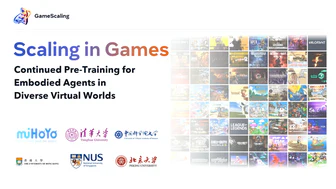
    MiHoYo, in collaboration with Tsinghua and Peking Universities, has released the open-source GameScaling game model, covering parameter scales from 0.8B to 27B.

    MiHoYo, in collaboration with Tsinghua and Peking Universities, has released the open-source GameScaling game model, covering parameter scales from 0.8B to 27B. This series of 8 models is based on the Qwen3.5 visual language model for continued pre-training, with training data involving games such as Minecraft and Doom. The model generates subsequent instructions based on game screens and operation records, supporting real-time game interaction. There are two versions for each of the 4 parameter scales: S1 and S3, and they are licensed under Apache 2.0.

Oct 21Wed
  1. QbitAI65

    Motubrain team from Shengshu Technology will live stream the entire process of Physical AI training, lasting for half a month.

    The Motubrain team from Shengshu Technology has launched a live stream of the 2.0 training process, lasting for half a month to showcase the training process of embodied models. The live stream covers four stages: pre-training, post-training, Agent task execution, and RSI exploration, opening the process from model training to capability iteration to the public. This move aims to enhance the transparency of Physical AI R&D and share research experiences in large-scale training and cross-task generalization.