Skip to content
Live
Oct 27Tue
  1. MarkTechPost71

    Baidu open-sources Unlimited OCR 2, supporting the parsing of hundreds of pages of documents.

    Baidu open-sources Unlimited OCR 2, a 3.34B parameter OCR visual language model that can parse hundreds of pages of books, financial reports, and reports in a single request. The weights are released under the MIT license, and the code is on GitHub.

    Why it matters: The original text provides a comparison of SR-SWA's sparse attention mechanism with the hundred-page document benchmark, showing how the contextual cost of long document OCR can be flattened.

  2. Hugging Face Daily Papers38

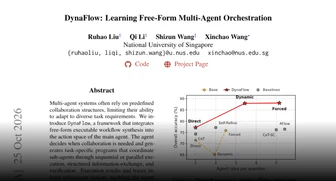
    DynaFlow: Learning Free-Form Multi-Agent Orchestration

    DynaFlow coordinates sub-agents by having the main agent synthesize executable processes, achieving adaptive multi-agent collaboration. The framework integrates free-form executable process synthesis into the action space of the main agent, where the main agent determines when collaboration is needed and generates programs for specific tasks, coordinating sub-agents through sequential or parallel execution, structured information exchange, and verification.

  3. Hugging Face Daily Papers

    InteractiveWorld: A verifiable human-centric environment for building better interactive MLLM assistants

    InteractiveWorld provides a verifiable simulation environment and benchmark for evaluating whether multimodal language models (MLLMs) can reliably guide humans to complete physical tasks. The experiment evaluates 12 cutting-edge MLLMs on a benchmark containing 120 multi-round tasks, showing that they are still far from becoming reliable assistants, even Claude Fable 5.1 scored only 20% and 25% on long-term guidance and planning tasks

  4. Hugging Face Daily Papers65

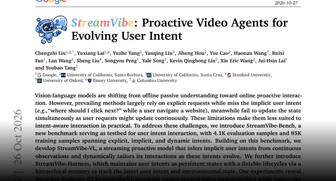
    StreamVibe: Active Video Agent and its benchmark, models, and memory framework

    StreamVibe-Bench releases a benchmark containing 4.1K evaluation samples and 85K training samples for testing explicit, implicit, and dynamic user intent interaction; StreamVibe-VL is a streaming active video language model that infers implicit intentions and dynamically adjusts interaction by continuously observing; StreamVibe-Harness maintains user intentions as persistent states through a hierarchical memory framework, tracking the latest user intentions and environmental states, improving the consistency of proactive interaction responses by 12.3%.

  5. Ant Group inclusionAI · Hugging Face new models38

    inclusionAI/Ling-3.0-flash-Sante-fp8 released: FP8 quantized medical dedicated large model

    inclusionAI/Ling-3.0-flash-Sante-fp8 released FP8 quantized version, retaining 124B parameters (5.1B/Token) and BF16 performance, reducing memory and improving deployment efficiency, supporting medical inference, research, and tool-assisted workflows, requiring professional manual review. Stable performance on benchmarks like Healthbench, ReDisQA, achieving efficient inference through block FP8 quantization (128x128 blocks).

  6. MarkTechPost82

    OpenAI Launches GPT-6.1 Terra, API Price Half of GPT-6.1 Sol

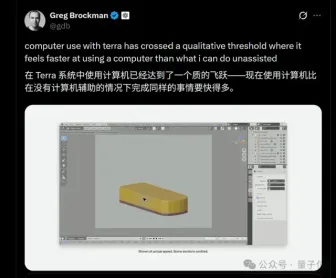
    OpenAI Launches GPT-6.1 Terra, a Fast Model for Visual Reasoning, Computer Use, and Writing, API Launched as gpt-6.1-terra with Standard Pricing of 1 USD per Million Input Tokens and 5 USD for Output, Half the Price of GPT-6.1 Sol

  7. ITHome · AI86

    OpenAI releases low-cost new model GPT-6.1 Terra, with a cost per task about one-ninth of Claude Opus 5.5

    OpenAI releases new model GPT-6.1 Terra, featuring lower costs for complex tasks requiring visual reasoning and desktop software operation, opening to Plus, Pro, Enterprise, and Edu users on October 27, available in ChatGPT Work and Codex, with the API model identifier as gpt-6.1-terra.

    Why it matters: The original text provides multiple benchmarks and cost per task comparisons, allowing readers to judge the trade-offs of low-cost models in desktop automation.

  8. LangChain Deep Agents releases

    LangChain Deep Agents deepagents-code==0.2.2 release: Security and performance improvements

    The deepagents-code==0.2.2 version of LangChain Deep Agents has been released, including security and performance improvements. New features include GPT-6.1 Terra support, Chinese text input to chat, plugin update detection, etc.; bug fixes include project .env file trust value settings, terminal UI link limits, Git option limits, etc.; performance has been improved by reusing parent process context, optimizing server startup processes, and streamlining transcription rendering, etc. It is recommended to upgrade as soon as possible.

  9. Databricks Blog22

    How is Databricks Free Edition used for teaching?

    Databricks Free Edition allows teachers and students to run full data or AI courses in the browser for free, without a cloud contract or license management, suitable for students and educators worldwide. The platform offers features such as collaborative notebooks, Spark, Delta Lake, Lakeflow, Databricks SQL, and Genie code assistant, supporting courses from introductory programming to AI projects. Skills are applied directly to industry-standard tools, with no conversion costs between production environments and teaching sandboxes.

  10. AWS Machine Learning Blog48

    Building enterprise-grade intelligent retrieval on Amazon Bedrock knowledge base using AWS CDK

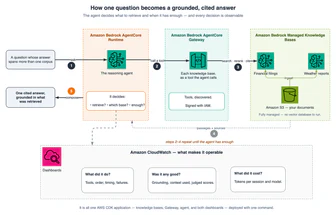
    Building enterprise-grade intelligent retrieval on Amazon Bedrock knowledge base using AWS CDK, providing multi-round planning and tool-driven retrieval through the reasoning agent and AgenticRetrieveStream API, returning referenced answers. The solution deployment includes a CDK application with Amazon S3 corpus, knowledge base, and reasoning agent, supporting semantic routing and multiple retrievals, and built-in Amazon CloudWatch monitoring and evaluation features.

Oct 26Mon
  1. ITHome · AI40

    NetEase's 'Nirvana in Fire: New World' will introduce a 'selfie mode', allowing users to customize actions and invite AI companion NPCs for photos.

    NetEase's 'Nirvana in Fire: New World' first major expansion pack, 'Miaojiang Guashi,' will launch on October 30, adopting a dual-line update framework for the first time and introducing a 'selfie mode' that supports custom actions, inviting AI guest NPC photos. Players can adjust actions, sightlines, pet interactions. The guest station supports works listing, custom opening lines, and voice, and can be precisely searched by IP, character name, etc., adapted to the selfie function.

  2. QbitAI38

    Wu Wen Xinqiong and Three-Body Universe jointly released the Zhizi Agent 1.0

    Wuwenshinqiong and Three-Body Universe have released the Zhizi Agent 1.0, an AI dialogue Agent with the role anchor of the 637th micro-universe administrator, achieving role consistency and interaction continuity through the AgentWorks platform, supporting cross-session memory, and relying on multi-agent collaborative mechanisms to ensure character and knowledge constraints. It adopts the PDD cross-cluster heterogeneous inference architecture to reduce the first Token latency by 51.5%.

  3. Hugging Face Daily Papers31

    The Omni-Woodpecker framework reduces cross-modal hallucinations in multimodal large models through evidence-prioritized rebalancing.

    Omni-Woodpecker is a training-free framework that reduces cross-modal hallucinations in multimodal large models by identifying modal conflicts and rebalancing hidden representations, improving Qwen2.5-Omni-7B by 12.9 and 8.6 points on CMM and AVHBench, respectively, and consistently improving by 0.67-2.25 points on four general OLLM reasoning benchmarks, with the code open-sourced.

  4. 36Kr · AI65

    Vivix has launched real-time interactive models W1 and A1, aiming to reduce the cost of generating interactive content to the level of YouTube.

    Vivix has launched real-time interactive models W1 and A1, aiming to reduce the cost of generating interactive content to the level of YouTube. The W1 model's real-time generation cost is close to YouTube's approximately $0.2 per hour CDN bandwidth cost; compared to the current top video generation models, the cost of generating real-time interactive content can be 1-2 orders of magnitude lower, and the model can generate the next frame within 300-600 milliseconds after user operation. The Vivix team has grown to 150-160 people.

Oct 25Sun
  1. ITHome · AI52

    KRAFTON AI previews the Raon-1 mini model: 30B-A4B parameter scale

    KRAFTON AI announces the Raon-1 mini preview model, adopting a hybrid expert architecture with linear attention, with parameter scale of 30B-A4B, supporting speculative decoding, balancing performance in Korean and English, Apache 2.0 open source, API limited-time free trial. The preview model is comparable to Meta Muse Glimmer 30B in programming and agent tasks, faster and more memory-efficient.

  2. The Decoder78

    Nvidia's open-source robot video annotation engine Flora claims to be 125 times cheaper than GPT-6 Astra.

    Nvidia's open-source data engine Flora, used for robot video annotation, claims to label one hour of video for about 0.72 USD, while GPT-6 Astra is about 88.50 USD. Flora consists of three fine-tuned Qwen3.5 models, each responsible for action segmentation, context-aware description, and reward scoring, covering three types of labels: action description, step-by-step scoring, and task success or failure judgment.

    Why it matters: The original text provides Flora's three types of annotation capabilities, cost estimates, and item-by-item comparison with GPT-6 Astra, allowing readers to judge the boundary of open-source alternatives for robot video annotation.

  3. Ant Group inclusionAI · Hugging Face new models58

    inclusionAI/Ling-3.1-flash-base released: a sparse MoE architecture large model with 560B parameters.

    inclusionAI/Ling-3.1-flash-base is released, a sparse MoE architecture large model with 560B total parameters and 25B active parameters. It adopts a hybrid linear attention mechanism (63 KDA + 9 Gated MLA) and performs excellently in 47 cross-domain benchmark tests spanning eight fields. It supports continuous pre-training, domain adaptation, and post-training research. The model is trained with FP8 precision and released with BF16 precision, following the MIT license.

Oct 24Sat
  1. Tencent Hunyuan · Hugging Face new models71

    Tencent Mixuan open-sources Hy-Nomas Interactive World Generation Model Diffusers version

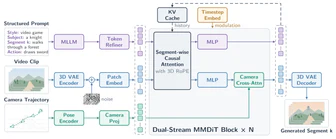
    Tencent's Huyuan has released Hy-Nomas' BF16 Diffusers format distilled weights on Hugging Face. This video world generation model supports multi-round free interaction through text instructions and camera control, generating the same world segment by segment.

    Why it matters: Officially releases distilled BF16 Diffusers weights and supporting benchmarks, allowing readers to judge the practical usage and threshold of multi-round interactive world generation.

  2. MarkTechPost58

    Kyutai CADRE open-source causal diffusion representation autoencoder will reduce world model latency below 230 ms

    Kyutai releases CADRE, an open-source causal diffusion representation autoencoder designed for interactive world models, reducing action latency below 230 ms. CADRE includes 7 autoencoders, each with approximately 476M parameters plus 86M frozen DINOv3 ViT-B/16, a world model of 1.2B parameters, video resolution of 288×512, frame rate of 20 fps, running on 1 H100.

  3. Cohere Blog

    Cohere Labs open science project reveals limitations in AI's understanding of culture

    Cohere Labs open-source science project collects cultural puzzles through global collaboration to test AI models, finding significant flaws in cross-linguistic cultural understanding, often answering incorrectly or hallucinating. Participants include over 100 people from more than 50 countries, including 16-year-old American student Henry Gagnier and retired teacher Jane Smith, who provided key insights, pointing out that the model not only lacks cultural knowledge but is almost clueless about common languages like Buginese.

  4. SemiAnalysis

    Amazon Trainium dominates the training market

    Amazon Trainium has significantly improved its training experience with native PyTorch, enhancing its competitiveness in the training field. Trainium3 supports the standard PyTorch API, allowing most PyTorch code to be migrated to .to('neuron') without XLA annotations, but the BF16 training experience is still not fully refined. SemiAnalysis's engineering team testing shows its performance is close to the CUDA ecosystem, but there is still room for improvement.

  5. Hugging Face Daily Papers

    The FRED framework enhances the future video representation capabilities of world action models through self-distillation and temporal conditioning.

    The FRED framework enhances the future video representation capabilities of world action models through self-distillation and temporal conditioning, consistently outperforming competing models in real-world operational scenarios, achieving significant gains in zero-shot generalization on long-term and out-of-domain tasks, and increasing the success rate of human video skill transfer from 19.4% to 50.0%.

Oct 23Fri
  1. Hugging Face Daily Papers

    WeVisOne-VL: A unified visual perception model from object to pixel

    WeVisOne-VL predicts structured tokens to achieve unified object-level and pixel-level visual perception, supporting tasks such as detection, localization, counting, OCR, segmentation, and matting. It employs a lightweight pixel decoder and multi-stage training, leading in over 30 benchmark tests while maintaining robust rejection of non-existent objects.

  2. Hugging Face Daily Papers75

    GAFU framework: Unlocking fine-grained visual understanding in unified multimodal models

    The GAFU framework enhances the fine-grained visual understanding capability of unified multimodal models by compressing the visual representations at the generation end into compact G tokens, supporting task-conditioned retrieval. On VStar-Bench, OmniSpatial, and VSR-Bench, GAFU achieves maximum relative improvements of 20.00%, 17.94%, and 8.62% compared to SFT baseline models with the same data.

  3. Tencent Hunyuan · Hugging Face new models

    Tencent Mixuan releases WeVisOne-VL-4B unified visual language model

    Tencent Mixuan released the WeVisOne-VL-4B model, built on Qwen3-VL, integrating a 9.6M parameter pixel decoder, supporting object-level perception (open-vocabulary object detection, pointing localization, counting, pointing and OCR) and pixel-level perception (pointing segmentation and promptable alpha friction), suitable for research tasks such as visual localization, pointing, counting, OCR localization, pointing segmentation, and image friction.

  4. Hugging Face Daily Papers75

    LaLa-World: Using Natural Language Actions to Extend Latent World Models

    LaLa-World is a language-conditioned latent world model that achieves efficient model prediction planning and strategy initialization by combining simulation, robotics, and video data. The model adopts a language-conditioned interface of video generation models, enabling JEPA-style latent world models (LWMs) to learn across different domains and data sources.

  5. Hugging Face Daily Papers65

    Factor-Aware Predictive Learning is released: a multi-modal large language model representation method for cinematic video generation.

    Factor-Aware Predictive Learning (FAPL) enables video diffusion Transformers to utilize multi-modal large language model (MLLM) representations for sparse temporal reasoning and cinematic control, achieving this through staged grounding and optimization. FAPL consistently outperforms baselines on three cinematic video generation tasks (sparse-to-video, factor-aware editing, and multi-shot generation), validating its contributions in MLLM feature utilization, temporal control, and factor coordination.