Skip to content
Live
Feb 6Thu
  1. Dify Blog

    Dify x DeepSeek: Deploy private AI assistants and build local DeepSeek R1 + web search applications

    Dify combined with DeepSeek can deploy private AI assistants and build local DeepSeek R1 + web search applications. Dify supports deploying the DeepSeek R1:7B model (175B parameters), integrating web search and document analysis, providing support for 1000+ models, ensuring data is completely private. Manage DeepSeek models via Ollama and create chatbots or workflow applications on the Dify platform.

Jan 28Tue
  1. Prime Intellect Blog

    TOPLOC: A Local Sensitivity Hashing Scheme for Trusted Verification Inference

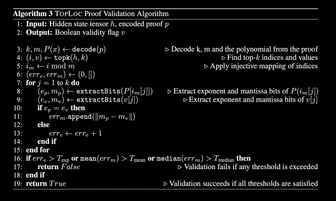
    TOPLOC detects unauthorized modifications to models, prompts, or computational precision through local sensitivity hashing mechanism, verification speed is 100 times faster than original inference, and submission storage for every 32 new tokens only requires 258 bytes (compared to 262 KB for Llama-3.1-8B-Instruct). This solution maintains robustness across various hardware configurations, GPU types, tensor parallel dimensions, and attention kernel implementations, reducing memory overhead by 1000 times and is suitable for large-scale deployment.

Jan 21Tue
Jan 9Thu
  1. Dify Blog

    Dify has released the Plugins plugin system to modularize component extensions to AI application capabilities.

    Dify has launched the Plugins plugin system into Beta, extending AI application functionality through plug-and-play components. Developers can obtain ready-made plugins or build their own on the Dify Marketplace, supporting capabilities such as image processing, audio analysis, text generation, data analysis, logical reasoning, and external integration. The system adopts a decoupled architecture, including five types of components: models, tools, strategies, extensions, and packages, achieving bidirectional communication with Dify's core functionality through custom endpoints.

Jan 6Mon
  1. Prime Intellect Blog

    MetaGene-1: A 7B parameter metagenomic base model for epidemic monitoring.

    MetaGene-1 is a 7B parameter metagenomic base model pre-trained on 1.5T DNA/RNA sequencing data for epidemic monitoring and pathogen detection. It achieves SOTA on pathogen detection and metagenomic embedding benchmarks, with a 512-token context length suitable for short sequence anomaly detection, but limited for complex task applications. The model was developed in collaboration by USC, Prime Intellect, and the Nucleic Acid Observatory, and is open-sourced.

Dec 26Thu
  1. Dify Blog65

    Dify v0.15.0 Released: Introducing Parent-Child Retrieval to Enhance Knowledge Acquisition

    Dify v0.15.0 Launches Parent-Child Retrieval Technology, Achieving Precise Retrieval by Matching Fine-Grained Child Fragments, Combined with Coarse-Grained Parent Fragments to Supplement Context, Improving RAG System's Response Accuracy and Information Richness. This Feature Supports Two Parent Fragment Splitting Modes (Paragraph/Full Text), Allows Users to Edit Parent-Child Fragments Independently and Choose Whether to Regenerate Child Fragments, While Optimizing Fragment Preview Interface to Enhance Low-Code Platform Usability.

Dec 16Mon
Dec 1Sun
  1. Liquid AI Blog

    STAR achieves automated architecture synthesis through target evolution.

    The STAR algorithm synthesizes customized architectures through evolutionary algorithms, with the generated architectures being superior in quality to strong Transformers and hybrid architectures, using fewer parameters and cache. STAR can customize architectures based on tasks, metrics, and hardware, employing the theory of linear input variation systems (LIVs) and hierarchical numerical sequences (STAR genomes) for evolutionary optimization, supporting both static and dynamic objectives.

Nov 29Fri
  1. Prime Intellect Blog

    INTELLECT-1 Released: The First Global Jointly Trained 10B Parameter Model

    INTELLECT-1 is released, the first 10B parameter language model trained through global collaboration, based on the Llama-3 architecture, completing 1T token training on 112 H100 GPUs across 5 countries and 3 continents, with the PRIME framework achieving a 400x reduction in communication bandwidth, 96% computational utilization, supporting sequence lengths of 8192 and a vocabulary of 128256, with the model code and data open-sourced.

Nov 14Thu
  1. LangChain Blog

    Promptim: An experimental library for prompt optimization

    Promptim is an experimental prompt optimization library that automatically runs an optimization loop to generate better prompts by providing an initial prompt, a dataset, and a custom evaluator (optional human feedback). It integrates LangSmith for dataset management, prompt management, and result tracking (optional human annotation). The core algorithm modifies prompts based on evaluator feedback and iteratively optimizes, supporting human feedback loops. The tool aims to save manual prompt engineering time, introduce rigorous processes, and simplify model switching, but requires manual review.

Oct 21Mon
Oct 11Fri
  1. Prime Intellect Blog

    INTELLECT–1 globally distributed training the first 10B parameter model

    INTELLECT-1 launches the world's first 10B parameter model distributed training, inviting the public to contribute computing power to advance the open-source AGI process. The training is based on the OpenDiLoCo open-source implementation, extending the 1B parameter scale of DeepMind DiLoCo's method by 10 times, significantly reducing communication frequency (up to 500 times), and lowering bandwidth requirements by 2000 times through quantized pseudo-gradients (int8) and 500-step outer optimizer synchronization.

Aug 20Tue
  1. Dify Blog55

    Dify partnered with Takin.ai to provide a more convenient GenAI education platform

    Dify announced a collaboration with GenAI education startup Takin.ai, simplifying GenAI education through its integrated platform. It supports teachers and students in zero-setting learning various GenAI concepts and tools, and integrates a customized version of Dify into the Takin.ai system as the core feature for building AI agents and agent workflows.

Aug 16Fri
Jul 11Thu
  1. Prime Intellect Blog

    OpenDiLoCo: An open-source global distributed low-communication training framework

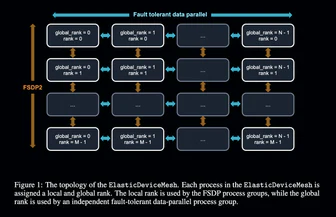
    OpenDiLoCo successfully replicated and extended DeepMind's DiLoCo experiment to a 10B parameter model scale, achieving cross-continent, three-country distributed training through Hivemind and PyTorch FSDP, maintaining 90-95% computational resource utilization. The framework is based on the open-source implementation of Hivemind, supporting dynamic resource joining/leaving and fault-tolerant training, significantly reducing communication requirements by 500x while maintaining performance on 1.5B parameter models.

Jul 10Wed
  1. Dify Blog

    DifySandbox Open Source: Secure Code Execution

    Dify announced the open-sourcing of DifySandbox to enhance code transparency. The sandbox provides a secure execution environment for code nodes, template conversion nodes, LLM nodes, and tool nodes in Dify workflows. It enhances security through operating system, file system, network, and permission isolation policies, supports Python and Node.js, and is extensible. The source code is hosted on GitHub.

  2. Dify Blog

    Introduction to DifySandbox

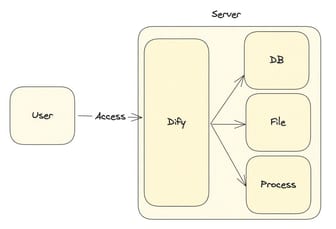
    DifySandbox is a code execution sandbox service provided by the Dify platform, used for processing JSON, XML data, and executing user-defined code in the background, while ensuring security by isolating the file system, database, and network. It supports two languages, Python and Node.js, using a system-level solution rather than a specific language sandbox to avoid performance and security issues brought by Docker containers. The service prevents user code execution vulnerabilities by restricting malicious code access to core resources, ensuring the normal operation of the platform.

Jul 2Tue
  1. Dify Blog65

    Dify Integrates LangSmith and Langfuse to Enhance LLM Application Observability

    Dify version 0.6.12 integrates LangSmith and Langfuse, allowing users to access detailed data of LLM applications through simple configuration, facilitating cost, latency, and quality evaluation. LangSmith provides rich evaluation features, and Langfuse supports open-source hosted architecture, both helping Dify users monitor and optimize LLM application performance.

Jul 1Mon
  1. Prime Intellect Blog

    Prime Intellect Compute platform officially launched: Global GPU resource aggregation and scheduling market

    Prime Intellect Compute platform officially launched, aggregating global GPU resources to democratize instant computing. The platform offers a unified resource pool, supporting instant access from single GPU to 512+ GPU clusters. The first batch integrates 12 cloud service providers, with H100 GPUs priced at $1.5-4 per hour.

Jun 17Mon
Jun 5Wed
  1. Dify Blog65

    Dify vs. LangChain comparison analysis

    Dify.AI and LangChain are two popular AI application construction tools. Dify.AI enables non-technical users to quickly develop LLM applications through a visual workflow interface, significantly reducing development time and complexity; LangChain requires users to code and debug themselves. Dify.AI has a BaaS architecture, RAG, and rich API features, and relies on an expert team to ensure reliable performance under high load, while LangChain depends on third-party code contributions, which may have maintenance issues.

May 31Fri
  1. Dify Blog65

    Dify Workflow v0.6.9 update: publish workflows as tools, iterative nodes, parameter extractors, and enhanced node functions.

    Dify Workflow v0.6.9 released, supporting the publication of workflows as tools for AI agents or other workflows to automatically call; new iterative nodes for more flexible multi-step generation; parameter extractors can extract structured parameters from unstructured information, simplifying tool calls; enhanced capabilities of various nodes. New features are suitable for encapsulating processes, batch processing tasks (such as email classification processing), and improving tool call barriers.

Apr 8Mon
  1. Dify Blog

    Dify launched the AI Workflow feature

    Dify launched the AI Workflow feature, achieving expected multi-step logic outputs through an intuitive drag-and-drop interface. This feature can be used as a standalone application or activated as Chatflow within Chatbot applications, supporting nodes such as LLM, tools, question classifiers, knowledge retrieval, code execution, and conditional logic, and can be integrated into existing systems via API.

Feb 22Thu
Jan 24Wed
Jan 10Wed
Jan 3Wed
  1. Dify Blog65

    Dify v0.4.1 release: Refactoring of the model runtime architecture.

    Dify has released version v0.4.1, refactoring the model runtime architecture to replace the old LangChain-based interface, aiming to simplify the development process and enhance the robustness of the codebase and the friendliness to contributors; the new architecture reduces external dependencies, aligns more closely with development needs, and supports model providers such as OpenAI, Anthropic, Azure, and Google Gemini, simplifying model deployment through YAML configuration.

Dec 26Tue
  1. Dify Blog65

    How does Dify.AI's Annotation Reply feature improve chatbot quality and reduce costs?

    Dify.AI's Annotation Reply feature allows manual editing of historical conversations or importing batches of Q&A to prioritize matching similar user questions with annotated replies, enabling chatbots to provide precise answers in specific scenarios. This feature helps build an LLMOps data feedback loop, reducing LLM call costs and latency in conversational scenarios, and accumulating valuable data assets for future model fine-tuning.

Dec 20Wed
Dec 5Tue
Nov 25Sat
  1. Dify Blog

    Dify's open-source assistant API is based on any large language model.

    Dify offers features such as self-hosted deployment, multi-model support, RAG engines, and APIs, providing more flexibility to address challenges with the OpenAI Assistants API in terms of cost, data security, and model selection. Its self-hosted deployment strategy ensures data privacy and security, compatible with commercial and open-source models like OpenAI, Anthropic, and Llama2. The RAG engine supports integration with vector databases like Qdrant and Weaviate, allowing users to customize indexing strategies.

Nov 21Tue
  1. Dify Blog

    Dify.AI v0.3.31 released: RAG technology improved by 20% over OpenAI Assistants API.

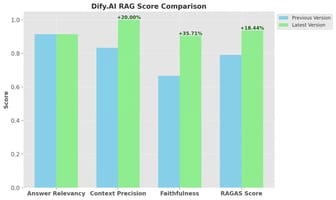
    Dify.AI v0.3.31 update enhances RAG technology through hybrid search, semantic reordering models, and multi-path retrieval, improving question-answering efficiency by 20%, significantly outperforming the OpenAI Assistants API. Ragas evaluation shows an increase of 18.44% in Ragas score, 20% improvement in context accuracy, and 35.71% increase in faithfulness.

Nov 13Mon
Nov 8Wed
Oct 12Thu
  1. Dify Blog35

    Enhanced Dify New Dataset Functionality

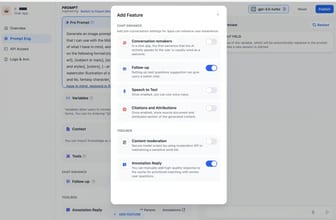
    Dify has released an update to its dataset management tool, introducing the 'Citation and Attribution' feature and a user-friendly interface, while expanding Dataset API support for multiple file formats and real-time data management. New features include creating empty datasets, document list queries, text/file imports, embedded model integration, and GPT-3.5-turbo-instruct integration, enhancing data management efficiency and interaction experience.

Aug 15Tue
  1. Dify Blog65

    Dify v0.3.13 released: Easily integrate open-source large models like Llama2 and ChatGLM

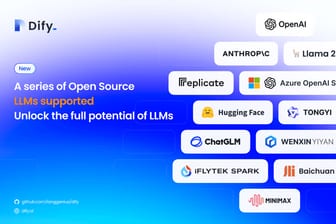
    Dify v0.3.13 released, integrating open-source large models like Llama2 and ChatGLM, supporting models from Hugging Face and Replicate platforms, allowing users to easily access and quickly build AI applications via API keys. The platform supports rapid switching between models, enabling users to compare performance by clicking the model selector, lowering the barrier for model selection and tuning.

Jul 17Mon
May 15Mon
May 10Wed
Apr 10Mon
  1. Dify Blog65

    Dify Launches Dify WebApp: Easily Build AI-Native Applications

    Dify Launches Dify WebApp, allowing users to quickly combine and deploy cloud-native AI applications without managing infrastructure. The platform offers two types of WebApps: conversational and text generation, respectively designed for building interactive experiences and content generation tasks. Users can deploy via GitHub repositories or self-hosted servers, and leverage open-source templates for lightweight or heavy customization development, integrating Dify's visual orchestration, operational, and dataset capabilities.