Skip to content
Live
Oct 23Fri
  1. Hugging Face Daily Papers75

    OpenDS-World: A benchmark for evaluating autonomous deep search agents in real network environments

    OpenDS-World introduces a real-time network benchmark to evaluate autonomous multi-step deep search agents, revealing a significant gap between cutting-edge models and human performance. Among 12 cutting-edge models, the best model achieved an accuracy of 39.0%, while 1000 human evaluations reached an accuracy of 21.1%. Analysis shows that research strategies vary among models, and tool coordination and long-term search management remain major challenges.


Oct 22Thu
Oct 20Tue
  1. Meta Engineering

    Meta introduces GenRecs Tokenization to reshape ad recommendations with a stable model vocabulary.

    GenRecs Tokenization enhances conversion rates by 0.35% for advertisers by representing items like ads and products with a stable semantic vocabulary, combined with Meta's Generative Ad Model (GEM) and adaptive ranking model. This technology leverages the world knowledge of pre-trained large models to enable recommendation systems to understand preferences of new items or users with no historical interaction, accelerates learning through shared concepts, achieves cross-activity transfer, and improves performance as large model scale increases, forming a feedback loop for performance improvement.

Oct 19Mon
  1. Inception Labs Blog

    Inception Labs launches Mercury 2, enhancing the ability and efficiency of building AI applications

    Inception Labs has launched Mercury 2, increasing the number of free tokens from 10M to 100M. The new Inception API key includes 100M free tokens, and the free tier's request frequency has been increased 10 times. Mercury 2 performs better in real-time speech, search, AI coding sub-agents, and multi-agent workflows. The first token response time is reduced, end-to-end latency is lowered, and tool calls are more reliable.

Oct 16Fri
  1. Google DeepMind

    How does Google Antigravity accelerate the discovery of antibacterial peptides?

    The Google Antigravity platform works through its intelligent agent workbench and ProtNLM model, helping biologists quickly discover, structure evaluate, and prioritize potential antimicrobial peptide targets, compressing searches previously scattered across multiple databases into a single session. The platform uses ProtNLM to predict protein function and supports researchers in scanning millions of uncharacterized proteins in the UniProt database. Researchers collaborate with AI agents on a shared 3D canvas, compressing the time required for the antimicrobial peptide discovery process from several days to a single session.

Oct 15Thu
  1. Apple Machine Learning Research

    Selection-Based Structured Reasoning: A framework for efficient multimodal search agents

    The Selection-Based Structured Reasoning (SSR) framework restructures reasoning into selection rather than open-ended generation, selecting the most likely solution from predefined reasoning candidates before each action, significantly reducing reasoning costs. Validated using 2B and 4B models on seven multimodal search benchmarks, SSR achieved average success rates comparable to leading search agents of the same scale, reducing single-step reasoning latency by 90% and total reasoning latency per task by 28-54%.

Oct 13Tue
  1. LangChain Blog

    LangSmith adds an AI search feature to optimize large language model agent debugging through behavior tracking

    LangSmith introduces an AI search feature that supports natural language queries for intelligent agent behavior tracking records. This feature can search for user inputs, agent reasoning, tool calls, and responses, helping teams discover specific behavior patterns, such as PII leaks or user frustration. The AI search combines SmithDB's data layer and decision models, achieving fast and efficient cross-SDK searches by analyzing standardized trajectories rather than raw long texts, prioritizing key information like user messages and agent responses.

Oct 7Wed
  1. Google Developers Blog

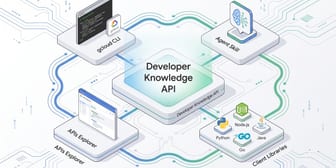
    The Google Developer Knowledge API ecosystem helps developers build AI tools efficiently.

    The Google Developer Knowledge API is Google's official developer documentation programmable source, providing semantic search, intelligent document chunking, and reliable Q&A capabilities for Google Cloud, Firebase, Android, and other Google ecosystems, reducing hallucinations in AI tools due to the expiration of LLM training deadlines.

Sep 30Wed
  1. Cohere Blog75

    Cohere has launched RCP-nDCG@10: a more comprehensive retrieval relevance metric.

    Cohere has introduced RCP-nDCG@10, which calibrates AI judges to score each retrieved document, addressing the flaw of traditional nDCG@k that relies on manual annotations and leads to the omission of relevant results, to optimize next-generation search models. This metric combines document ranking and relevance evaluation, determining the actual relevance of each document through AI rather than relying solely on original annotations.

Aug 13Thu
  1. Factory News75

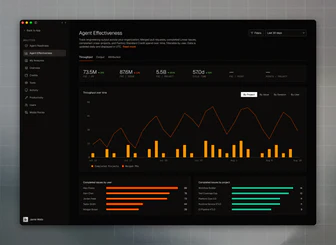
    Factory introduces Agent Effectiveness for integrated usage and delivery outcomes

    Factory's Agent Effectiveness feature is now live, linking data with delivery cycles, work intentions, and delivered outcomes to help engineering leaders understand delivery acceleration points, robot work content, and how usage maps to actual output. This feature provides an operational view of AI investment return by connecting Droid usage with delivery results, addressing questions about delivery speed changes, profit concentration points, and whether new capabilities are used for priority work.

Jul 22Wed
  1. Prime Intellect Blog

    Prime Intellect Integrates 365,000+ Software Engineering, Terminal, and Search Environments for Agent Reinforcement Learning

    Prime Intellect integrates 23 agent task sets for software engineering, terminal, and search, providing a unified API, runtime/sandbox hooks, including approximately 198,000 software engineering tasks, 28,600 terminal tasks, and 137,600 search tasks. It decomposes the environment into three layers of task sets, sandbox, and runtime through verifiers v1, standardizes the scoring logic for different task sets, and provides 135,000 pre-built open-source task images.

Mar 25Wed
Jan 29Thu
  1. LangChain Blog

    How does the LangChain Deep Agents SDK implement efficient context management?

    The LangChain Deep Agents SDK manages limited memory of AI agents through three compression techniques: offloading large tool results (>20,000 tokens) and inputs (>85% context window) to the file system, and using LLM to generate session summaries. The SDK triggers compression on Claude Sonnet 4.5 in terminal benchmark tests, retaining complete records through filesystem search and summaries, supporting frequent compression to optimize performance.

Oct 29Wed
  1. Dify Blog70

    Dify integrates Qdrant high-performance vector database, accelerating the development of next-generation AI applications

    Dify Platform now integrates Qdrant high-performance Rust vector database, providing faster retrieval, hybrid search, and scalable performance for building reliable, production-grade AI applications. This integration enables developers to choose Qdrant without becoming vector search experts through simple configuration, achieving millisecond-level retrieval for millions of documents, complex metadata-based retrieval strategies, and hybrid search capabilities, supporting high-performance scaling from prototype to production.

Oct 17Fri
  1. Dify Blog65

    Dify platform integrates Tavily API to achieve real-time web data knowledge pipeline construction

    Dify platform now supports Tavily Real-time Web Search API, allowing users to directly embed web data into knowledge pipelines to enhance accuracy and timeliness; Tavily can be used as a data source plugin in Dify Marketplace, paired with Dify knowledge pipelines, which support modular components from upload and parsing to chunk embedding; users can install the plugin, obtain an API key, and configure LLM nodes to use Tavily search results for generating Q&A pairs and storing them in a knowledge base.

May 20Tue
  1. Dify Blog

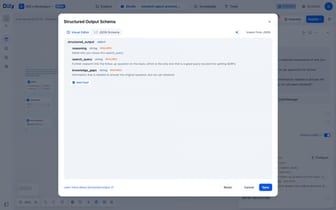
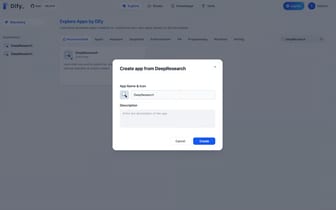
    Dify Deep Research Workflow: Step-by-Step Guide

    Dify builds deep research workflows using loop variables, structured output, and Agent nodes to achieve iterative exploration and comprehensive report generation. The workflow includes three stages: intent recognition, dynamic research loops (tracking six variables), and research synthesis. Agent nodes utilize exa_search, exa_content, and think tools for information collection and processing. The final output is a cited Markdown report, accelerating the automation of expert-level research methods.

Mar 6Thu
  1. Dify Blog

    Dify x Brave Search: Use the Brave Search API plugin to enhance real-time search functionality for AI applications.

    Dify v1.0.0 introduces a plugin system, allowing developers to easily integrate real-time search functionality through the Brave Search API plugin. Create smart agents or workflows in Dify Studio, choose models like Claude-3.5 Sonnet, and add the Brave Search tool to enable search. Deploy in workflows or integrate custom plugins to extend functionality.

Feb 19Wed
Jan 22Wed
Nov 5Tue
  1. Dify Blog65

    How Dify Enhances GPT-Researcher Through Parallel and Advanced Iterative Features

    Dify Workflow accelerates GPT-Researcher's research tasks through parallel mode and advanced iterative features, breaking down the problem into 4-6 independent sub-problems, parallel extracting topics to form subheadings, calling the Tavily API to search and analyze results, and finally integrating them into a structured report, significantly shortening research time and isolating error handling.

Nov 21Tue
  1. Dify Blog

    Dify Blog: Introducing hybrid search and re-ranking to improve the retrieval accuracy of RAG systems.

    Hybrid search and re-ranking techniques significantly improve the document recall and accuracy of RAG systems. Hybrid search combines the advantages of semantic relevance and keyword matching, while re-ranking techniques optimize the ordering of candidate results, making them suitable for scenarios such as customer service robots and corporate knowledge bases.

Aug 1Tue