Skip to content
Live
Oct 30Fri
  1. ITHome · AI58

    Google Released the 'Sleep Framework': Let AI Learn to 'Sleep', Learn While Using and Not Forget Old Knowledge

    Google Launches 'Sleep Framework' Continuous Learning Solution, Solving Large Model Knowledge Solidification and Forgetting Problems Through a 'Wake-Sleep' Cycle; The Model Processes Input When Awake, Integrates Memory and Self-Improves When Asleep, Experiments Show It Can Handle Millions of Token Contexts While Maintaining Stable Performance, AIME Benchmark Accuracy Improves

  2. Hugging Face Daily Papers65

    Hugging Face Daily Papers: Formal benchmark evaluation through difficulty measures identifies measurement mismatches and coverage gaps

    Research formalizes benchmark evaluation through difficulty measures to identify measurement mismatches and coverage gaps, proposing diagnostic metrics and rewrite algorithms to improve benchmark coverage; analyzing 25 popular benchmarks across 7 fields reveals that most implicitly overestimate specific difficulty areas or fail to cover most of the difficulty axis, limiting model improvement monitoring capabilities; introduces BenchFill algorithm to effectively reduce local coverage gaps.

  3. ITHome · AI

    AI model usage costs are affected by different languages, with token consumption varying up to 17 times

    When AI models process different languages, token consumption can vary up to 17 times, with English and other mainstream language users incurring lower costs. The implicit 'tokenizer tax' results in users of less common languages paying higher fees, affecting response speed and context capacity. AI labs need to publish evaluation results for each language and improve tokenizer design to narrow the gap.

  4. Hugging Face Daily Papers52

    WeVisCut: An integrated smart editing agent from narration to long videos

    WeVisCut coordinates video editing tools, recovers from failures, and reduces token usage through a compact strategy trained on 9B parameters, while maintaining output quality. The system employs a four-stage data pipeline, combining editing inversion and validation replay, to generate over 130K training examples from 3,750 finished videos for training a single strategy.

  5. Epoch AI88

    Epoch AI: GLM 5.3 can break multiple Firefox versions during the patch window period.

    Epoch AI's experiment shows that the open-source weight model GLM 5.3 released by Z.ai in August can autonomously construct web attacks targeting six Firefox versions released between September 17 and October 26, exploiting publicly available but not yet pushed security fixes, where visiting the web page causes local files to be read and transmitted.

    Same story · 2 outlets

    How the accounts differ:The Decoder mentions the cost of 1000 dollars and that the vulnerability was fixed in Firefox 159.0, while Epoch AI does not mention these details.

    Why it matters: Epoch AI replicates patch window attacks using open-source weight models, providing a cost level of about 1000 US dollars per version, available for evaluating the security boundaries of open models.

  6. Databricks Blog28

    How to evaluate Postgres management services: a checklist for technical buyers

    When evaluating Postgres management services, focus on infrastructure operations and maintenance, disaster recovery, and compatibility, rather than just the feature list. Key validation points include: operational scope (patches, upgrades, tuning permissions), high availability (automatic failover, cross-availability zone switching), backup and recovery (PITR, retention period), compatibility (supported PostgreSQL versions and extensions), migration paths and costs. Red flags include managing only virtual machines, no clear RPO, critical extensions not supported, or data export restrictions.

  7. Amazon Science

    Amazon Science explores technology to accelerate language models in travel applications

    Amazon Science combines knowledge distillation (KD) and the Medusa framework to optimize the travel platform LLM. After fine-tuning, KD training, and Medusa head modification, the TinyLlama 1.1B model achieves performance close to the 70B parameter Llama-3.1 teacher in AI travel planning, intelligent filtering, and accommodation description generation scenarios, with costs reduced by two-thirds and speed increased by 10-20 times.

  8. AWS Machine Learning Blog42

    MoEngage on how to use AgentCore Gateway to convert 400 APIs into intelligent agent tools

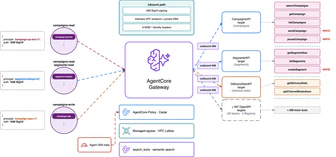
    MoEngage transforms 400 internal APIs into permission-controlled intelligent agent tools through Amazon Bedrock AgentCore Gateway, solving multi-team API integration challenges. This solution eliminates the need to set up MCP servers or configure networks, reducing the time to launch new APIs from days to hours while meeting constraints such as keeping APIs within the VPC, controlling identities from the server side, and ensuring tool definitions do not occupy the reasoning context window.

  9. Meta Engineering66

    Meta rolls out JiTTesting to production: Use LLM to generate tests and catch bugs before code merge

    Meta announced that Catching JiTTests has been put into internal production, using LLM to automatically generate executable tests for diffs to be merged, exposing behavioral differences before the code is landed

    Why it matters: Meta has disclosed the production deployment details and quantitative results of JiTTests, available for evaluating the implementation of LLM-generated tests in ultra-large-scale codebases.

Oct 29Thu
  1. NVIDIA Technical Blog35

    NVIDIA unlocks Tensor Core performance to accelerate machine learning atomic potential energy calculations

    NVIDIA significantly accelerates machine learning atomic potential energy calculations by optimizing Tensor Core performance. Its technology can improve the computational efficiency of quantum mechanics methods such as Density Functional Theory (DFT), balancing cost and accuracy. This solution is suitable for large systems or long-time simulations, but the specific parameter scale, benchmark scores, and availability (open source/closed source/API) were not provided in the original text.

  2. Hugging Face Blog

    Project ProtoStar project release: Promoting the AI compatibility of publicly funded scientific research

    Project ProtoStar is announced, aiming to unlock the potential of publicly funded scientific research by making datasets, models, and code more accessible and reusable. The project brings together universities, research institutions, industry, and the open science community, supporting the release of scientific achievements in AI-compatible, machine-actionable formats, and demonstrating its value through a series of public challenges. The first challenge, hosted by Carnegie Mellon University, will launch on November 2.

  3. Hacker News · AI hot posts

    Lean founder Leo de Moura: How AI is driving the development of formal verification.

    Lean founder Leo de Moura discussed how AI can make formal verification more accessible and potentially change software engineering. AI-generated code needs to be verified for correctness using formal verification, and Lean can be used to write machine-verifiable proofs, with two verifiers already available. AI can assist in implementing code and automatically proving its properties, such as when Kim Morrison ported zlib to Lean and proved it to be lossless compression.

  4. ITHome · AI65

    Today is auspicious for rest, announcing strategy, plans to collect over 1000 gold standard clinical PSG data within a year

    Today is auspicious for rest at ISHO Today is auspicious for rest AI Sleep Technology Ecosystem Product Launch Conference announced its strategy, focusing on precise monitoring, scientific intervention, and energy recovery, planning to collect over 1000 cases of gold standard clinical PSG data within a year, and extending the research scope from nighttime sleep quality to daytime energy status.

  5. Hacker News · AI hot posts

    DAYJOB: Tax released, evaluating the performance of AI agents in 50 professional tax tasks.

    DAYJOB: Tax evaluates the performance of AI agents in 50 professional tasks across 8 tax areas, requiring agents to complete tax filing, compliance, and advisory work. Claude Sonnet 5.5 leads the rankings with a pass rate of 10.8%, while Claude Opus 5.5 has a pass rate of 9.2%. The benchmark includes 1,789 workspace files, covering various tax scenarios and complex materials, created and reviewed by tax experts.

  6. QbitAI78

    PSI claims AI-assisted resolution of 5 open problems in quantum information

    Physical Superintelligence (PSI) claims to have achieved results on 5 open problems in quantum information theory with the help of its self-developed AI research system Emmy. Papers, Lean formal proofs, and verification code have been released on GitHub for review.

    Why it matters: Readers can see a new company challenging quantum open problems with a process that separates generation from formal verification, and learn about its team and funding background.

  7. Hugging Face Daily Papers

    Prox model achieves channel selection for expert mixture decoding without calibration data

    The Prox model accelerates expert mixture inference through top-k channel selection and weighted reader, while maintaining accuracy without calibration data. Under 13% and 18% budgets, the top-k version of Prox outperformed or matched the threshold version in 40 out of 43 comparisons, including all 23 generation tasks, and avoided the repetitive loop crashes caused by calibration thresholds on Gemma 4.

  8. ITHome · AI

    Momenta CEO Cao Xudong first publicly shares insights on large model definition chip

    Momenta CEO Cao Xudong first publicly defined the large model definition chip, which improves performance 10 times compared to general chips and can support billion-parameter models to achieve large-scale L4, driving breakthroughs in physical AI applications such as robots. XHEART New Chip Journey released a new X7 Ultra large model chip, specifically designed for large models, featuring a super-large core NPU architecture and Armv9 automotive-grade CPU.

  9. Hugging Face Daily Papers65

    Sensorimotor Alignment: A Successful Embodied Agent Metric Based on Sensorimotor Alignment

    The Sensorimotor Alignment (S²) metric finds that the alignment degree between vision and motor representations of embodied agents is positively correlated with task success rates, verifying the applicability of the Platonic representation hypothesis in the robotics field. In simulation and real robot tests, models with high S² (such as Vision-Language-Action and World Action Models) perform better and can explain the phenomenon where the VLA model ignores instructions and relies on visual features, serving as a low-cost offline proxy metric.

  10. QbitAI

    MolCell MMDesign achieves breakthrough progress in the AI pharmaceutical field

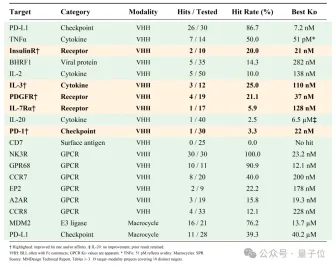
    MolCell AI's MMDesign platform completes 18 design projects with a success rate of 94.7%, hitting all six GPCR targets among them, with the best affinity reaching nanomolar level; the platform uses a 'generate-screen-verify' workflow, generating tens of thousands of candidate molecules in computational space and testing only 9-50 to achieve success, with an overall candidate hit rate of 30.7%, demonstrating efficient and precise molecular design capabilities.

  11. QbitAI

    Zhuji Dynamics releases FluxVLA Engine V2 technical report, one-click reuse of engineering capabilities makes embodied AI R&D more efficient

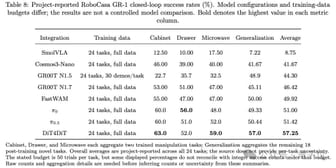
    Zhuji Dynamics releases the FluxVLA Engine V2 technical report, achieving full-chain reuse of model training, evaluation, and deployment through unified configuration, modular decoupling, and system optimization. It supports 14 mainstream strategies, with inference path frequency improved by 2.31–9.64 times, validated in closed-loop execution on 6 real machines including ALOHA and dual-arm Franka. Online reinforcement learning boosts SmolVLA success rates by 10.0–15.4 percentage points.

  12. QbitAI

    Zhuji Dynamics releases the FluxVLA Engine V2 technical report, enhancing the R&D efficiency of physical intelligence.

    Zhuojì Power updates the second technical report of the open-source engineering base FluxVLA Engine. V2 supports 14 strategies for LIBERO evaluation on the simulation side, increases model path frequency by 2.31–9.64 times on the inference end, and verifies deployment links on real hardware platforms such as ALOHA and dual-arm Franka. Online reinforcement learning boosts SmolVLA's success rates in LIBERO-10 and RoboTwin Clean tasks by 10.0% and 15.4%, respectively.

  13. Hugging Face Daily Papers

    EmbeddingGemma 2: A Unified and Efficient Cross-Modal Representation Model

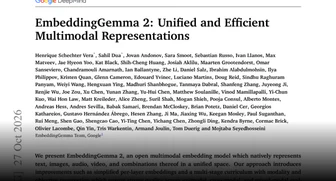
    EmbeddingGemma 2 is an open-source multimodal embedding model that unifies text, image, audio, and video representations in an efficient and resource-flexible design, and performs excellently in benchmark tests. It has established a new Pareto frontier in embedding benchmark tests for all modalities, outperforming professional models and other models that are two to twelve times larger in scale. The model supports selective modality encoder loading, adjustable visual token budgets, truncatable embedding dimensions, and quantized weights to adapt to resource-constrained environments.

  14. Hugging Face Daily Papers

    Falcon audio-visual target speaker extraction model released

    Falcon is a causal audio-visual target speaker extraction model that extracts the voice of the target speaker from the mouth video of the target speaker in noisy overlapping speech, combined with a single multi-scale time-frequency separator and an encoder spatial speaker contrast loss, reducing interference speaker leakage without increasing inference cost.

  15. Hugging Face Daily Papers65

    DTCA: A Noise-Aware Label Credit Assignment Framework for Diffusion Language Models using Reinforcement Learning

    DTCA performs label-level credit assignment through confidence enhancement and entropy calibration, improving the mathematical reasoning ability of diffusion language models. The framework, when tested on LLaDA-8B-Instruct, shows significant performance improvement in mathematical reasoning under different generation budgets, with the MATH500 metric increasing by 9.0 points and the GSM8K metric improving by 5.3 points.

  16. Hugging Face Daily Papers

    Explore human feedback driven recursive self-improvement in RSI Arena

    RSI Arena demonstrates that autonomous AI intelligence can independently use human feedback to train and iteratively improve language models. Most agents achieved preference gains in the second phase, although benchmark test improvements were limited. Ten cutting-edge models were used as training agents, starting from NVIDIA Nemotron 3.5 Lightning 30B-A3B Base, which independently selected data, implemented training, and selected checkpoints in the first phase within six days, using a 64-GPU cluster and 300 USD API credits.

  17. ITHome · AI

    The first batch of extreme weather AI models for the Fengyun meteorological satellites were released, generating a typhoon 'health report' in 27 seconds.

    The first batch of extreme weather AI models for the Fengyun meteorological satellites were released, with the typhoon intelligent cloud map interpretation model interpreting every 15 minutes and generating typhoon analysis text in 27 seconds; the short-term warning model for strong convection, combined with observations from Fengyun-4 satellite, will advance the warning time to four hours.

  18. AWS Machine Learning Blog58

    Build an enterprise-grade agent platform based on Amazon Bedrock AgentCore

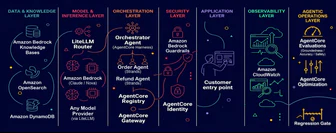
    Amazon Bedrock AgentCore provides modular services such as runtime, gateway, identity, memory, policy, registration, and evaluation, supporting large-scale agent construction, deployment, and operation. The enterprise-grade agent platform blueprint based on AgentCore adds enterprise-level constraints such as ownership, account boundaries, software delivery, observability, cost governance, and retirement, achieving controlled access through inference gateway and tool gateway, and including an evaluation process to ensure agents are validated before production deployment.

  19. Hugging Face Daily Papers

    EvidenceConnect framework and Zooming without Zooming v2 model released

    The EvidenceConnect framework generates comparative, aggregated, or chained visual evidence queries by synthesizing image region thumbnails, enhancing the evidence connection capability of VLMs. The ZwZ2 model is trained based on this framework, without targeting any downstream benchmarks but improving fine-grained and spatial perception, and achieving progress in embodied spatial reasoning, multimodal long-context understanding, multimodal agent tasks, and general visual reasoning

Oct 28Wed