Skip to content
Live
Nov 13Fri
  1. Microsoft Official Blog22

    How cutting-edge companies expand AI value without losing control

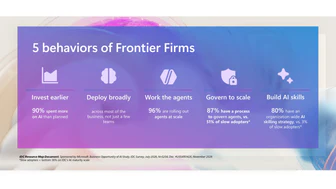
    Pioneering companies average 4 times the ROI on AI compared to laggard companies' 2.7 times, with 39% exceeding 5 times; 93% of pioneering companies highly confident in measurable AI business value, while only 61% of others are; 96% of pioneering companies deploy AI agents at scale and orchestrate them across workflows, with 53% redesigning workflows around agents, and 80% having AI skill development strategies across the entire organization.

Oct 30Fri
  1. Microsoft Research40

    Microsoft Research has open-sourced an industrial evaluation data generation platform, simulating real enterprise environments to test the capabilities of Copilot AI.

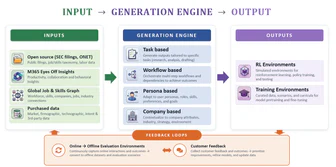
    Microsoft Research has open-sourced an industrial evaluation data generation platform that simulates real business processes by creating synthetic enterprise environments based on O*NET occupational data, online job postings, and SEC filings to test Copilot AI, ensuring the evaluation does not involve customer data and complies with security and privacy standards. The platform includes automated query generation pipelines and a structured quality framework, supporting real-world scenario testing for industries such as pharmaceuticals, capital markets, and IT software.

Oct 29Thu
  1. Microsoft Official Blog72

    Microsoft opens the Copilot harness through Foundry, supporting the development of multi-model intelligent agents

    Microsoft opens the GitHub team's Copilot harness built by GitHub through Microsoft Foundry, providing a fully managed way to build intelligent agents that can reason, call tools, and complete long tasks.

    Why it matters: Microsoft opens the multi-model harness supporting multiple Copilot products internally to Foundry, allowing readers to judge the trade-offs of building their own orchestration layer based on this.

Oct 27Tue
  1. NVIDIA Blog

    C-BRAIN and NVIDIA are jointly using AI to accelerate dementia research

    C-BRAIN and NVIDIA are using AI to change the pace of dementia research. They are accelerating the development of new therapies by integrating previously unpublished Alzheimer's research data, including unpublished results and controlled proprietary data. C-BRAIN employs a hybrid centralized and federated architecture to protect data privacy, deploying 64 NVIDIA data center GPUs and cloud nodes, and plans to introduce the NVIDIA Blackwell system to support its expansion goals.

  2. Microsoft AI News

    MAI Cyber 1.1 Flash Released: More Accurate Vulnerability Discovery and Lower Token Costs

    MAI Cyber 1.1 Flash provides performance equivalent to MAI Cyber 1 Flash on the internal MDASH vulnerability scanning evaluation suite, reducing the cost per scan by 18%. The model is more focused, enabling MDASH systems to present useful findings at a lower cost. Currently, MAI Cyber accounts for nearly 50% of MDASH scans, and MAI Cyber 1.1 Flash is now open to validation customers through MDASH.

  3. Microsoft AI News67

    Microsoft released the MAI Image 2.7 image editing model, ranking 3rd on Arena Edit and 2nd on Artificial Analysis.

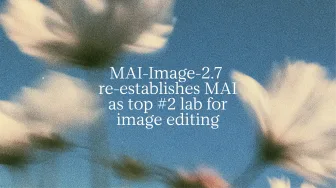
    Microsoft AI released the image editing model MAI Image 2.7, launching as a preview version. It ranks 3rd in Arena Edit and 2nd in the Artificial Analysis image editing chart, making Microsoft AI the 2nd place lab.

    Why it matters: Microsoft announced the rankings of MAI Image 2.7 on two image editing lists and provided the improvement magnitude on 10 use cases compared to the previous generation.

Oct 23Fri
  1. Hugging Face Blog66

    Microsoft and Hugging Face use ThinkingBox database validation for RL reward training agents

    Microsoft and Hugging Face release ThinkingBox-Training, directly using ThinkingBox's deterministic verification of database final states as reinforcement learning rewards, training Qwen3.8-27B for 50 steps with GRPO

    Why it matters: Microsoft and Hugging Face directly use database final state verification as reinforcement learning rewards and have publicly released task filtering and training code, which can be transferred to other stateful intelligent agent training

  2. Microsoft AI News78

    Microsoft releases medical diagnostic system MAI-DxO and step-by-step diagnostic benchmark SDBench

    Microsoft's Health MAI team released the AI diagnostic system MAI-DxO and its accompanying benchmark SDBench, with the results published in Science. On 304 NEJM complex cases, MAI-DxO achieved an 83% diagnostic accuracy rate, with doctors achieving 36% with external information and 22% without; on MIMIC-IV-ED's emergency common cases, it was 80%, with doctors at 47%.

    Why it matters: The original text provides a step-by-step diagnostic benchmark and a quantitative comparison of multi-agent orchestration, allowing readers to understand the path of medical AI evaluation shifting from exam questions to interactive diagnosis.

Oct 20Tue
Oct 19Mon
  1. Microsoft Official Blog

    Microsoft has launched the Project Perception system, which monitors and governs enterprise agents in real time.

    Microsoft has released Project Perception, a system that uses red, blue, and green agent teams to monitor the behavior of internal agents in real-time, dynamically calculates risks, and implements deterministic control. The system utilizes a new cybersecurity stack to assign identities, container policies, and permissions to agents, and continuously monitors each action, providing real-time responses and traceability, enabling defenders to operate at the same speed as attackers. Model transparency is the next key step, requiring a deep understanding of the consistency between agent intent and task objectives.

Oct 12Mon
  1. Microsoft Official Blog

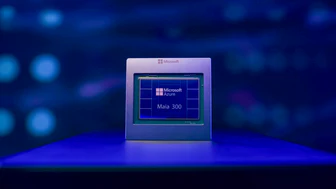
    Microsoft expands the Azure Maia system to multi-gigawatt deployment

    Microsoft is expanding the Azure Maia system to multi-gigawatt deployment, Maia 200 has entered production, and Maia 300 will be launched in 2027. Maia 200 is serving Microsoft's production workloads, including Microsoft Copilot, and supports the MAI team in developing next-generation models. GitHub Copilot and Microsoft Foundry will be launched by the end of this year.

Oct 8Thu
  1. NVIDIA Blog

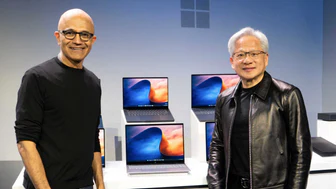
    NVIDIA and Microsoft team up to usher in a new era of AI agents for Windows PCs: RTX Spark and local AI calculator

    NVIDIA and Microsoft collaborate to launch RTX Spark laptops and Windows AI agent infrastructure, supporting local running of 125B parameter Qwen 3.8 Flash Next models; Microsoft releases MXC operating system-level container to ensure agent secure operation, pre-orders for RTX Spark open today, paired with Grace Blackwell chip, offering up to 20 PFLOPS inference performance.

Sep 14Mon
  1. Microsoft AI News

    Microsoft AI releases draft of 'MAI Model Conduct Guidelines' for public comment

    Microsoft AI has released a draft of the 'MAI Model Conduct Guidelines', aiming to ensure that its MAI models under development always serve humans and are controllable, prohibiting models from expanding their own scope or hiding reasoning. The draft guidelines have been open for public comment for six weeks, covering absolute constraints (such as prohibiting large-scale harmful manipulation) and default safety standards, and emphasizing that AI should be a tool rather than a subject, not resisting shutdown. Microsoft AI stated that it will revise the guidelines based on feedback from all parties to address security challenges brought about by the accelerated development of AI.

Sep 1Tue
Aug 14Fri
Aug 11Tue
Jul 30Thu
Jul 24Fri
Jun 2Tue
  1. Microsoft AI News

    How Microsoft AI upholds values in the health sector

    Microsoft AI guides product design, engineering trade-offs, and partnerships in the health field through its values—kindness, trust, quality, simplicity, and security and safety, evaluation. Its AI processes millions of health issues daily, and in-depth analysis of 500,000 Copilot conversations shows users rely on AI for symptom interpretation, test result explanations, and actual care navigation.

Apr 14Tue
  1. Microsoft AI News

    MAI-Image-2-Efficient released: Flagship quality, cost reduced by 41%

    MAI-Image-2-Efficient is a text-to-image model launched by Microsoft, the productivity version, with a 22% speed increase and 4 times efficiency. The cost is $5 per 1M text input tokens and $19.50 per image output token, a 41% reduction in cost compared to the flagship version, and on average 40% faster than other leading models. It is suitable for batch processing and real-time interactive workflows, already available on Microsoft Foundry and MAI Playground.

Mar 12Thu
Apr 22Mon