Skip to content
Live
Nov 11Wed
  1. ITHome · AI

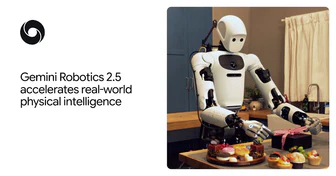
    Google's strongest VLA robot model, Gemini Robotics 2.5, debuts, can tie bows, already on the Mercedes production line

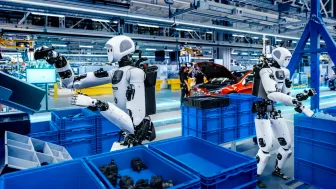
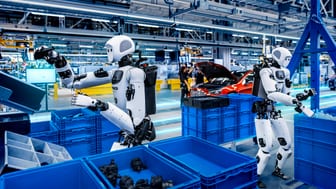
    Google launches VLA robot model Gemini Robotics 2.5, achieving leaps in dexterity, reliability, and safety, with a success rate of 96% on the Mercedes production line. The model has tested 200 tasks, with a success rate 30%-100% higher than the baseline, a speed increase of 20%-30%, and is compatible with robots like Apptronik Apollo 2, adopting ASIMOV-Jailbreak benchmark to enhance jailbreak resistance to 99.5%.

Nov 10Tue
  1. Google DeepMind76

    Google DeepMind releases Gemini Robotics 2.5 vision-language-action model

    Google DeepMind released Gemini Robotics 2.5, claiming it is the most capable vision-language-action (VLA) model to date, with a 30% to 100% increase in success rate on 200 tasks compared to previous baselines, and 20% to 30% faster task completion speed.

    Why it matters: Officially disclosed were 200 task evaluations and actual production line test data showing a 96% success rate for Mercedes-Benz, which can be used to judge the extent of VLA model deployment in real industrial scenarios.

Nov 6Fri
  1. Hugging Face Blog71

    NVIDIA has released four open-source world model checkpoints for Cosmos 3.

    NVIDIA has added four new open-source weight checkpoints for Cosmos 3 under the Cosmos World Model platform, all of which are post-trained versions of Cosmos 3 Nano, containing 16B trainable parameters, using the OpenMDW1.1 license, allowing commercial and non-commercial use.

    Why it matters: The original text provides four open-source weight checkpoints and a four-stage training recipe, allowing readers to judge how to adapt the world model to their own sensors and robot bodies.

Nov 5Thu
  1. Cognition Blog

    SWE-2 Flash Released: A Low-Cost Intelligent Coding Model in the US

    SWE-2 Flash introduces a mid-training stage before reinforcement learning for the first time, significantly outperforming the baseline model Inkling-Small. Terminal-Bench 4.0 scores increased from 0.9% to 20.0%, and FrontierCode 2.0 improved from 3.2% to 24.0%, surpassing all US open-source models. This model is available in Devin Desktop and CLI, priced at one-fifth of SWE-2 and three times faster.

Nov 4Wed
  1. ITHome · AI62

    XPeng, in collaboration with Peking University, Hong Kong University, and others, has released the GroundingPI pre-trained model, with its perception module scoring over GPT-6 Astra.

    The GroundingPI model jointly released by Xpeng, Peking University, Hong Kong University, etc., scored 73.68 in a comprehensive evaluation of 34 perception benchmarks, surpassing GPT-6 Astra's 71.54. The model, with a parameter size of about 4 billion, adopts a 'perception-first' technical approach, demonstrating higher data processing efficiency and stronger scene generalization capabilities in robotic simulation tasks, significantly reducing teaching costs while maintaining stability.

Nov 3Tue
  1. ITHome · AI

    Xiaomi-Robotics-1 Embodied Base Model Starts 'Trial Operation' at Xiaomi Youth Apartments

    The Xiaomi-Robotics-1 Embodied Base Model has started 'trial operation' at Xiaomi Youth Apartments, capable of autonomously planning tasks such as desk organization and trash cleaning. The model is pre-trained on 100,000 hours of UMI data and post-trained on 10,000 hours of cross-ontology data, supporting mobile operation and dual-arm robots, adapted for complex tasks. The Agent closed-loop system built by Xiaomi Technology achieves long-term validation with coverage of 3 rooms and over 50 tasks within 30 minutes.

Oct 30Fri
  1. ITHome · AI78

    Zhiyuan released the embodied model GO-3 Preview, topped three major lists, and plans to open source by the end of 2026.

    Zhiyuan launched the embodied model GO-3 Preview on October 29, adopting an embodied-native WRAM architecture that connects task reasoning, future prediction, and action generation, and has topped the three major evaluation lists: RoboDojo, RoboTwin, and RoboColiseum. It plans to fully open source by the end of 2026.

    Why it matters: The deployment data provided by the original text shows a success rate of real-life convenience store tasks ranging from 28.6% to 85.7%, which can be observed as the path of online self-improvement of embodied models.

Oct 27Tue
Oct 26Mon
Oct 21Wed
  1. Hugging Face Blog66

    NVIDIA has released the Cosmos3-H-Dreams surgical generative simulation model.

    NVIDIA has released Cosmos3-H-Dreams, extending interactive generative simulation to clinical gallbladder removal scenarios, capable of generating surgical scenes in real-time based on instrument movements.

    Why it matters: The original text explains the migration path from desktop stitching to clinical cholecystectomy scenarios, as well as the trade-off between quality and delay between four-step and two-step distillation checkpoints.

Oct 16Fri
Jul 27Mon
  1. Meta AI Blog

    Meta AI's DINOv3 and SAM models help the University of Pittsburgh reshape assistive robots

    Meta AI's DINOv3 and SAM models achieve real-time perception in edge computing, supporting the University of Pittsburgh's RAMMP project development of assistive robots, interacting through natural language and image data to reduce user cognitive load, already integrated in prototypes with automatic door button detection, cup recognition, and navigation assistance features, and plans to add voice and touch input support.

Apr 3Fri