Skip to content
Live
Nov 14Sat
Nov 13Fri
  1. Ant Group inclusionAI · Hugging Face new models

    inclusionAI/Duo-1.0-causal-base released: A multimodal world model for full-duplex interaction

    inclusionAI releases Duo 1.0 causal-base model, a full-duplex multimodal world model for real-time audio-video interaction, including implementation weights and backbones, intent models and adapters, audio-video encoders, speech recognizers, and forced aligners. The model weights are based on MiniMax H3 initialization and are open-sourced.

  2. Hacker News · 300+

    Gemini 4 Hydrogen released: bringing cutting-edge intelligence and efficiency to daily coding and agent workflows

    Gemini 4 Hydrogen has been released, boosting the Artificial Analysis Intelligence Index score to 51 at the default high reasoning level (Argon is 50, with a maximum of 54), and typically outperforming similar models in task execution speed.

  3. Google DeepMind87

    Google DeepMind releases Gemini 4 Hydrogen model

    Google DeepMind releases Gemini 4 Hydrogen, targeting daily coding and intelligent agent workflows, with an Artificial Analysis intelligence index of 51 at the default high thinking level, higher than Argon's 50, and reaching 54 at the xhigh level

    Why it matters: Google provides the division of labor and positioning of Hydrogen, Carbon, and Argon, as well as the actual differences in cost and speed between multi-model arrangements.

Nov 12Thu
  1. The Decoder78

    Google launches Gemini Decision 1 and Gemini Decisions API, capable of processing 1000 issues at a time

    Google DeepMind launches Gemini Decisions API, targeting yes/no, multiple choice, and scale scoring for closed-form judgments. The underlying model, Gemini Decision 1, can handle up to 1000 independent questions at once, covering text, images, audio, video, and PDF.

Nov 11Wed
  1. Ant Group inclusionAI · Hugging Face new models

    inclusionAI/ZoomGain-4B-GGUF released: Multimodal model supporting image input

    inclusionAI/ZoomGain-4B-GGUF is a 175B parameter multimodal model supporting image input, using FP16, Q8_0, and Q4_K_M precision quantization. The model includes a language model and mmproj visual encoder/projector, converted to GGUF format via llama.cpp. It provides llama-mtmd-cli for command-line inference and llama-server for network chat functionality.

  2. Ant Group inclusionAI · Hugging Face new models

    inclusionAI/ZoomGain-9B-GGUF Released GGUF Format Weights

    The GGUF format weights for inclusionAI/ZoomGain-9B have been released, converted using llama.cpp, with the language model in FP16, Q8_0, Q4_K_M. The visual encoder and projector (mmproj) also adopt this quantization scheme. Both the language model and mmproj files need to be provided for image input, supporting CLI inference (llama-mtmd-cli) and Web Chat (llama-server) deployment.

  3. Ant Group inclusionAI · Hugging Face new models

    inclusionAI/SingVL_S1_4B released: A multimodal decision-making model based on Qwen3.5

    Sing VL S1 is a multimodal decision-making model based on Qwen3.5, capable of answering named entity questions with text or JSON and up to four images, scoring options for each question using a single Transformers forward pass, performing excellently on 43 text datasets and 11 visual datasets, supporting Python 3.12 and PyTorch inference.

  4. ITHome · AI

    Google's strongest VLA robot model, Gemini Robotics 2.5, debuts, can tie bows, already on the Mercedes production line

    Google launches VLA robot model Gemini Robotics 2.5, achieving leaps in dexterity, reliability, and safety, with a success rate of 96% on the Mercedes production line. The model has tested 200 tasks, with a success rate 30%-100% higher than the baseline, a speed increase of 20%-30%, and is compatible with robots like Apptronik Apollo 2, adopting ASIMOV-Jailbreak benchmark to enhance jailbreak resistance to 99.5%.

Nov 10Tue
  1. Hacker News · 300+

    Meta launches Muse Ember: its smallest and most efficient model

    Meta launches Muse Ember, its smallest and most efficient model designed for complex reasoning tasks, outperforming Claude Haiku 5.5 and GPT-6 Luna in smartness-to-cost ratio, with a cost of 0.10 USD per million input tokens and 0.50 USD per million output tokens, supporting a 1M context window and 512K output tokens.

  2. MarkTechPost

    Meta launches Muse Ember: a high-capacity intelligent model with 1M context

    Meta releases Muse Ember, its smallest and most efficient model, designed for repetitive steps in agents. Muse Ember scores 36 on the AA Intelligence Index, matching Claude Haiku 5.5 (max effort), with a cost of about 0.14 USD per task.

  3. ITHome · AI

    Meta launches lightweight AI model Muse Ember: benchmark scores comparable to Claude Haiku 5.5, with a single-task cost of just 1/3

    Muse Ember is Meta's smallest and most efficient AI model, performing comparably to Claude Haiku 5.5 on the Artificial Analysis rankings, but with a single-task cost of only 1/3 and surpassing GPT-6 Luna.

  4. Claude · YouTube75

    Anthropic released Claude Fable 5.2

    Anthropic released Claude Fable 5.2, stating that it has improved in coding, reasoning, and vision, targeting the most complex and open-ended technical work. The official recommendation is to start most coding and knowledge tasks from Opus 5.5, and Fable 5.2 has been launched in the Pro, Max, Team, and Enterprise packages.

    Same story — showing the featured version《Anthropic released Claude Fable 5.2》

  5. Claude · YouTube75

    Anthropic released Claude Fable 5.2

    Anthropic releases Claude Fable 5.2, designed for the most challenging technical challenges, with improvements in coding, reasoning, and vision, suitable for the most ambitious open-ended technical work. The official recommendation is to use Opus 5.5 for most coding and knowledge tasks, and Fable 5.2 is now available in the Pro, Max, Team, and Enterprise packages.

    Why it matters: The official statement explains the positioning and applicable scenarios of Fable 5.2, and provides a choice suggestion between Opus 5.5, making it easier to decide which model to use.

  6. TechCrunch · AI72

    Meta releases lightweight model Muse Ember, highlighting agent execution and low cost.

    Meta Superintelligence Lab releases lightweight model Muse Ember, priced at 10 cents per million tokens, focusing on high-frequency agent tasks such as tool calling, coding subtasks, routing, extraction, and long document parsing.

    Why it matters: Meta uses a pricing of 10 cents per million input tokens and the Artificial Analysis comprehensive benchmark to place the lightweight model in the agent execution context, comparing it with Haiku and Luna.

Nov 9Mon
  1. QbitAI82

    Tencent Hunyuan Hy4 released: 770B total parameters, 49B activation parameters, first supports native vision and computer operation

    Tencent Mixuan Hy4 is officially released, with a total of 770B parameters and 49B activation parameters. It introduces native visual capabilities and computer operation support for the first time, while also upgrading command compliance, long text understanding, and long-range Agent capabilities. The model has been launched on products such as Tencent Cloud TokenHub, WorkBuddy/CodeBuddy, and Yuanbao. API access has been provided to platforms like OpenRouter, Hermes, and OpenCode, with weights to be open-sourced in the near future.

    Why it matters: The author uses multiple long-range tasks to test the autonomous execution and self-check capabilities of the open-source model 'Hunyuan Hy4', thereby judging the actual level of open-source models in Agent delivery.

  2. MIT News · AI38

    MIT develops FLEX platform to help robots understand natural language instructions

    The FLEX platform developed by researchers from MIT and New York University enables robots to infer deep meaning from natural language instructions, enhancing their motion planning capabilities. The platform uses GPT-4o to analyze instruction patterns, allowing robots to avoid electronic devices such as laptops and phones in virtual scenarios without explicit instructions. The entire process takes about five seconds, aiming to help robots understand the underlying intent behind human instructions.

Nov 6Fri
  1. The Decoder73

    Thinking Machines has released the Inkling 2 Small, claiming it is the strongest Western open-source weight model.

    Thinking Machines releases second-generation model Inkling 2 Small, using MoE architecture, with total parameters of 594B and activation parameters of 17B, supporting text and image input and adjustable thinking depth.

    Why it matters: The original text provides specific comparisons of the new model in terms of intelligence index, agent tasks, and cost, allowing readers to judge the competitive position of open-source weight models accordingly.

  2. MarkTechPost71

    Thinking Machines has released the Inkling 2 Small: a MoE model with 594B total parameters and 17B activations.

    Thinking Machines Lab released the first model of the second-generation Inkling, Inkling 2 Small, a sparse MoE with 594B total parameters and 17B activation parameters, supporting text and image input and variable inference strength, with a context of 1M tokens.

  3. MarkTechPost72

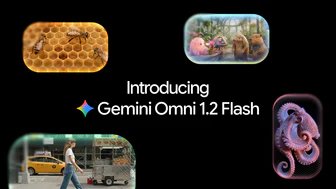
    Google releases Gemini Omni 1.2 Flash, supporting 15-second videos, priced at $0.07 per second for 720p

    Google releases video generation and editing model Gemini Omni 1.2 Flash, natively supporting up to 15-second clips, with 720p video pricing at $0.07 per second, a reduction of about 30% compared to Omni 1.1 Flash

  4. ITHome · AI78

    Ant Group's Baidu Ling-3.2-flash releases a native multimodal model, with three benchmarks surpassing Claude Opus 5

    Ant Media official team releases native multimodal model Ling-3.2-flash, with a total of 560B parameters, 25B activation parameters, and 1M context window, supporting image, text, and video input.

    Why it matters: The original provides three benchmark comparisons and API pricing, allowing readers to judge the capability position and call cost of this multimodal model.

  5. Hugging Face Blog71

    NVIDIA has released four open-source world model checkpoints for Cosmos 3.

    NVIDIA has added four new open-source weight checkpoints for Cosmos 3 under the Cosmos World Model platform, all of which are post-trained versions of Cosmos 3 Nano, containing 16B trainable parameters, using the OpenMDW1.1 license, allowing commercial and non-commercial use.

    Why it matters: The original text provides four open-source weight checkpoints and a four-stage training recipe, allowing readers to judge how to adapt the world model to their own sensors and robot bodies.

  6. Google AI Blog78

    Google releases Gemini Omni 1.2 Flash, supports 15-second videos and cuts prices by 30%

    Google has released Gemini Omni 1.2 Flash and has officially opened it through the Gemini API and Gemini for business. The duration of native video generation has increased from 10 seconds in Omni 1.1 to 15 seconds, with a step length of 1 second specified from 3 to 15 seconds. The price of 720p has been reduced to 0.07 US dollars per second, a decrease of 30% from 1.1.

  7. Google DeepMind78

    Google DeepMind has released Gemini Omni 1.2 Flash, supporting 15-second videos and reducing the price by 30%.

    Google DeepMind has released Gemini Omni 1.2 Flash, increasing the native video generation duration from 10 seconds in Omni 1.1 to 15 seconds, and it has been fully opened in the Gemini API and Gemini for business.

    Why it matters: The original text lists specific changes in duration, price, and reference consistency, allowing readers to judge how the cost and workflow of video generation will change.

  8. The Decoder70

    Tencent has released the Hy4 model, which first supports image understanding and computer operation.

    Tencent has released the Hy4 model, which is capable of image understanding for the first time and can operate software such as Blender, CAD autonomously, the weight will be opened on an undetermined date later, it is currently only provided through applications such as Tencent Cloud, OpenRouter, and Yuanbao.

    Why it matters: Tencent Hy4 has joined image understanding and computer operation capabilities for the first time, there is a gap between third-party reviews and official statements, you can compare to see the real position of the open weight model.

Nov 5Thu
  1. ByteDance Seed · Hugging Face new models

    ByteDance-Seed/Qwen3-30B-A3B-MoE-SAE released

    ByteDance-Seed/Qwen3-30B-A3B-MoE-SAE is released, containing TopK sparse autoencoders (k=100, 2^20 latent variables) trained on layers 4, 30, and 46 of the Qwen3-30B-A3B model. Each SAE is approximately 17.2 GB, with reconstruction variance unexplained scores of 12.6%, 25.1%, and 7.6% respectively.

Nov 2Mon