 Ollama releases00
llama.cpp v0.40.13 has been released
llama.cpp v0.40.13 has been released, version number b11963.
Ollama releases00llama.cpp v0.40.13 has been released, version number b11963.
 Baseten Blog
Baseten achieved the lowest cost per minute for batch speech transcription by optimizing Qwen3-ASR 1.7B (175B parameters, 5.4% WER) on Baseten. Its vLLM stack supports 7 times the throughput of standard vLLM on RTX PRO 6000, with a maximum real-time factor of 3,128, enhanced by native audio decoding, FP8 KV cache quantization, and reduced host-device synchronization.
Apple's 2026 14-inch MacBook Pro M6 version was launched for pre-order at 1:10 AM on October 29 with a starting price of 15,999 RMB, featuring a 12-core CPU, 12-core GPU, and dual 16-core neural engines, with AI performance on the device up to 13 times faster than the 13-inch M1 model.
Apple has launched its first touchscreen MacBook Pro, offering 14-inch and 16-inch models, introducing the Dynamic Island for the first time on Mac computers. The Dynamic Island on Mac supports answering calls, controlling music playback, and displaying AirDrop requests, and also serves as an interaction entry point for focused search and Siri AI.
 The DecoderFeatured8080
Google announced Android Studio Rabbit 2 at the Android Dev Summit, supporting more than 40 coding agents, including Claude, Codex, and Google Antigravity, to run within the IDE through the open-sourced Agent Client Protocol.
Why it matters: Android Studio opens third-party intelligent agent access and provides corresponding changes at the CLI and MCP levels, which can be used to judge the changes in mobile development workflows.
 Mastra Blog
Mastra platform and Studio now allow you to filter or group spans by time range, span type, span name, status, error, duration, etc. Your coding agents can also use CLI, Mastra client SDK, and HTTP observability endpoints to build the same queries to find and fix issues.
 PyTorch Blog5858
PyTorch® 2.15 released, defaulting to the rewritten NCCL backend, supporting fault logging and rollback; torch.distributed adds NIXL backend for unilateral transmission; FSDP2 and pipeline parallel optimize memory communication control.
 TechCrunch · AI
Google launches a connection application platform, allowing developers to integrate apps with Gemini and Search, enabling secure interaction with services like Canva, YouTube Music; the platform is currently conducting a public beta in the United States
TechCrunch · AISame story · 2 outlets6565Chrome browser updates its Autofill feature, using AI to extract information from users' Gmail to automatically fill out forms, including flight confirmation numbers, member IDs, tracking information, order numbers, addresses, phone numbers, or credit card numbers, etc. This feature expands Google's Personal Intelligence, and users can choose whether to enable it. Sensitive data will be encrypted. The feature has been launched in the US desktop version of Chrome and Chrome versions for iOS and Android.
 Microsoft Official BlogFeatured7272
Microsoft opens the GitHub team's Copilot harness built by GitHub through Microsoft Foundry, providing a fully managed way to build intelligent agents that can reason, call tools, and complete long tasks.
Why it matters: Microsoft opens the multi-model harness supporting multiple Copilot products internally to Foundry, allowing readers to judge the trade-offs of building their own orchestration layer based on this.
 The Verge · AISame story · 2 outlets
Chrome's enhanced auto-fill feature can now extract information from Gmail to help fill out forms, such as shipping numbers, flight reservation numbers, or hotel reservation numbers, while keeping sensitive data encrypted. This feature is implemented through Gemini with Personal Intelligence and is currently rolling out in the U.S., supporting desktop, Android, and iOS versions of the Chrome browser. Users can manage access permissions or completely turn off the feature in settings.
 Artificial Analysis ArticlesFeatured7272
Artificial Analysis tested GitHub Copilot CLI's Copilot Fusion highest settings in Coding Agent Index v2.0, with a single task cost of 5.59 USD, while Claude Code with Opus 5.5 (max) costs 11.42 USD, only 2 points lower in overall score.
Why it matters: Artificial Analysis used Coding Agent Index to test Copilot Fusion, providing a cost and token comparison with Claude Code at the same performance level.
The DecoderAnthropic introduces automatic verification for Claude for Legal, which automatically verifies information sources before processing legal documents and links each statement to its original source for lawyers to review. The new feature includes interactive summaries and tables, supporting tasks such as verifying citations, cross-border legal comparisons, case document management, legislative tracking, and contract review, while integrating with over 60 legal databases like Bloomberg Law and includes built-in data protection settings.
The Decoder6565OpenAI announced at Berlin DevDay 2026 that the European version of its AI assistant Dots will be launched in a few weeks. Codex users in Germany have surged 20-fold since January 2026, but the company did not disclose absolute data; OpenAI emphasized platform ecosystem building, locking developers with the Agents API and plugin system, and open-sourcing Codex Harness to support infrastructure self-construction.
 Meta Engineering
Meta Andromeda's Next-Generation Ad Retrieval Engine Achieves Near-Ranking-Level Model Performance at the Retrieval Layer, Processing Over 1 Billion Ads Per Card Per Second, System Throughput Reaches 100 Billion Times Per Second, 100 Times Higher Than the 2024 Version, and Brings a 2.4% Conversion Rate Increase for Advertisers.
 OpenAI News
Legora uses OpenAI models, ChatGPT, and Codex to accelerate legal workflows, expand contract analysis capabilities, and allow lawyers to focus on high-value work.
The Huawei Mate 90 Pro Max Limited Edition adopts yttrium crystal gemstone technology. The Mate 90 series is equipped with the Kirin 9030/9035/9050 flagship τ chips, with performance improved by 20%-27%. The Pro series introduces the second-generation Linglong screen for doubled lifespan and support for BT.2020/Pointer color gamut. It is equipped with the third-generation Hongfeng Original Color Imaging System, with color accuracy improved by 37%. The Pro Max is the first to adopt optical Kunlun glass, with a 20-fold increase in drop resistance and support for quad SIM triple standby.
TechCrunch · AINVIDIA has released the open-source speech-to-text model Nemotron 3.5 Transcribe, supporting transcription in 40 languages, containing 3 billion parameters, and running on Jetson AGX Thor and DGX Spark chips. The model can translate 31 languages, distinguish 8 speakers, and surpass competitors in the Hugging Face Open ASR Leaderboard benchmark tests, but only supports recording audio.
 NVIDIA NewsroomSame story · 2 outlets5858
NVIDIA RTX Spark laptop with new models, featuring Blackwell RTX GPU and Grace CPU Super Chip, supporting up to 128GB unified memory and 1 petaflop FP4 AI performance.
How the accounts differ:NVIDIA Technical Blog states the platform is for 'AI development, creation, and gaming', while NVIDIA Newsroom specifies 'new models' and 'game support'.
Apple's iOS 27.2 brings two new improvements for the iPhone Photos app, involving shared album features and the ability to recognize AI-generated or edited images. Users can now edit photo descriptions and comments in shared albums, avoid adding duplicate photos, and receive reminders before albums expire; the system also adds support for SynthID digital watermarking to help identify images created or modified using generative AI.
JiMi remembered the AI Memory Glasses G1 and AI Memory Bracelet L1 went on sale today, with starting prices of 1299 yuan and 599 yuan respectively, both offering standard and lifetime membership versions. G1 is the world's first titanium 3D printed AI memory glasses, weighing as little as 17.9g; L1 supports switching between bracelet and pendant forms, supports all-weather AI recording, automatic note organization and to-do lists, with a battery life of 2-5 days.
Huawei adopts a dual-layer OLED architecture Linglong screen on Mate 90 Pro series phones, doubling lifespan at the same brightness, and increasing brightness at the same power consumption; Supports Kirin Zhuque dual-core synergy, Kirin chip achieves high-precision calibration under low brightness, Zhuque chip achieves low-power calibration under high brightness; Mate 90 Pro Max screen supports BT.2020 and Pointer color gamut display, color gamut coverage increases by 30% compared to P3
Amazon releases Echo Dot, Echo Studio with Home Camera, Echo Time smart alarm clock, Alexa Photo Frame digital photo frame, and Echo Show 16 smart display, all equipped with the latest Alexa+, priced from $99.99 to $499.99.
The Verge · AI3535Meta launches 'pet-raising style' AI game Waddle World, where virtual pets can chat with users and draw illustrations of conversations. This '16-bit pet care game' is actually a 'pet-disguised daily diary', requiring users to interact with pets through voice and participate in 'comfort games' like stacking items. The app is free and available only to adults in the Philippines.
OpenAI NewsLegora accelerates legal workflows using OpenAI models, ChatGPT, and Codex, expanding contract analysis capabilities, allowing lawyers to focus on higher-value work.
The all-new Jietu Freedom 7 will go on sale on November 4, equipped with Lingxi Smart Cabin TOUR OS, featuring a dual-supported AI voice large model with DeepSeek+ and iFlytek Spark, a 2.5K ultra-clear screen, and a Qualcomm Snapdragon 8155 chip. Additionally, the car supports APA all-scenario automatic parking.
Volkswagen Group China has launched its first self-developed full-scenario L2++ level advanced driving assistance solution, Hyper Sense 8 (HS8), supporting urban and highway NOA and all-scenario parking assistance. It will be equipped on seven new electrified products this year.
Volkswagen Group China has launched the integrated technology matrix 'VEGA', with the core including the CEA electronic and electrical architecture, creating each vehicle as a 'software-defined car'. By 2026, the CEA architecture will be equipped on five locally produced Volkswagen brand electric vehicles; by 2027, it will cover more domestically produced plug-in hybrid and fuel-powered vehicles, achieving central computing integration for the cabin and intelligent driving; by 2029, CEA 3.0 will support full-domain AI agents, enabling the development of L4-level autonomous driving technology.
Survival LLM is a free AI assistant and emergency knowledge base that runs entirely on a personal computer, providing answers based on trusted sources without the internet and displaying the answer sources.
Zhiyuan Technology announced it has won a case for AI chip development with a US customer, setting company records in design process, complexity, NRE amount, and advanced packaging. The cloud-based AI chip is based on Samsung's 2nm process, using a logic SoC with custom DRAM vertical stacking and hybrid bonding technology, supporting PCIe Gen6.
Huawei FreeClip 2 earbuds introduce a new trendy color-block design, priced at 1299 yuan, with a limited-time discount of 50 yuan, bringing the price down to 1249 yuan. The product features a three-color accessory ring design (blue/yellow, red/blue, red/yellow), supports adaptive left and right ear use, is equipped with an AI smart assistant on the ear, supports personalized pop-ups, high-definition spatial audio, IP57 dustproof and water-resistant, Star Flash precise finding, with a total battery life of 38 hours and a single earbud battery life of 9 hours.
The Kirin 9050 series smartphone chip adopts logic folding technology, boosting the performance of the Mate 90 Pro Max by 31%, the Mate 90 Pro by 20%, and the standard Mate 90 by 27%. This series integrates the Lingxi CPU, the Mali GPU (with doubled computing units and cache), and the Da Vinci architecture NPU, which supports on-device deployment of a 30B parameter hybrid expert architecture large model.
PHYMI Launches Its First Physical Agent Product, Sagi, Positioning It as an 'Action Partner' for Camping, Office, and Community Collaboration Scenarios, Performing Tasks like Delivery and Moving.
Qualcomm will bring a 6G terminal prototype to the 9th China International Import Expo, marking its global debut. It has previously been used in joint 6G technology testing with partners such as China Mobile and ZTE. The booth will also showcase innovations in AI agents and diverse intelligent terminals, including smart devices, the latest flagship smartphones, AI PCs, smart glasses, cars, and robots.
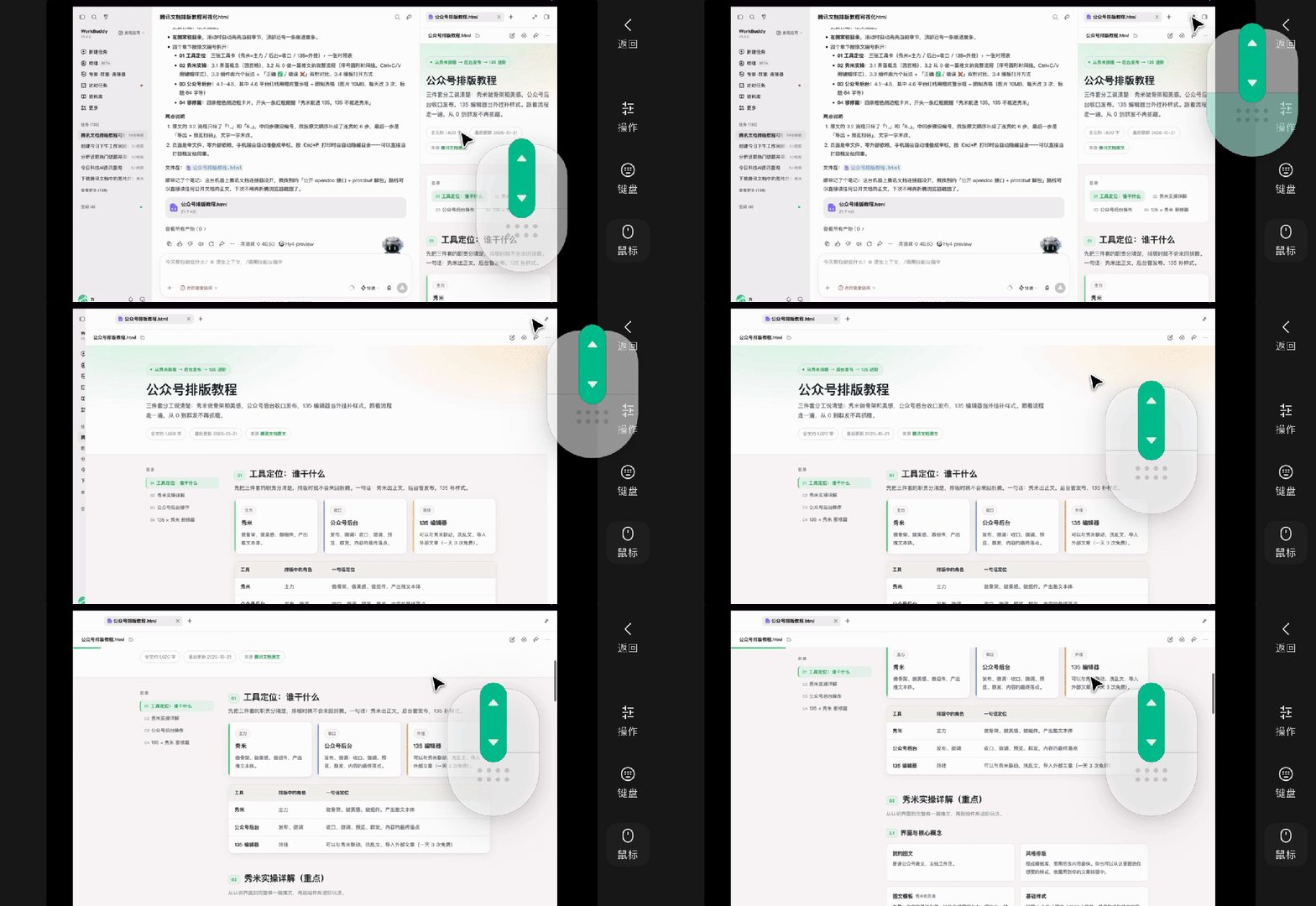
Tencent WorkBuddy has launched the 'Remote Control' feature today. Users can view and operate their computer desktop in real-time via the mobile app. The computer screen is displayed as a small floating window, supporting full-screen switching, virtual mouse, and shortcut keys. The mobile app needs to be updated to v2.7.0 or later, and the desktop app to v5.9.3 or later. The connection is fully encrypted and does not record user input content.
Doubao Work has been upgraded to support recording computer operations as skills. Users can teach the model by demonstrating and explaining while operating, and directly call the skill when performing similar tasks next time to avoid repetitive steps; at the same time, after enabling the lock screen function, the Mac lock screen can also continue to execute computer operation tasks. When people are away from the computer, they can issue commands using their mobile phones.
 Codex releases55
GitHub Copilot released rust-v0.166.0-alpha.5, which provides developers with code creation features.
Samsung has launched its first earbud-style wireless earphones, Galaxy Buds On, priced at 299,000 KRW (approximately 1,508 RMB). They feature a flexible earhook design that doesn't block the ear canal and support environmental awareness. Equipped with TwinBoost dual speakers and the Qualcomm Snapdragon S7 Gen 1 audio platform, they offer up to 9.5 hours of battery life.